The Beginning · the world of the text · Lokosmos Academy
Part 4
for The Beginning · Part 4 · Genesis 1–11
The World of Genesis
4 Parts40 min
What Happens in Part 4
Where we left offBabel is behind us, the families have scattered, and the book is about to leave the beginning and follow one man.
This part asks a different question than the three before it. Not what happens, but where — which rivers, which cities, which materials, and how anybody knows.
Why these chapters go togetherThe first three parts walked Genesis 1–11 forward. This one goes back over the whole span at once, because the details that make the world of these chapters — four rivers, a plain, brick and bitumen, a repeated heading — are scattered across all eleven and only add up when you look at them together.
What We Will Learn
Section
What you will practice
Word Study
Words for the world the chapters are set in: river, east, plain, city, gold, kind, generations
Bible Study
How a repeated heading joints a book together, and how to tell what a piece of evidence settles from what it only suggests
Lokosmos Treasure Wisdom
The four rivers of Genesis 2, the first cities the text names, and how a buried mound is read
Chapter Summary
Ch.
What happens
1–2
A World, Then a Garden In It — The opening moves from everything to one place. Chapter 2 plants a garden eastward in Eden and names a river that divides into four heads, two of which — the Tigris and the Euphrates — are rivers still on the map. Gold and stone are named as well, attached to a land the chapter calls Havilah.
3–5
Ground, Work and the First City — Outside the garden the world is one of farming and herding, and the text starts naming occupations: tents and livestock, music, metalwork in bronze and iron. Cain builds a city and names it. A family record then walks the line as far as Noah.
6–9
Measures, Materials and a Mountain — The world here is one of building and measuring: dimensions given in cubits, a hull sealed with pitch, decks and a door. Afterwards the ark rests on the mountains of Ararat, an actual region to the north, and an altar is built on dry ground.
10–11
Lands, Languages and Cities — The last stretch is the most crowded with real places. Nations are sorted by land and language; cities are named in Shinar and in Assyria; and the builders on the plain use the exact materials Mesopotamia actually built with.
Part 1 · The Beginning · Genesis 1–11
Word Study
Study 7 key words from Genesis 1–11, then answer each question.
🌎
💎 Lokosmos Treasure Wisdom · a true fact behind the storyFour Rivers, and Only Two You Could Visit
Open your Bible atGenesis 2:10–14
Maps & Places · The Rivers of Genesis 2Read those five verses slowly. One river leaves Eden and splits into four. All four get names. Two of them are easy. The Tigris and the Euphrates are on any map of the region today. They have run through the middle of that part of the world for as long as we have records. The other two are a puzzle. Pishon and Gihon are described in the text. One of them runs beside a land where there is gold. But nobody can say for certain where either of them ran. Genesis is just as sure about all four.
Why this helps you read the BibleThe Bible can be clear and still leave you without a map. Being sure of a name is not the same as being sure of a place. Knowing where Scripture stops keeps you from speaking for it.
One river, four heads — two known, two not
Diagram of what the text names · the single river, the four heads and all four names are Genesis 2:10–14. The dashed boxes mark the two the text describes but that nobody has securely located; the drawing is not a map and shows no course, direction or distance for any of them.
Names, order and the division into four: Genesis 2:10–14. Drawn for Lokosmos Academy.
⚖ Still argued aboutWhere the Pishon and the Gihon were. Genesis names four rivers and two of them are still on the map; the other two have been placed in Arabia, in Africa and in Mesopotamia, and none of those has settled it.
🗣 Say itHavilahHAV-ih-luh(ha-vi-lə)PishonPIE-shon(pī-shän)GihonGUY-hon(gī-hän)Euphratesyoo-FRAY-teez(yü-frā-tēz)ErechEE-rek(ē-rek)toledottoh-leh-DOTE(tō-le-dōt)
rivern.Gen 2:10
A large natural stream of flowing water
“Genesis 2 says one of these leaves Eden and splits into four.”
eastn.Gen 2:8
The direction the sun rises from
“Genesis 2 says the garden was planted toward this direction.”
plainn.Gen 11:2
A wide, flat stretch of land
“Genesis 11 uses this word for the flat ground the people stop on.”
cityn.Gen 4:17; 11:4
A large settlement where many people live together
“Cain builds a city, and later the people of Shinar set out to build one.”
goldn.Gen 2:11–12
A valuable yellow metal
“Genesis 2 says the land the first river runs through holds this.”
kindn.Gen 1:11–12
A broad grouping of living things named in the passage
“Genesis 1 repeats this word as each group of living things is made.”
generationsn.Gen 2:4; 5:1
A record of what came from someone, used as a heading
“Six times Genesis opens a section with the generations of someone.”
ⓘ The vocabulary words in this list are selected to help you understand and complete this workbook. Some may not appear word-for-word in your Bible. The example sentences are our own wording, written to make the verse clearer — they are not quotations from it. Read each verse in your own Bible.
1Genesis 2 names four rivers. How many can still be found on a map today?💎 Uses the box aboveGen 2:10–14
2In Genesis 2, a ‘river’ flows out of Eden and divides into four heads.Gen 2:10
3Fill in each blank with the correct word.Gen 2; 4
Word choices:goldcityplainkind- some words will not be used
The land of Havilah is named as a place where there is . Gen 2:11–12
Cain builds a and gives it a name. Gen 4:17; 11:4
4In Genesis, ‘generations’ is used as ___.Gen 2:4; 5:1
5In Genesis 1, ‘kind’ is a broad grouping of living things.Gen 1:11–12
6In Genesis, ‘east’ names the direction the sun sets in.Gen 2:8
7Fill in each blank with the correct word.Gen 2; 11
Word choices:plaineastgenerationsgold- some words will not be used
A wide, flat stretch of land is a . Gen 11:2
The garden in Eden is planted toward the . Gen 2:8
Part 2 · The Beginning · Genesis 1–11
Understanding
Show you understood what happens in Genesis 1–11.
🧠
💎 Lokosmos Treasure Wisdom · a true fact behind the storySix Headings Holding Eleven Chapters Together
Open your Bible atGenesis 2:4, 5:1, 6:9, 10:1, 11:10, 11:27
Bible Study Skill · Following a Repeated HeadingGenesis keeps saying the same thing. Six times in these eleven chapters, a line arrives. It announces the generations of somebody. First the heavens and the earth. Then Adam, Noah, the sons of Noah, Shem, and last of all Terah. The Hebrew word behind it is toledot. Go and mark all six in your Bible before you answer anything below. The verse numbers are at the top of this box. Once you can spot them, Genesis stops being a set of separate stories. It turns into something jointed, because each heading opens the part that comes after it.
The word
Say it
What it means
Where it is
toledot
toh-leh-DOTE
generations; what came from someone
Genesis 2:4
Written the way the word sounds, not in its own alphabet — this is here to let you hear it, not to teach you to spell it.
Why this helps you read the BibleA book has its own parts. A printer added the numbers later. Finding the divisions the Bible gives itself is closer to reading it the way it was written.
1How many of the four rivers named in Genesis 2 can still be pointed to on a map?Gen 2:10–14
2Which materials do the builders in Shinar use?Gen 11:3
3How many times does the ‘generations of’ heading appear in Genesis 1–11?💎 Uses the box aboveGen 2:4 – 11:27
4Where does the ark come to rest?Gen 8:4
5These four are all places or things Genesis 1–11 names. Number them 1–5 in the order the book first names them.Gen 1–11
The mountains the ark comes to rest on.
The pitch that seals the ark inside and out.
The river that leaves Eden and divides into four.
The city Cain builds and names.
The plain in Shinar where the builders settle.
6Genesis 10 names cities in Assyria as well as in Shinar.Gen 10:10–12
7Genesis says where the Pishon and the Gihon are on a modern map.Gen 2:11–13
Part 3 · The Beginning · Genesis 1–11
Literary Craft
Understanding HOW and WHY the story is told across Genesis 1–11.
📖
💎 Lokosmos Treasure Wisdom · a true fact behind the storyWhere a Writer Puts the Joints
Open your Bible atGenesis 11:27, and the start of Genesis 12
Literary Craft · How a Book Is JointedChapter numbers are late. Nobody writing Genesis had them. They were added many hundreds of years later, to help people find things. So when an ancient book wants to show you a seam, it has to do it with words. The usual way is a line repeated at the joint. Genesis uses one heading over and over for exactly that. Now look at where the heading for Terah falls. It is partway through chapter 11, not at a chapter break. The beginning of Genesis ends where the book says a new family starts. That boundary is the writer's, not the printer's.
Why this helps you read the BibleThe chapter numbers are a helpful map, not part of the message. When they disagree with the book's own seams, trust the book. That is reading Scripture on its own terms.
The heading that keeps coming back
Diagram of a heading the text repeats · all six verse references and all six subjects are in Genesis. That each heading opens the section after it is the ordinary reading, and the drawing marks it as such; Genesis nowhere labels these as divisions or says how many there should be.
Verses: Genesis 2:4, 5:1, 6:9, 10:1, 11:10 and 11:27. Drawn for Lokosmos Academy.
Formula
A set of words repeated in the same form each time it is used. “These are the generations of…” is a formula, and Genesis 1–11 uses it six times.
Structure
The way a piece of writing is put together. Genesis is jointed by its own repeated headings, not by the chapter numbers printed in a modern Bible.
Setting
The world a piece of writing takes place in: its places, its materials, its work. The setting of Genesis 1–11 is the ancient Near East, named river by river and city by city.
1A set of words repeated in the same form each time is a ___.Gen 2:4; 5:1
2Fill in each blank with the correct word.Gen 1–11
Word choices:structureformulasettingcity- some words will not be used
The world a piece of writing takes place in is its .
The way a piece of writing is put together is its .
3Why do the chapter numbers in a modern Bible not show where Genesis divides?💎 Uses the box aboveGen 11:27
4The heading naming Terah's generations falls inside chapter 11, not at the start of chapter 12.Gen 11:27
5The setting of a piece of writing means the order its events happen in.Gen 1–11
6Fill in each blank with the correct word.Gen 2:4 – 11:27
Word choices:formulasettingstructureplain- some words will not be used
A repeated line used the same way each time is a .
What that repeated line reveals about the book is its .
7What does noticing the six headings change for a reader?Gen 1–11
Part 4 · The Beginning · Genesis 1–11
Wisdom
Three deeper challenges — no single-word recall. Read, weigh the evidence, and reason it out.
🏙️
💎 Lokosmos Treasure Wisdom · a true fact behind the storyThe Cities Genesis Names, and What Is Left of Them
Open your Bible atGenesis 10:10–12
City Life · The First Cities NamedRead those three verses and you get a short list of cities. Several are places archaeologists have actually dug. Erech is the city we now call Uruk. It was one of the biggest early cities of southern Iraq. Nineveh and Calah were both Assyrian capitals, and both have been dug at length. Accad is the exception. The city that gave a whole language and a whole empire its name has never been found. So the digging shows something real but narrow. This list names cities that existed, in the region it puts them in.
Why this helps you read the BibleA city being real is not the same claim as a story about it being proved. Digging can do the first. It cannot do the second. Knowing the difference keeps you trusting Scripture for what only Scripture can tell you.
Why a buried city is a stack
Schematic cross-section · not any particular site, and not to scale. It shows only why settlement mounds stack and why the stacking alone does not date anything. No layer here is connected to any event in Genesis.
Standard stratigraphic principles as set out in general archaeological method. Drawn for Lokosmos Academy.
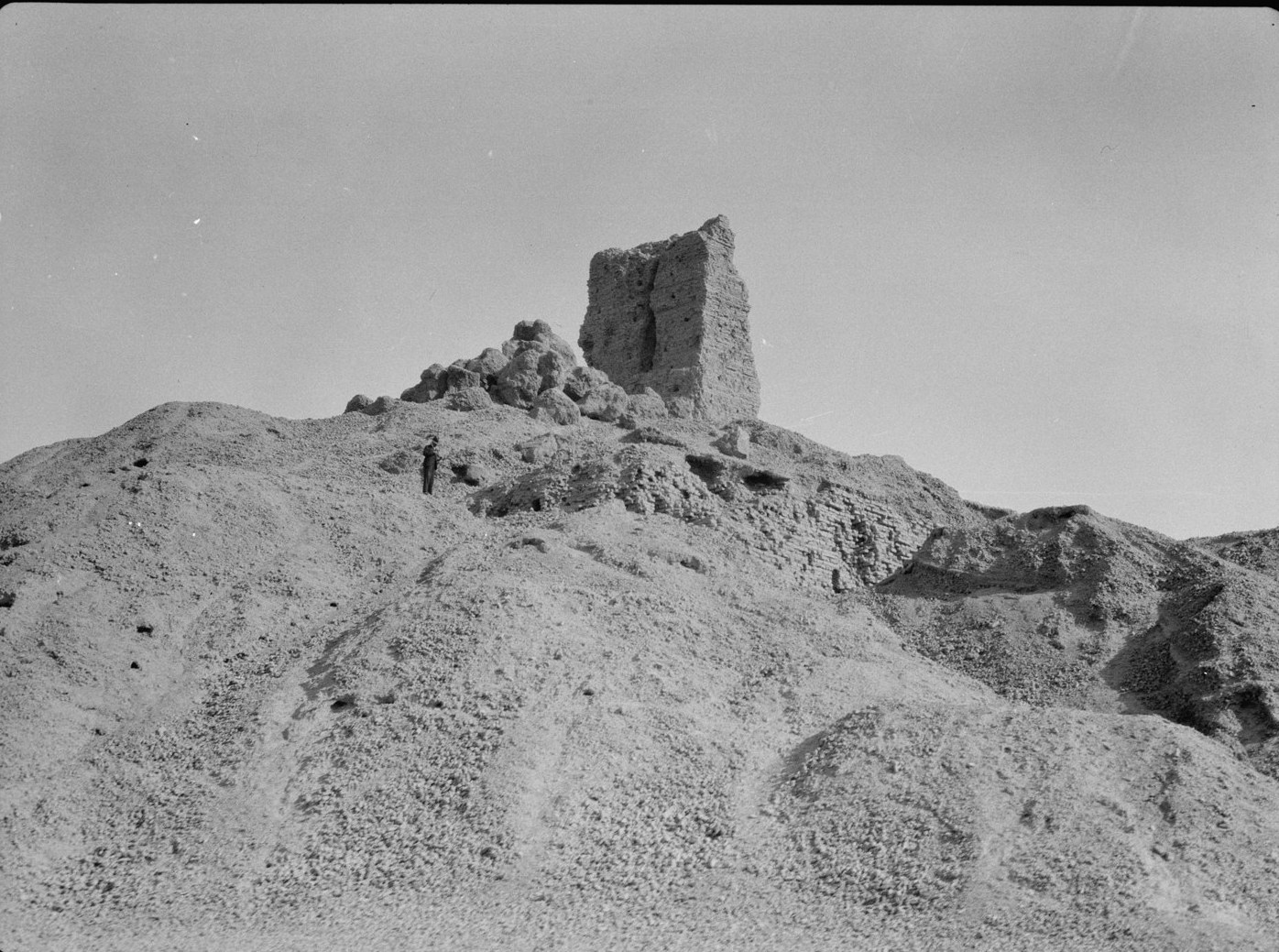
What a ruined city actually looks like
Birs Nimrud in southern Iraq, photographed in 1932. The whole hill is collapsed mudbrick; one wall of the core still stands, courses of brick show in the face below it, and the figure on the slope gives the scale. The archive that holds this photograph titles it “Possibly the Tower of Babel.” That is a tradition, not a finding: the site is ancient Borsippa, Genesis never names it, and nothing ties it to Genesis 11. It is here because it is what the diagram above looks like in real life.
Birs Nimrud (ancient Borsippa), Iraq, 1932. G. Eric and Edith Matson Photograph Collection; Library of Congress, Prints and Photographs Division, digital ID matpc.16129. Public domain. Source: Wikimedia Commons, File:Iraq. Birs Nimrud. (Possibly the Tower of Babel). So-called Tower of Babel. Distant view LOC matpc.16129.jpg.
This section is about the difference between a thing being real and a story about it being proved. Genesis 1–11 names rivers you can still stand beside, cities that have been dug up, and materials archaeologists pull out of the ground by the ton. All of that is worth knowing, and none of it settles a date or an event. As you work through these four challenges, keep asking one question of every statement: does the evidence named actually reach that far, or does it stop somewhere short and leave the rest to be assumed?
Original passage written for this workbook — not a quotation from Scripture.
1What the evidence can settle, or What it cannot? Tap each detail to send it left or right.💎 Uses the box aboveSort into two
◄ What the evidence can settleWhat it cannot ►
2Match each first detail with the detail paired with it.Match the Pairs
Erech→
Accad→
The Euphrates→
Bitumen→
Ararat→
3Fill both blanks to complete the reasoning.Build the Argument
Archaeologists have excavated several of the cities Genesis 10 names, which shows that , which shows .
That is the whole workbook. The standardized test is optional and is scored separately.
Optional · The Beginning · Genesis 1–11
Standardized Test
Reading passage · Reading a Mound · Evidence, and Where It Stops · ten questions in the shapes a standardized reading test uses: main idea, detail, vocabulary in context, inference, evidence, synthesis, insert text, prose summary and fill in a table.
Optional. This section is not counted in your workbook score. It gets a report card of its own, and skipping it still leaves your workbook complete.
Original passage written for this workbook — not a quotation from Scripture.
Reading a Mound
Across the ancient Near East, a flat plain is often broken by a low, broad hill with oddly straight sides. Many are not hills at all. A mudbrick town that is abandoned or burned slumps into a mound of its own material, and the next town is built on the flattened remains, so one place can hold twenty or more settlements stacked in order. Archaeologists call such a mound a tell, and its rule is simple: the deeper a layer sits, the earlier it usually is. A pit dug from a late street, a deep foundation trench, or a wall robbed of its stones centuries later can each carry a late object down into an early layer. What dates a layer is therefore never its depth, but what lies in it and how that got there. Excavation is also destruction: a layer is dug once and never again, which is why a dig's written record counts as evidence itself. A well-read mound shows that a city stood here, and roughly in what order its towns rose and fell. It cannot, on its own, tell you who any of them were.
1What is the passage mostly about?Main Idea
2Why does a mudbrick town turn into a mound?Detail
3In this passage, a “plain” is ___.Vocabulary in Context
4What can carry a late object down into an early layer?Detail
5Why is a dig's written record treated as evidence in its own right?Inference
6Which statement is supported by the passage?Evidence
7What does the last sentence say a mound cannot do?Synthesis
8Insert Text. Look at the four squares [1]–[4] in the passage below. They mark the places this sentence could be added: “The word doing the work there is usually.”
Archaeologists call such a mound a tell, and its rule is simple: the deeper a layer sits, the earlier it usually is. [1] A pit dug from a late street, a deep foundation trench, or a wall robbed of its stones centuries later can each carry a late object down into an early layer. [2] What dates a layer is therefore never its depth, but what lies in it and how that got there. [3] Excavation is also destruction: a layer is dug once and never again, which is why a dig's written record counts as evidence itself. [4]
Where does the sentence fit best?Insert Text
9Prose Summary.The passage explains how a settlement mound is read. Six statements are listed below. Choose the THREE that best capture what the passage is saying. The other three do not belong — they are small details, or ideas the passage never puts forward. Each correct choice earns a mark of its own.Prose Summary
10Fill in a Table. Sort what a well-read mound settles from what it leaves open. Tap each statement to send it to the left column or the right one. Three belong in each.Fill in a Table
◄ A well-read mound shows thisA mound cannot show this ►
Independent study guide by Lokosmos Academy. Not affiliated with or endorsed by Crossway or any Bible publisher. Contains original retelling and analysis only; no Scripture text is reproduced in full. Reference edition: keyed to the ESV® Bible — read Genesis 1–11 in your own Bible alongside this workbook; any Bible works for reading, and the vocabulary and questions follow the ESV’s wording. No ESV® text is quoted in this workbook. ESV® and the English Standard Version® are registered trademarks of Crossway.
Lokosmos Academy is an independent study resource, not affiliated with or endorsed by Crossway or any Bible publisher. This workbook is keyed to the wording of the ESV® Bible; any Bible works for reading — the vocabulary and quiz answers simply follow the ESV’s wording. These workbooks reprint no text of the ESV® Bible; every passage summary, question and example sentence is original wording. ESV® and the English Standard Version® are registered trademarks of Crossway.