Where we left offThe brothers are home in Canaan with grain, returned silver they cannot explain, and an order not to come back without Benjamin.
The brothers come back with Benjamin. Joseph tests them, then tells them who he is. The whole family moves to Egypt and settles in Goshen. Jacob dies, and then Joseph does, and both are prepared for burial the Egyptian way.
Why these chapters go togetherThese eight chapters are one long ending. The test, the naming, the move and the two burials all answer something set up earlier, and the last chapter says out loud what the whole book has been doing.
What We Will Learn
Section
What you will practice
Word Study
Words for testing, mercy and burial: silver, steward, weep, reveal, settle, embalm, mourning
Bible Study
How a book closes the questions it opened
Lokosmos Treasure Wisdom
What Egyptian embalming actually involved, and where Goshen was
Chapter Summary
Ch.
What happens
43–44
The Test — Jacob finally lets Benjamin go. Joseph feeds his brothers in his own house and seats them in order of age, which frightens them. He sends them away with a silver cup hidden in Benjamin's sack, then has them brought back as thieves. Judah, who once sold Joseph, offers himself in Benjamin's place.
45–47
I Am Joseph — Joseph sends everyone else out of the room and tells his brothers who he is. He weeps so loudly the Egyptians hear it. Pharaoh invites the family down, and Jacob comes to Egypt and sees the son he thought was dead. The family makes its home in Goshen, and Joseph provides for them through the famine.
48–50
Two Burials — Jacob blesses Joseph's two sons and then all twelve of his own, and asks to be buried in Canaan, not in Egypt. He is embalmed, and Egypt mourns him for seventy days. The brothers fear Joseph will now take revenge. He tells them that what they meant for evil, God meant for good. Joseph dies at a hundred and ten, is embalmed, and is put in a coffin in Egypt.
Part 1 · Joseph · Genesis 43–50
Word Study
Study 7 key words from Genesis 43–50, then answer each question.
🏺
💎 Lokosmos Treasure Wisdom · a true fact behind the storyForty Days, and Then Seventy
Open your Bible atGenesis 50:2–3
Word Study · Burial WordsGenesis says Jacob was embalmed, and it counts the days. Forty for the embalming. Seventy in all for the mourning. Egyptian sources describe the same work. The body was dried out with a salt called natron, then wrapped in linen. They count it the same way too: about forty days of drying, inside about seventy days in all. To embalm a body is to treat it so it will last. Jacob is given the treatment an important Egyptian would get. Then he is carried to Canaan and buried in a cave his grandfather bought. The chapter gives him an Egyptian funeral and a Canaanite grave.
Why this helps you read the BibleGenesis counts the days for a reason. Learn what those days were for. Then you can see the family in two worlds at once. They are honored in Egypt, and still holding on to a promise about another land. That tension is what the last chapters are about.
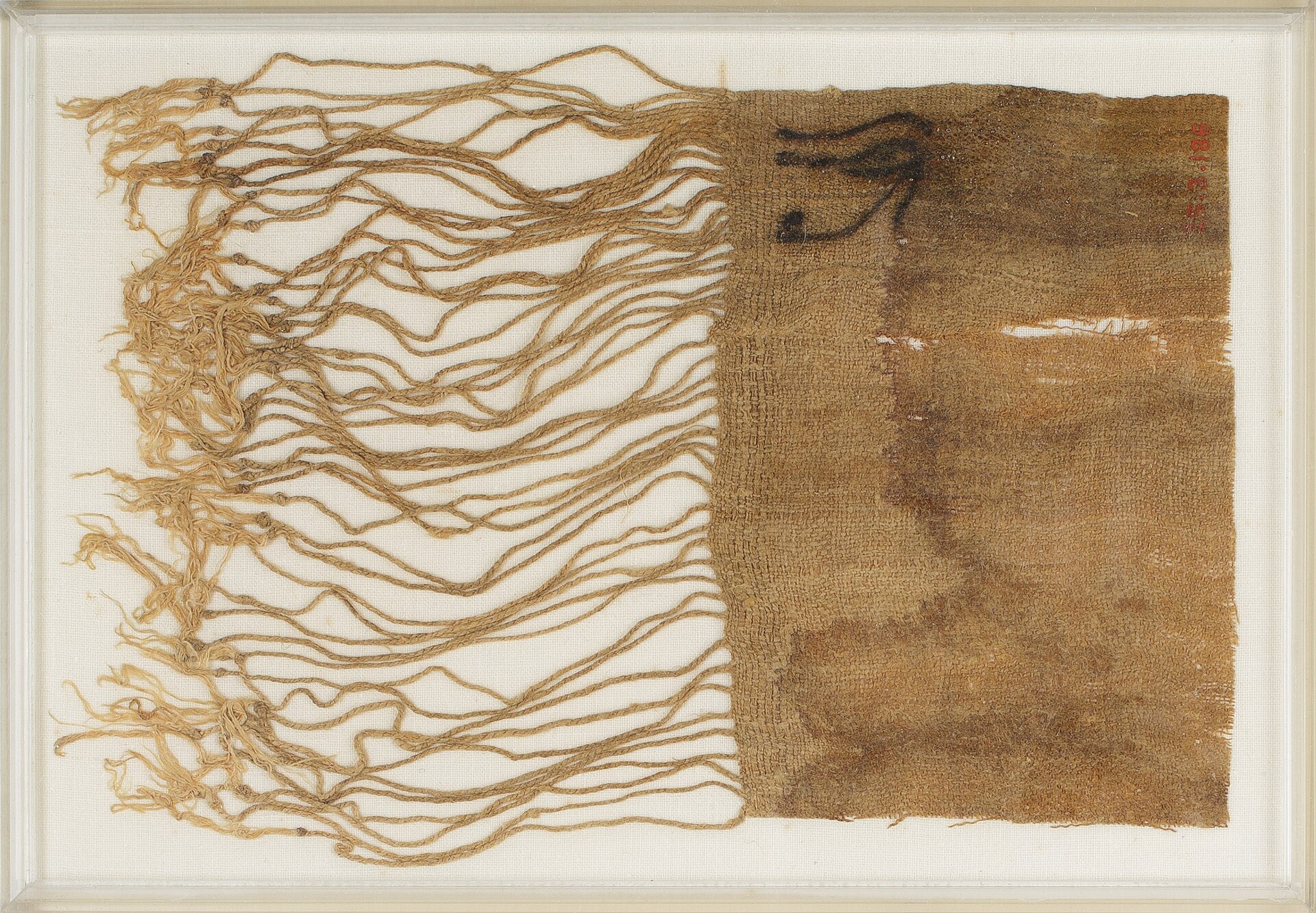
The linen itself
A fringed square of Egyptian burial linen with a wedjat eye, a protective emblem, drawn on it in ink. It comes from a burial at Deir el-Bahri of about 1000 BC, a thousand years or more after any date proposed for Jacob. Linen wrapping is one part of what Egyptian sources describe; this particular owner's body was wrapped but not dried, so the piece does not show the drying step. The eye belongs to Egyptian religion, not to Genesis.
Mummy bandage inscribed with a wedjat eye, Egypt. The Metropolitan Museum of Art, 25.3.186. Source: Wikimedia Commons, File:Mummy bandage inscribed with a wedjat eye MET 25.3.186 EGDP021680.jpg. CC0 public domain dedication.
⚖ Still argued aboutWhere exactly Goshen was. It is generally placed in the eastern Nile delta, and no inscription has been found that fixes its borders.
🗣 Say itGoshenGOSH-un(gä-shən)BenjaminBEN-juh-min(ben-jə-mən)JudahJOO-duh(jü-də)embalmem-BAHM(im-bäm)Machpelahmak-PEE-luh(mak-pē-lə)EphraimEE-fray-im(ē-frā-im)
silvern.Gen 44:2
A precious metal used for money and cups
“Genesis 44 has a cup made of this hidden in Benjamin's sack.”
stewardn.Gen 44:1
A servant who runs a household
“Genesis 44 has a servant with this job fill the sacks.”
weepv.Gen 45:2
To cry
“Genesis 45 says Joseph did this loudly enough to be heard outside.”
revealv.Gen 45:1
To make something known that was hidden
“Genesis 45 has Joseph clear the room before doing this.”
settlev.Gen 47:6
To make a home in a place and stay there
“Genesis 47 has Pharaoh tell Joseph to do this with his family, in Goshen.”
embalmv.Gen 50:2
To treat a body so that it will last
“Genesis 50 says this was done to Jacob, and gives it forty days.”
mourningn.Gen 50:3
A time of deep sadness after a death
“Genesis 50 says Egypt kept seventy days of this.”
ⓘ The vocabulary words in this list are selected to help you understand and complete this workbook. Some may not appear word-for-word in your Bible. The example sentences are our own wording, written to make the verse clearer — they are not quotations from it. Read each verse in your own Bible.
1To make known something that was hidden is to ___ it.Gen 45:1
2A ‘steward’ is a servant who runs a household.Gen 44:1
3Fill in each blank with the correct word.Gen 45:2, 47:6
Word choices:weepssettlesilverembalm- some words will not be used
Joseph so loudly that the Egyptians hear him. Gen 45:2
Pharaoh tells Joseph to his family in the land of Goshen. Gen 47:6
4What does it mean to ‘embalm’ a body?💎 Uses the box aboveGen 50:2
5‘Mourning’ is a time of deep sadness after a death.Gen 50:3
6The cup hidden in Benjamin's sack was made of clay.Gen 44:2
7Fill in each blank with the correct word.Gen 44:1, 50:3
Word choices:stewardmourningrevealsettle- some words will not be used
Joseph speaks to his about filling the sacks. Gen 44:1
Egypt keeps seventy days of for Jacob. Gen 50:3
Part 2 · Joseph · Genesis 43–50
Understanding
Show you understood what happens in Genesis 43–50.
🧠
💎 Lokosmos Treasure Wisdom · a true fact behind the storyAn Ending Answers Its Own Beginning
Open your Bible atGenesis 44:14 beside 37:7, then 44:33 beside 37:26–27
Close Reading · How a Book ClosesA long book leaves questions open on purpose. Then it closes them. Joseph dreamed that sheaves bowed to him, and in Genesis 44 all eleven brothers bow. Judah once said, let us sell him. In Genesis 44 Judah offers to stay a slave so his brother can go free. Jacob mourned a son he thought was dead, and in Genesis 46 he sees him alive. None of those three is an accident. The book has been holding them open the whole time. Reading an ending well means reading it with the beginning open beside it. So ask what a last chapter is answering.
Why this helps you read the BibleBooks of the Bible are shaped whole, not written a page at a time. Looking back at the start while you read the end shows you what the writer has been working toward. It is one of the plainest ways to read a book as its writer built it.
What Genesis opened, Genesis 50 closes
Diagram of stated events · every box gives the verse it comes from. Pairing them across the middle is a way of reading the end of Genesis against its beginning. Genesis does not draw the lines or call these pairs.
2What does Judah offer when Benjamin is accused?Gen 44:33
3What does Joseph do before he tells his brothers who he is?Gen 45:1
4Where does Pharaoh tell Joseph to settle his family?Gen 47:5–6
5Write the numbers 1–5 in the boxes to show the correct order across Genesis 43–50. Number 1 = what happens first.💎 Uses the box aboveGen 43–50
The silver cup is hidden in Benjamin's sack.
Joseph tells them God meant it for good.
Judah offers to stay in Benjamin's place.
Joseph tells his brothers that he is Joseph.
Jacob is embalmed and buried in Canaan.
6Jacob asks to be buried in Egypt, near the family's new home.Gen 49:29–30
7The brothers are afraid Joseph will pay them back after Jacob dies.Gen 50:15
Part 3 · Joseph · Genesis 43–50
Literary Craft
Understanding HOW and WHY the story is told across Genesis 43–50.
📖
💎 Lokosmos Treasure Wisdom · a true fact behind the storyOne Sentence That Reads the Whole Story
Open your Bible atGenesis 50:20
Literary Craft · A Closing StatementAt the very end, Joseph says something about everything that has happened. His brothers meant it for evil. God meant it for good. That one sentence does not undo the wrong. It does not say the pit was fine. It says two things were true at once, and the story has shown you both. Writers often put a line like this near the end, where the reader has enough to weigh it. This one is the key to the whole book. So watch for the sentence that tells you how to read what you have just read.
Why this helps you read the BibleSome verses are keys to a whole book, and Genesis 50:20 is one. Find the sentence where a writer states his own point. It protects you from inventing a point of your own. That is the surest way to hear what the Bible is actually saying.
Resolution
The part of a story where open questions are answered. Genesis 43 to 50 answers the dream, the selling and the mourning all together.
Reversal
When a character does the opposite of what they did before. Judah sold one brother and then offers himself for another.
Thematic statement
A line where the story says what it has been about. Genesis 50:20 is the clearest one in the book.
1Why is Judah's offer in Genesis 44:33 a reversal?💎 Uses the box aboveGen 44:33; 37:26–27
2Fill in each blank with the correct word.Gen 43–50
Word choices:resolutionreversalstewardmourning- some words will not be used
The part of a story that answers its open questions is the .
A character doing the opposite of what they did before is a .
3What makes Genesis 50:20 a thematic statement?Gen 50:20
4Genesis 50:20 says the brothers had done nothing wrong.Gen 50:20
5Joseph's dream of bowing sheaves is answered when his brothers bow in Genesis 44.Gen 37:7; 44:14
6Fill in each blank with the correct word.Gen 50:20
Word choices:statementreversalsilverresolution- some words will not be used
A line where a story says what it is about is a thematic .
Judah acting against his old choice is a .
7What does the ending do with the promise of land?Gen 49:29–30; 50:24
Part 4 · Joseph · Genesis 43–50
Wisdom
Three deeper challenges — no single-word recall. Read, weigh the evidence, and reason it out.
🌴
💎 Lokosmos Treasure Wisdom · a true fact behind the storyThe Land They Were Given
Open your Bible atGenesis 47:5–6
Places & Geography · The Eastern DeltaPharaoh tells Joseph to settle his family in the country's best ground, in Goshen. Goshen is usually placed in the eastern part of the Nile delta. That corner of Egypt is flat and well watered. It is good land for animals. That matters, because this family keeps flocks and herds. It also sits on the side of Egypt nearest Canaan. So a shepherd family walking in from the east would stop about there. No writing has been found that draws the borders of Goshen. What we can say is that the place Genesis describes fits the ground it names.
Why this helps you read the BibleKnowing the ground helps you picture the story truly, not vaguely. It also shows you where the evidence stops. Genesis names a region. The maps we draw of it are careful guesses. Reading well means keeping those two apart.
The seventy days Genesis counts
Diagram of stated numbers · Genesis 50:2–3 gives forty days and seventy days, and Genesis 50:10 gives the seven at Atad. The bars are drawn to scale. Genesis does not say what was done on any particular day.
Verses: Genesis 50:2–3, 50:10. Drawn for Lokosmos Academy.
Read Genesis 43 to 50 in your Bible. Keep a page open at Genesis 37 while you read. Every time the ending answers something the opening asked, write both verses down side by side. Then read Genesis 50:20 on its own, twice. Keep what the chapters state apart from what you might add: Genesis never tells us whether the brothers believed him.
Original passage written for this workbook — not a quotation from Scripture.
1Stated in Genesis 43–50, or Not stated there? Tap each detail to send it left or right.Sort into two
◄ Stated in Genesis 43–50Not stated there ►
2Match each first detail with the detail paired with it.Match the Pairs
The silver cup→
Judah→
Goshen→
Seventy days→
Genesis 50:20→
3Fill both blanks to complete the reasoning.💎 Uses the box aboveBuild the Argument
Egyptian sources describe drying a body with natron and wrapping it in linen over a set number of days, so Genesis counting forty days and then seventy , which shows .
That is the whole workbook. The standardized test is optional and is scored separately.
Optional · Joseph · Genesis 43–50
Standardized Test
Reading passage · Seventy Days, and Who Was Counting · Ancient Funerals and Careful Evidence · ten questions in the shapes a standardized reading test uses: main idea, detail, vocabulary in context, inference, evidence, synthesis, insert text, prose summary and fill in a table.
Optional. This section is not counted in your workbook score. It gets a report card of its own, and skipping it still leaves your workbook complete.
Original passage written for this workbook — not a quotation from Scripture.
Seventy Days, and Who Was Counting
Egyptian burial was not a single act but a schedule. Written sources and the objects found in tombs agree on the outline: a body was dried with natron, a natural salt, and then wrapped in many layers of linen, with the whole process running over a set stretch of days. Ancient writers give numbers, and the numbers do not all match. Herodotus, writing much later and from outside Egypt, gives seventy days for the drying alone. Egyptian sources point elsewhere: about forty days of drying, inside a whole period of about seventy days from death to burial. Where they differ is the drying step, not the total. The disagreement is useful rather than embarrassing. It tells us the practice varied by period, by region and by how much a family could pay, which is what you would expect of anything done for two thousand years. To embalm a body well was expensive, and the length of the mourning that surrounded it was a statement about the person's standing. What the sources cannot give us is one fixed timetable that every funeral followed.
1What is the passage mostly about?Main Idea
2What was used to dry the body?Detail
3In this passage, to “embalm” a body means to ___.Vocabulary in Context
4What does Herodotus give seventy days for?Detail
5You can infer that a longer, costlier burial marked someone who was ___.Inference
6Which detail best supports the idea that practice varied?Evidence
7What does the passage say the sources cannot give?Synthesis
8Insert Text. Look at the four squares [1]–[4] in the passage below. They mark the places this sentence could be added: “That is not a flaw in the record.”
Ancient writers give numbers, and the numbers do not all match. [1] Herodotus, writing much later and from outside Egypt, gives seventy days for the drying alone. [2] Egyptian sources point elsewhere: about forty days of drying, inside a whole period of about seventy days from death to burial. [3] Where they differ is the drying step, not the total. [4]
Where does the sentence fit best?Insert Text
9Prose Summary.The passage explains why ancient sources disagree about burial. Six statements are listed below. Choose the THREE that best capture what the passage is saying. The other three do not belong — they are small details, or ideas the passage never puts forward. Each correct choice earns a mark of its own.Prose Summary
10Fill in a Table. Sort what these sources settle from what they leave open. Tap each statement to send it to the left column or the right one. Three belong in each.Fill in a Table
◄ The sources show thisThe sources cannot show this ►
Independent study guide by Lokosmos Academy. Not affiliated with or endorsed by Crossway or any Bible publisher. Contains original retelling and analysis only; no Scripture text is reproduced in full. Reference edition: keyed to the ESV® Bible — read Genesis 43–50 in your own Bible alongside this workbook; any Bible works for reading, and the vocabulary and questions follow the ESV’s wording. No ESV® text is quoted in this workbook. ESV® and the English Standard Version® are registered trademarks of Crossway.
Lokosmos Academy is an independent study resource, not affiliated with or endorsed by Crossway or any Bible publisher. This workbook is keyed to the wording of the ESV® Bible; any Bible works for reading — the vocabulary and quiz answers simply follow the ESV’s wording. These workbooks reprint no text of the ESV® Bible; every passage summary, question and example sentence is original wording. ESV® and the English Standard Version® are registered trademarks of Crossway.