for The Coming of Jesus · Part 4 · Matthew 3; Mark 1; Luke 3; John 1
John the Baptist Prepares the Way
4 Parts40 min
What Happens in Part 4
Where we left offAbout eighteen years have passed since the temple, and the Gospels say almost nothing about them.
A man in rough clothing preaches in the desert and baptizes people in the Jordan. Crowds walk out from the towns to hear him. Asked who he is, he says he is only a voice, and points to somebody coming after him. Then Jesus comes to be baptized.
Why these chapters go togetherFour writers introduce this one man, and three of them open with the same quotation. The fourth puts that quotation in John's own mouth. Reading them together is how you see the agreement.
What We Will Learn
Section
What you will practice
Word Study
Words for the desert and the river: wilderness, repentance, confessing, garment, worthy, locusts, descending
Bible Study
What it means when separate writers reach for the same text
Lokosmos Treasure Wisdom
What camel's hair cloth actually was, and where the Jordan runs
Chapter Summary
Ch.
What happens
Matthew 3; Mark 1; Luke 3
A Voice in the Desert — John appears in the wilderness of Judea preaching repentance. All three writers quote Isaiah about a voice crying in the wilderness, preparing a way. John wears camel's hair with a leather belt and eats locusts and wild honey. People come out from Jerusalem and the whole region, confessing their sins and being baptized in the Jordan. He warns those who come without meaning it, and says one is coming after him whose sandals he is not worthy to carry. Then Jesus comes from Galilee to the Jordan, and John baptizes him. As Jesus comes up from the water the heavens open, the Spirit comes down like a dove, and a voice from heaven speaks about him.
John 1:19–34
Asked Directly, He Says Less — Priests and Levites are sent from Jerusalem to find out who John is. He answers with a run of denials before he gives them anything positive, and what he finally gives is a line from Isaiah rather than a title. The next day he sees Jesus coming, calls him the Lamb of God, and describes what he saw at the baptism.
Part 1 · The Coming of Jesus · Matthew 3; Mark 1; Luke 3; John 1
Word Study
Study 7 key words from Matthew 3; Mark 1; Luke 3; John 1, then answer each question.
🧹
💎 Lokosmos Treasure Wisdom · a true fact behind the storyWhat Camel's Hair Cloth Was Really Like
Open your Bible atMatthew 3:4
Daily Life · Clothing and ClothMatthew says John's clothing was made of camel's hair. That is not a fur coat. Camel hair was spun into a coarse, scratchy cloth, and it was rough working cloth. Matthew reports the clothing and the food, and never says why John dressed this way. Mark reports the same clothing in the same words. Readers have long noticed that a hairy garment and a leather belt describe the prophet Elijah too. That is 2 Kings 1:8. Matthew does not draw the line himself. What the chapter gives you is a man with almost nothing to his name.
Why this helps you read the BibleA clothing detail can be an argument. Learn what the cloth was, and the verse stops being scenery. It is telling you how John chose to live before he opens his mouth.
⚖ Still argued aboutHow John's baptism related to other washing practices of the time. Stepped, plaster-lined pools have been dug up in large numbers across the region, and most scholars read them as pools for washing. Whether John's one-time baptism grew out of that is argued.
🗣 Say itJordanJOR-dun(jȯr-dən)Isaiaheye-ZAY-uh(ī-zā-ə)Judeajoo-DEE-uh(jü-dē-ə)LevitesLEE-vites(lē-vīts)PhariseesFAIR-uh-seez(fer-ə-sēz)locustsLOH-kusts(lō-kəsts)
wildernessn.Matt 3:1
Wild, empty country where few people live
“Matthew 3 puts John in the Judean wilderness before quoting him.”
repentancen.Matt 3:8
Turning away from wrong and changing direction
“Matthew 3 has John ask for a change you can actually see.”
confessingv.Matt 3:6
Saying openly what one has done wrong
“Matthew 3 says people owned up to what they had done as they were baptized.”
garmentn.Matt 3:4
A piece of clothing
“Matthew 3 describes John's clothing as camel hair, belted with leather.”
worthyadj.Matt 3:11
Good enough to deserve something
“Matthew 3 has John use this word to put himself below the one coming.”
locustsn.Matt 3:4
Large insects, eaten as food in some places
“Matthew 3 names two foods John lived on in the desert.”
descendingv.John 1:32
Coming down from above
“John 1 has him describe the Spirit coming down like a dove.”
ⓘ The vocabulary words in this list are selected to help you understand and complete this workbook. Some may not appear word-for-word in your Bible. The example sentences are our own wording, written to make the verse clearer — they are not quotations from it. Read each verse in your own Bible.
1Wild, empty country where few people live is called the ___.Matt 3:1
2A ‘garment’ is a piece of clothing.Matt 3:4
3Fill in each blank with the correct word.Matt 3:4, 3:6
Word choices:locustsconfessingworthywilderness- some words will not be used
His food was and wild honey. Matt 3:4
They were baptized in the Jordan, their sins. Matt 3:6
4What does ‘repentance’ mean?💎 Uses the box aboveMatt 3:8
5To be ‘worthy’ is to be good enough to deserve something.Matt 3:11
6‘Descending’ means climbing upward.John 1:32
7Fill in each blank with the correct word.Matt 3:1, 3:4
Word choices:wildernessgarmentrepentancedescending- some words will not be used
John came preaching in the of Judea. Matt 3:1
He wore a of camel's hair. Matt 3:4
Part 2 · The Coming of Jesus · Matthew 3; Mark 1; Luke 3; John 1
Understanding
Show you understood what happens in Matthew 3; Mark 1; Luke 3; John 1.
📜
💎 Lokosmos Treasure Wisdom · a true fact behind the storyFour Writers, One Quotation
Open your Bible atMatthew 3:3, Mark 1:2–3, Luke 3:4, then John 1:23
Close Reading · A Shared Starting PointMatthew, Mark and Luke all begin John's story the same way. Each of them reaches for the same lines from Isaiah about a voice in the wilderness. Three writers who choose different material elsewhere agree on this one starting point. Then John's Gospel goes further. There John is asked who he is, and he answers with that same passage himself. So the quotation is not only what the writers say about him. It is also what he is reported to have said about himself, and that is worth noticingtwice.
Why this helps you read the BibleWhen separate books reach for the same Old Testament line, that is worth marking. It shows you how the first Christians read John, and it sends you back to Isaiah to see what they were reading.
Four writers, one quotation
Diagram of stated quotations · each row gives the verse where that Gospel quotes Isaiah about a voice in the wilderness. Grouping them shows an agreement across four books. None of the four says the others quote it, and the diagram does not claim any writer copied another. Isaiah 40:3 itself may read differently in your Bible: there ‘in the wilderness’ sits inside what the voice says — ‘In the wilderness prepare the way.’ The Gospels follow the old Greek translation, which joins those words to the voice itself.
Verses: Matthew 3:3; Mark 1:2–3; Luke 3:4–6; John 1:23. Drawn for Lokosmos Academy.
1Which prophet do Matthew, Mark and Luke all quote about John?💎 Uses the box aboveMatt 3:3
2What does John wear?Matt 3:4
3What does John say he is, when he is asked directly?John 1:23
4What does John say about the one coming after him?Matt 3:11
5Write the numbers 1–5 in the boxes to show the correct order across Matthew Chapter 3 and John Chapter 1. Number 1 = what happens first.Matt 3; John 1
John quotes Isaiah and calls himself a voice.
John says he is not the Prophet.
John says he is not Elijah either.
Priests and Levites are sent to question John.
John says plainly that he is not the Christ.
6John says plainly that he is not the Christ.John 1:20
7The people who came to John were baptized in the Dead Sea.Matt 3:6
Part 3 · The Coming of Jesus · Matthew 3; Mark 1; Luke 3; John 1
Literary Craft
Understanding HOW and WHY the story is told across Matthew 3; Mark 1; Luke 3; John 1.
📣
💎 Lokosmos Treasure Wisdom · a true fact behind the storyA Man Who Describes Himself as a Sound
Open your Bible atJohn 1:19–27
Literary Craft · The HeraldAsked who he is, John does not give a title. He says he is a voice. Not a man with a message, not a teacher, not a prophet by name at that moment, but a sound in the wilderness. That is a strange way to describe yourself, and it is doing a job. A voice points away from itself to whoever is speaking through it. Everything he says next runs the same way. He is smaller, the other is greater, and he is not worthy to untie his sandalstrap.
Why this helps you read the BibleHow a person in the Bible describes himself is information. John picks a word that points past him. Reading that carefully shows you what he thought his job was.
Herald
Someone whose whole job is to announce another. John calls himself a voice, which points past him to the one speaking.
Shared quotation
The same older text used by more than one writer. Four Gospels reach for the same lines of Isaiah about John.
Self-description
What a character says about himself. John's answers are all denials until he gives one image, and it is a sound.
1John calls himself a voice. What does that image do?💎 Uses the box aboveJohn 1:23
2Fill in each blank with the correct word.Matt 3; John 1
Word choices:heraldquotationwildernessgarment- some words will not be used
Someone whose job is to announce another is a .
The same older text used by several writers is a shared .
3Why does it matter that four writers reach for the same Isaiah lines?Matt 3:3; John 1:23
4In John's Gospel, John the Baptist quotes Isaiah about himself.John 1:23
5A herald is someone who takes attention for himself.John 1:19–27
6Fill in each blank with the correct word.John 1:19–23
Word choices:self-descriptionheraldlocustsworthy- some words will not be used
What a character says about himself is his .
Someone whose job is to announce another is a .
7John answers three questions with a denial before giving an image. What does that build?John 1:19–23
Part 4 · The Coming of Jesus · Matthew 3; Mark 1; Luke 3; John 1
Wisdom
Three deeper challenges — no single-word recall. Read, weigh the evidence, and reason it out.
🌊
💎 Lokosmos Treasure Wisdom · a true fact behind the storyA River in the Lowest Valley on Earth
Open your Bible atMatthew 3:5–6
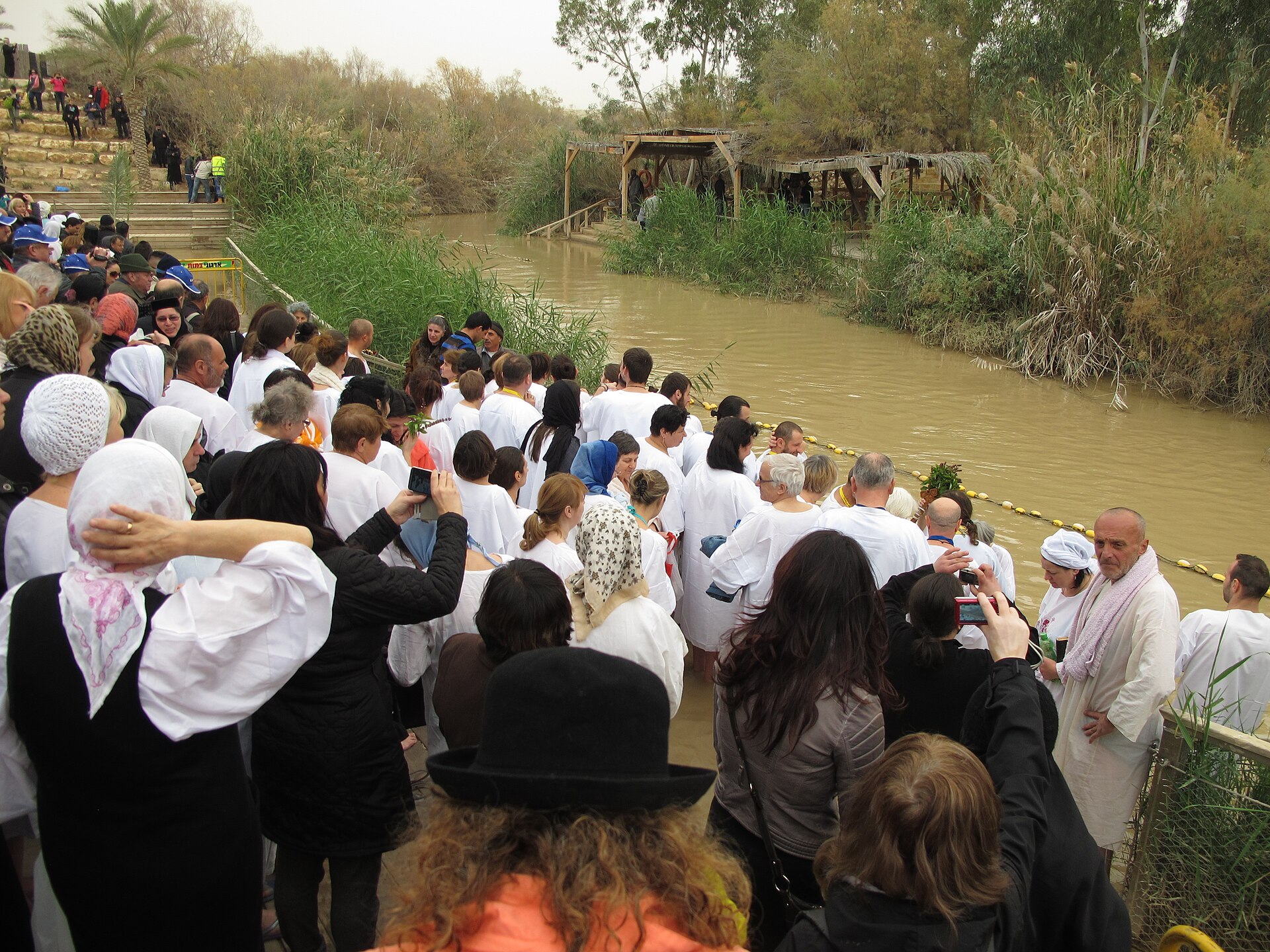
Places & Geography · The Jordan RiftThe Jordan runs through the deepest valley on the face of the earth. Its lower course lies well below sea level. It ends in the Dead Sea, which is lower still. That is not a wide river. In most places you could throw a stone across it, and the water runs brown with mud. The valley around it is hot and dry. So the wilderness Matthew names is not far from Jerusalem at all. It is a steep walk down, and the crowds who came out to John made that walk on foot in the heat.
Why this helps you read the BibleKnowing the ground turns a sentence into an effort. Matthew says people went out to him. The map tells you what going out actually cost them.
The river itself
The Jordan at Qasr el-Yahud, on the modern border between Israel and Jordan. The point of the picture is the river: narrow, brown, and reed-lined, which is not what most people expect. Everyone here is a modern visitor at a present-day service. This is a traditional site, honored for centuries, and no spot on the river has been identified as the place John stood.
Photograph of the Jordan River at Qasr el-Yahud. Source: Wikimedia Commons, File:Epiphany Qasr el Yahud.jpg. Public domain.
Read Matthew 3, then John 1:19–34 in your Bible. Write down every word John uses about himself, and every word he uses about the one coming after him. Put the two lists side by side and look at the difference in size. Keep what the chapters state apart from what you might add: none of the four writers says why John chose the desert.
Original passage written for this workbook — not a quotation from Scripture.
1Stated in these chapters, or Not stated there? Tap each detail to send it left or right.Sort into two
◄ Stated in these chaptersNot stated there ►
2Match each first detail with the detail paired with it.Match the Pairs
Isaiah→
Camel's hair→
A voice→
The Jordan→
A dove→
3Fill both blanks to complete the reasoning.💎 Uses the box aboveBuild the Argument
Camel hair was spun into a coarse cheap cloth that ordinary people knew, so Matthew reporting John's garment , which shows .
That is the whole workbook. The standardized test is optional and is scored separately.
Optional · The Coming of Jesus · Matthew 3; Mark 1; Luke 3; John 1
Standardized Test
Reading passage · The Lowest Ground There Is · Geography and Careful Evidence · ten questions in the shapes a standardized reading test uses: main idea, detail, vocabulary in context, inference, evidence, synthesis, insert text, prose summary and fill in a table.
Optional. This section is not counted in your workbook score. It gets a report card of its own, and skipping it still leaves your workbook complete.
Original passage written for this workbook — not a quotation from Scripture.
The Lowest Ground There Is
Run your finger down a map of the Middle East and you cross a crack in the earth's surface. The Jordan Valley is part of a rift that runs for thousands of kilometers, and it holds the lowest dry land anywhere on the planet. The river that runs through it is smaller than its fame suggests: in many stretches it is only a few meters across, brown with silt, and screened by reeds. The wilderness on either side is hot, bare and steep. From Jerusalem the walk down is under thirty kilometers, and it drops more than a thousand meters on the way. That is close enough for a city crowd to reach in a day and punishing enough that reaching it meant something. A person who went down in a rough garment was not going somewhere comfortable. What geography cannot tell us is who stood where, or on what day.
1What is the passage mostly about?Main Idea
2How wide is the river in many stretches?Detail
3In this passage, the “wilderness” is ___.Vocabulary in Context
4How far is the walk down from Jerusalem?Detail
5You can infer that going down there took real effort because ___.Inference
6Which detail best supports the idea that the valley is unusual?Evidence
7What does the passage say geography cannot tell us?Synthesis
8Insert Text. Look at the four squares [1]–[4] in the passage below. They mark the places this sentence could be added: “It is not the river most people picture.”
Run your finger down a map of the Middle East and you cross a crack in the earth's surface. [1] The Jordan Valley is part of a rift that runs for thousands of kilometers, and it holds the lowest dry land anywhere on the planet. [2] The river that runs through it is smaller than its fame suggests: in many stretches it is only a few meters across, brown with silt, and screened by reeds. [3] The wilderness on either side is hot, bare and steep. [4]
Where does the sentence fit best?Insert Text
9Prose Summary.The passage describes the Jordan Valley and what knowing it is worth. Six statements are listed below. Choose the THREE that best capture what the passage is saying. The other three do not belong — they are small details, or ideas the passage never puts forward. Each correct choice earns a mark of its own.Prose Summary
10Fill in a Table. Sort what geography settles from what it leaves open. Tap each statement to send it to the left column or the right one. Three belong in each.Fill in a Table
◄ Geography shows thisGeography cannot show this ►
Part 4 Complete!
You finished Matthew 3; Mark 1; Luke 3; John 1 of The Coming of Jesus.
Independent study guide by Lokosmos Academy. Not affiliated with or endorsed by Crossway or any Bible publisher. Contains original retelling and analysis only; no Scripture text is reproduced in full. Reference edition: keyed to the ESV® Bible — read Matthew 3; Mark 1; Luke 3; John 1 in your own Bible alongside this workbook; any Bible works for reading, and the vocabulary and questions follow the ESV’s wording. No ESV® text is quoted in this workbook. ESV® and the English Standard Version® are registered trademarks of Crossway.
Lokosmos Academy is an independent study resource, not affiliated with or endorsed by Crossway or any Bible publisher. This workbook is keyed to the wording of the ESV® Bible; any Bible works for reading — the vocabulary and quiz answers simply follow the ESV’s wording. These workbooks reprint no text of the ESV® Bible; every passage summary, question and example sentence is original wording. ESV® and the English Standard Version® are registered trademarks of Crossway.