A world is spoken into being and called good. Five chapters later one brother is dead, another is a wanderer, and a list of names is walking the family forward to a man called Noah.
Why these chapters go togetherGenesis 1–5 is one movement: the world is made, people are placed in it, the first family breaks, and a genealogy carries the line on. Splitting it would separate the making of people from what the first people actually did.
What We Will Learn
Section
What you will practice
Word Study
Words for making, sorting, worship and family: create, image, rest, crafty, offering, keeper, descendant
Bible Study
How to find a pattern in a chapter, and how to keep what a text states apart from what it leaves unsaid
Lokosmos Treasure Wisdom
The ancient Near East behind these chapters: garden work, early farming and herding, and the long family records scribes kept
Chapter Summary
Ch.
What happens
1
Six Days and a Seventh — The earth begins dark, deep and without shape. God speaks and light comes. Days one to three make room: day and night, then a sky between the waters, then dry land with plants. Days four to six fill that room: lights in the sky, then creatures for sea and sky, then land animals and people, male and female, made in God's own image and given the earth to care for. God calls everything he has made very good.
2
A Garden and Two Jobs — God rests on the seventh day. The account then narrows to one place. A man is formed and put in a garden in Eden, with rivers named and trees described, and he is given the garden to work and to keep. One tree is placed off limits. The man names the animals, and a woman is made; the chapter ends with the two of them together and unashamed.
3
The Garden Is Left Behind — The serpent questions God's command, and the woman and the man eat the forbidden fruit. They make coverings and hide. God questions them and speaks consequences: the ground will yield thorns and thistles, and food will come harder. God clothes them, sends them out of Eden to work the ground, and guards the way back to the tree of life.
4
Two Brothers and a Family Line — Cain works the ground and Abel keeps sheep. Both bring offerings. God questions and warns an angry Cain, but Cain later attacks Abel, who dies. Cain becomes a wanderer, though God also protects him from retaliation. A family line then names people connected with a city, with tents and livestock, with music and with metalwork. Seth is born at the close of the chapter.
5
From Adam to Noah — The chapter is a list. It runs from Adam through Seth down to Noah, ten named men in all, and for each of them it gives a name, an age at fatherhood and a total number of years. Enoch is the exception the list marks out. It ends with Noah and his three sons, which is where the next part picks the story up.
Part 1 · The Beginning · Genesis 1–5
Word Study
Study 7 key words from Genesis 1–5, then answer each question.
⚖
💎 Lokosmos Treasure Wisdom · a true fact behind the storyTwo Brothers, Two Names, One Explained
Open your Bible atGenesis 4:1–2
Word Study · Names That Mean SomethingRead Genesis 4:1. Watch Eve name her first son. She says she has gotten a man. The Hebrew word for gotten is qanah. It sounds a lot like Qayin, the name we say as Cain. Genesis tells you that one itself. Now read the very next verse. Abel is born, and his name in Hebrew is hevel. It means a puff of breath. Think of the little cloud you can see on a cold morning, and then cannot. Genesis never stops to explain that name. It just gives it to him and moves on.
The word
Say it
What it means
Where it is
Qayin
KAH-yin
the name we say as Cain
Genesis 4:1
qanah
kah-NAH
to get, to gain something
Genesis 4:1
hevel
HEH-vel
a puff of breath; mist
Genesis 4:2
Written the way the word sounds, not in its own alphabet — this is here to let you hear it, not to teach you to spell it.
Why this helps you read the BibleUse a name's meaning to explain a verse only when the Bible explains that name. Genesis explains Cain's name. It never explains Abel's. That line matters, because it keeps us reading what God has said, and not what we have added.
One name explained, one name not
Diagram of what the two verses do · Genesis 4:1 gives a reason for Cain's name and Genesis 4:2 gives none, and that is the whole difference the drawing shows. The dashed row is empty because the verse is silent, not because something is missing from the drawing. Nothing here claims the writer meant hevel to describe Abel's life.
Verses: Genesis 4:1 and 4:2. The link between qanah and Qayin is made by Genesis 4:1 itself; the meaning of hevel follows standard Hebrew lexicons. Drawn for Lokosmos Academy.
⚖ Still argued aboutHow the totals in Genesis 5 should be taken. Readers who hold the same view of Scripture divide between plain arithmetic, an inherited number system, and a claim about standing rather than years — and the chapter gives no key of its own.
🗣 Say itAdamAD-um(a-dəm)EveEEV(ēv)CainKAYN(kān)AbelAY-bul(ā-bəl)SethSETH(seth)EnochEE-nuk(ē-nək)Methuselahmuh-THOO-zuh-luh(mə-thü-zə-lə)
createv.Gen 1:1
To make something new
“Genesis 1:1 uses this word for what God does at the very start.”
imagen.Gen 1:27
A likeness of something
“Genesis 1 uses this word for the likeness people are made to carry.”
restv.Gen 2:2
To stop working
“Genesis 2 says the seventh day is when the making stopped.”
craftyadj.Gen 3:1
Clever in a tricky or misleading way
“The serpent speaks in a crafty, tricky way.”
offeringn.Gen 4:3–4
Something presented as a gift in worship or honor
“Each brother brings an offering connected with his work.”
keepern.Gen 4:2, 9
A person who watches over or cares for someone or something
“Abel looks after sheep, and Cain later throws the word back as a question.”
descendantn.Gen 5:3–32
A person who comes later in someone's family line
“Genesis 5 names one descendant after another, from Adam down to Noah.”
ⓘ The vocabulary words in this list are selected to help you understand and complete this workbook. Some may not appear word-for-word in your Bible. The example sentences are our own wording, written to make the verse clearer — they are not quotations from it. Read each verse in your own Bible.
1To make something new is to ___ it.Gen 1:1
2‘Crafty’ means clever in a tricky or misleading way.Gen 3:1
3Fill in each blank with the correct word.Gen 4:2–4
Word choices:keeperdescendantofferingimage- some words will not be used
Abel is a of sheep. Gen 4:2, 9
Each brother brings an connected with his work. Gen 4:3–4
4Genesis explains one of these two brothers’ names and leaves the other alone. Which one does it explain?💎 Uses the box aboveGen 4:1–2
5To ‘rest’ means to stop working.Gen 2:2
6Genesis 1 says the sun and the moon were made in the image of God.Gen 1:27
7Fill in each blank with the correct word.Gen 1; 5
Word choices:imagedescendantscraftykeeper- some words will not be used
People were made in the of God. Gen 1:27
Adam's family line down to Noah is a list of his . Gen 5:3–32
Part 2 · The Beginning · Genesis 1–5
Understanding
Show you understood what happens in Genesis 1–5.
🧠
💎 Lokosmos Treasure Wisdom · a true fact behind the storyRead the Week Sideways, Not Downwards
Open your Bible atGenesis 1:3–31
Bible Study Skill · Spotting a PatternMost people read Genesis 1 straight down, day one to day six. Try it sideways instead. Write days one, two and three down the left of a page, and days four, five and six down the right, then read across. Light and dark (day one) sit beside sun and moon (day four). Sky and sea (day two) sit beside the creatures that fill them (day five). Dry land and plants (day three) sit beside land animals and people (day six). The left column makes an empty room. The right column fills the very same room, in the very same order.
Why this helps you read the BibleWhen a chapter repeats itself, that is a clue and not a mistake. Look for the shape before the details. Genesis 1 was made to be heard and remembered, and seeing its shape is part of hearing what God said in it.
Days 1–3 make room; days 4–6 fill it
Diagram of the chapter's own order · the six days and their contents are all stated in Genesis 1. Pairing them left to right is a way of reading the order, not a claim that the chapter labels the halves or explains why they match.
Verses: Genesis 1:3–31 and 2:2. Drawn for Lokosmos Academy.
1What is the earth like at the very start of Genesis 1?Gen 1:2
2What do the man and the woman make after they eat the fruit?Gen 3:7
3Read the six days in two columns, the way the box above shows. Which day fills the room that day two makes?💎 Uses the box aboveGen 1:6–23
4What does Genesis 5 mainly do?Gen 5
5Write the numbers 1–5 in the boxes to show the correct order across Genesis 1–5. Number 1 = what happens first.Gen 1–5
A family line is traced from Adam down to Noah.
God rests on the seventh day.
The serpent questions God's command in the garden.
God says “Let there be light,” and there is light.
The two brothers bring offerings connected with their work.
6God questions and warns Cain before the scene in the field.Gen 4:6–8
7Genesis 4 says that keeping sheep is better work than farming.Gen 4:2–5
Part 3 · The Beginning · Genesis 1–5
Literary Craft
Understanding HOW and WHY the story is told across Genesis 1–5.
📖
💎 Lokosmos Treasure Wisdom · a true fact behind the storyThe Line That Keeps Coming Back
Open your Bible atGenesis 1:4, 10, 12, 18, 21, 25, 31
Literary Craft · The RefrainTurn to those seven verses. Read only them, one after another. You will hear almost the same words each time. God looks at what he has made, and it is good. A line that comes back like that is called a refrain. Songs use them too. It is the part everybody joins in on. Genesis 1 is built the same way. Read the chapter out loud and the beat is hard to miss. Then look at verse 31, the very last one, and find the small word that has been added.
Why this helps you read the BibleA line you have heard six times teaches your ear what to expect. So the change in verse 31 is worth stopping at. The Bible often makes a point by breaking a pattern it taught you first.
Pattern
Something that repeats. Genesis 1 repeats the same shape every day: God speaks, it happens, God sees that it is good, evening and morning.
Refrain
A line that comes back again and again, like a chorus in a song. “And God saw that it was good” is the refrain of Genesis 1.
Contrast
A difference placed side by side. Genesis 4 sets a worker of the ground beside a keeper of sheep without saying that either job is the better one.
Genealogy
A record that traces a family line. Genesis 5 walks ten generations from Adam to Noah, one name at a time.
1The refrain comes back one last time in Genesis 1:31, with one extra word in it. Which word is added?💎 Uses the box aboveGen 1:31
2Fill in each blank with the correct word.Gen 1
Word choices:patternrefraingenealogycontrast- some words will not be used
Something that repeats is a .
A line that comes back like a chorus is a .
3Genesis 4 puts a worker of the ground beside a keeper of sheep and never says which job is better. What is that?Gen 4:2
4Genesis 4 states plainly which brother had the better job.Gen 4:2–5
5Fill in each blank with the correct word.Gen 4–5
Word choices:genealogycontrastrefrainpattern- some words will not be used
A record that traces a family line is a .
A difference placed side by side is a .
6A genealogy is a list of farming tools.Gen 5
7Why does the writer end every day of Genesis 1 with the same words?Gen 1
Part 4 · The Beginning · Genesis 1–5
Wisdom
Three deeper challenges — no single-word recall. Read, weigh the evidence, and reason it out.
📜
💎 Lokosmos Treasure Wisdom · a true fact behind the storyAnother Country Kept a List Too
Open your Bible atGenesis 5:5, 5:27, 5:32
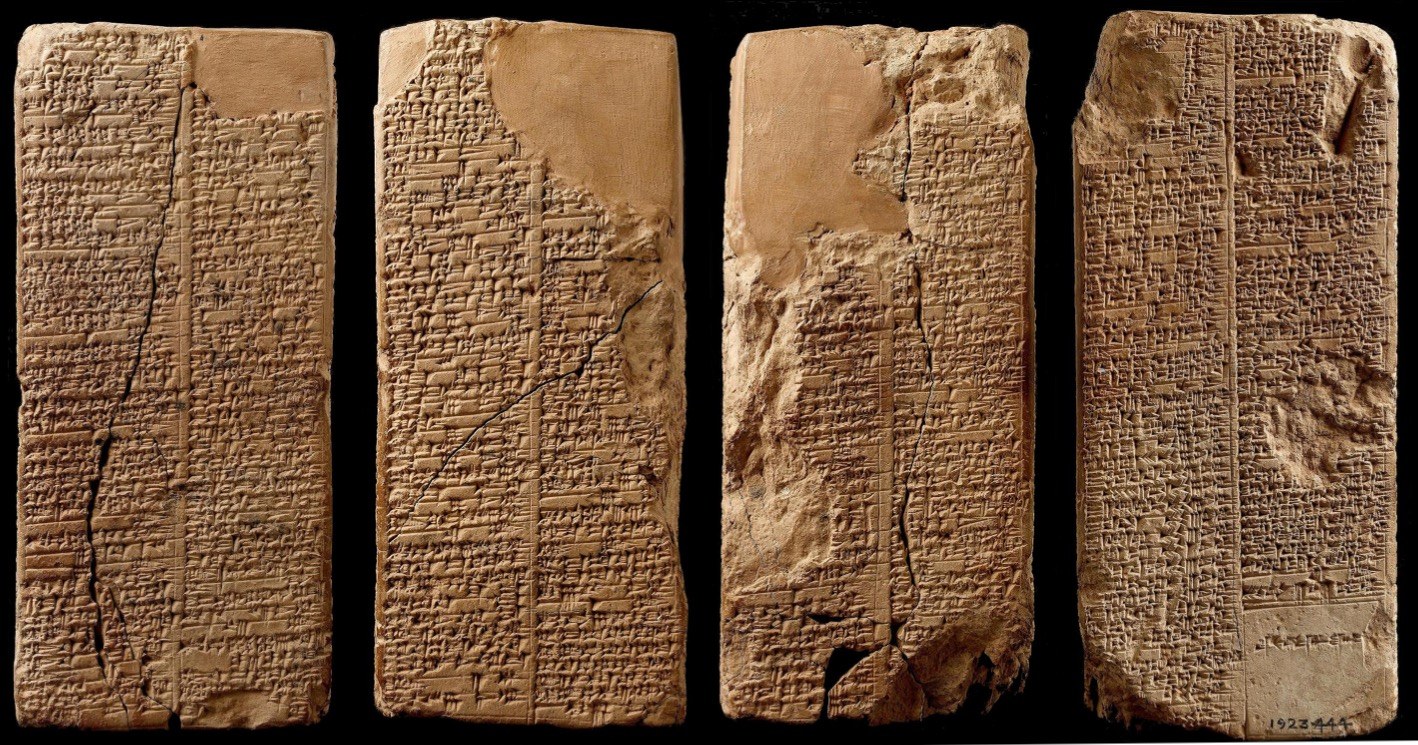
Ancient Records · King Lists and Long LivesGenesis 5 gives every man a total number of years. The biggest is Methuselah's 969. Now here is something from outside the Bible. Long ago, scribes in Iraq kept their own list of rulers from before a great flood. We still have copies of it, written on clay. That list gives its first ruler 28,800 years. Genesis never comes near a number like that. So two peoples both kept long records of the time before a flood. But the two sets of numbers are nowhere near each other. Genesis never explains its own totals.
The word
Say it
What it means
Where it is
Sumerian King List
soo-MAIR-ee-an
an ancient list of rulers, from Iraq
not in the Bible
Alulim
ah-LOO-lim
the first ruler that list names
not in the Bible
Written the way the word sounds, not in its own alphabet — this is here to let you hear it, not to teach you to spell it.
Why this helps you read the BibleSomething outside the Bible can show you the world a passage was written into. It cannot tell you what the passage means. Keeping those two apart protects Scripture from being explained by things it never said.
969 years beside 28,800
Two figures drawn to one scale · 969 is the largest total Genesis 5 gives, and 28,800 is the first reign in the Sumerian King List. The bars compare the two numbers as written. They do not claim either document borrowed from the other, and they do not say how either set of numbers should be counted.
Genesis 5:27 for the total. Sumerian King List reign lengths follow the standard published editions of the text, known from copies made early in the second millennium BC. Drawn for Lokosmos Academy.
The list itself: four faces of one clay prism
The Weld-Blundell Prism in the Ashmolean Museum, Oxford, photographed from all four sides. This is the copy of the Sumerian King List the box is about: one clay prism, written early in the second millennium BC, carrying the reigns in columns of cuneiform. The photograph dates the object, not the kings on it, and nothing on this prism mentions Genesis.
The Weld-Blundell Prism (W-B 1923.444), Ashmolean Museum, Oxford. Photograph published in S. H. Langdon, Oxford Editions of Cuneiform Texts, Oxford University Press, 1923, Plates I–IV; the line transcription printed beneath it on the same plate is cropped away here. Public domain. Source: Wikimedia Commons, File:Weld-Blundell Prism with transcription by Stephen Herbert Langdon (1876-1937).jpg.
Read Genesis 1–5 in your Bible first. Watch the ground. It is made on the third day, the man is placed on it and then sent back to work it, Cain works it, and it takes his brother's blood. Watch the questions too: God asks them in the garden and asks them again in the field. Then notice how chapter 5 changes gear — no scenes, no dialogue, only names and numbers walking forward. Some things these chapters state outright. Others they simply do not explain. Keep those two kinds of information apart as you work.
Original passage written for this workbook — not a quotation from Scripture.
1Stated in Genesis 1–5, or Not stated there? Tap each detail to send it left or right.💎 Uses the box aboveSort into two
◄ Stated in Genesis 1–5Not stated there ►
2Match each first detail with the detail paired with it.Match the Pairs
The first day→
The seventh day→
Cain→
Abel→
Seth→
3Fill both blanks to complete the reasoning.Build the Argument
Genesis names Cain by his work and Abel by his , which shows .
That is the whole workbook. The standardized test is optional and is scored separately.
Optional · The Beginning · Genesis 1–5
Standardized Test
Reading passage · Family Lists in the Ancient World · Background and Textual Evidence · ten questions in the shapes a standardized reading test uses: main idea, detail, vocabulary in context, inference, evidence, synthesis, insert text, prose summary and fill in a table.
Optional. This section is not counted in your workbook score. It gets a report card of its own, and skipping it still leaves your workbook complete.
Original passage written for this workbook — not a quotation from Scripture.
Family Lists in the Ancient World
Genesis 5 is a list. It moves from Adam to Noah one generation at a time, and for each descendant it records a name, an age and a total number of years. Lists of this kind were ordinary in the ancient world, and scribes in Mesopotamia kept a famous one of their own. The Sumerian King List, preserved in copies made early in the second millennium BC, names rulers said to have governed before a great flood, and the reigns it assigns them run into the tens of thousands of years. Setting the two documents beside each other shows something useful and something limited. It shows that Genesis was written into a world where recording long stretches of time before a flood was a familiar thing for a scribe to do. It does not show how either set of numbers was meant to be counted, and it dates not one descendant in Genesis 5. Careful readers use a comparison like this to picture the setting, and then stop.
1What is the passage mostly about?Main Idea
2What does Genesis 5 record for each man in the line?Detail
3In this passage, a “descendant” is ___.Vocabulary in Context
4When were the surviving copies of the Sumerian King List made?Detail
5You can infer from the passage that keeping records of very early times was ___.Inference
6Which sentence best supports the idea that the comparison has limits?Evidence
7Which habit of reading does the passage model?Synthesis
8Insert Text. Look at the four squares [1]–[4] in the passage below. They mark the places this sentence could be added: “That is the useful half.”
Setting the two documents beside each other shows something useful and something limited. [1] It shows that Genesis was written into a world where recording long stretches of time before a flood was a familiar thing for a scribe to do. [2] It does not show how either set of numbers was meant to be counted, and it dates not one descendant in Genesis 5. [3] Careful readers use a comparison like this to picture the setting, and then stop. [4]
Where does the sentence fit best?Insert Text
9Prose Summary.The passage sets Genesis 5 beside an ancient king list. Six statements are listed below. Choose the THREE that best capture what the passage is saying. The other three do not belong — they are small details, or ideas the passage never puts forward. Each correct choice earns a mark of its own.Prose Summary
10Fill in a Table. Sort what this comparison settles from what it leaves open. Tap each statement to send it to the left column or the right one. Three belong in each.Fill in a Table
◄ The comparison shows thisThe comparison cannot show this ►
Independent study guide by Lokosmos Academy. Not affiliated with or endorsed by Crossway or any Bible publisher. Contains original retelling and analysis only; no Scripture text is reproduced in full. Reference edition: keyed to the ESV® Bible — read Genesis 1–5 in your own Bible alongside this workbook; any Bible works for reading, and the vocabulary and questions follow the ESV’s wording. No ESV® text is quoted in this workbook. ESV® and the English Standard Version® are registered trademarks of Crossway.
Lokosmos Academy is an independent study resource, not affiliated with or endorsed by Crossway or any Bible publisher. This workbook is keyed to the wording of the ESV® Bible; any Bible works for reading — the vocabulary and quiz answers simply follow the ESV’s wording. These workbooks reprint no text of the ESV® Bible; every passage summary, question and example sentence is original wording. ESV® and the English Standard Version® are registered trademarks of Crossway.