Where we left offThe nations have scattered from Babel, and the line of Shem has narrowed down to one family living in Ur.
A man is told to leave his country for a land nobody will name for him. He goes. Within three chapters there is a famine, a lie, a quarrel over grazing and a war.
Why these chapters go togetherGenesis 12 to 14 put the same promise through three ordinary kinds of trouble — hunger, fear and conflict — one after another, and the promise is restated in the middle of them.
What We Will Learn
Section
What you will practice
Word Study
Words for family, food, worship and rescue: descendants, famine, possessions, priest, tithe, captive, rescue
Bible Study
How to follow a promise as it is restated across a passage, and how a writer uses two choices side by side
Lokosmos Treasure Wisdom
The real city of Ur, the letters that record families moving with their herds, and the donkey caravans of the ancient roads
Chapter Summary
Ch.
What happens
12
The Call and the Journey — The LORD tells Abram to leave his country and his father's house for a land he will be shown, and promises to make him a great nation. Abram, Sarai and Lot travel to Canaan, where Abram builds an altar. A famine then sends the household down to Egypt for a time, where Abram says Sarai is his sister and Pharaoh takes her into his house; the family is sent away and returns to Canaan.
13
Abram and Lot Separate — Their herds are too large for one stretch of land and the herdsmen quarrel. Abram gives Lot the first choice. Lot looks at the well-watered plain of the Jordan and takes it, settling toward Sodom, and Abram stays in Canaan. Once Lot has gone, God tells Abram to look in every direction, because all of it will belong to his offspring.
14
The Rescue of Lot — Four eastern kings defeat the kings of the plain and carry off goods and people, Lot among them. Abram arms the trained men of his household, pursues, and brings back Lot, the people and the goods. Melchizedek, king of Salem and priest of God Most High, brings out bread and wine and blesses Abram, and Abram gives him a tenth of everything. The king of Sodom offers Abram the goods, and Abram refuses them.
Part 1 · Abraham · Genesis 12–14
Word Study
Study 7 key words from Genesis 12–14, then answer each question.
🏙️
💎 Lokosmos Treasure Wisdom · a true fact behind the storyUr: A City Dug Back Out of the Sand
Open your Bible atGenesis 11:31, then Genesis 12:1
Word Study · A City Under the SandGenesis says Abram's family came out of Ur. Most readers take that to be a real city in southern Iraq. A man named Leonard Woolley dug it up between 1922 and 1934. What came out of the ground was not a village. His team cleared a graveyard of about two thousand graves. Sixteen of them held so much gold and fine work that he called them royal. He kept careful records, thousands of numbered field cards, one object at a time. Newspapers ran the story for years. So whatever else Abram walked away from, he walked away from a rich and busy city.
Why this helps you read the BibleAbram is not leaving nowhere. He is leaving a real and wealthy city, and we can see what it looked like. That makes his going cost something, which is part of what the passage is showing.
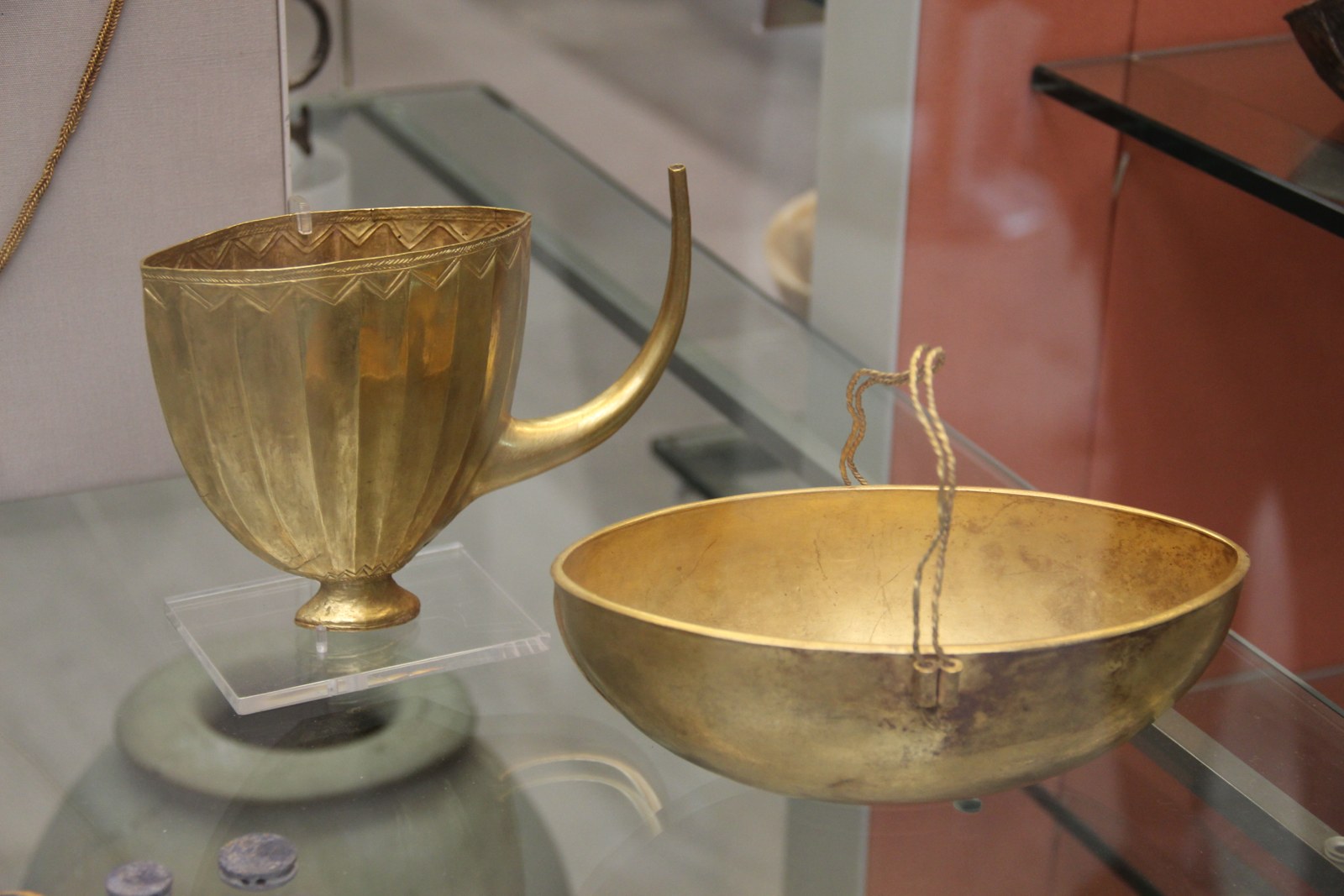
What came out of the graves at Ur
A gold cup and a gold bowl from the Royal Tombs at Ur, now in the British Museum. Objects like these are why Woolley called sixteen of the graves royal, and why the city Genesis names is not a guess — it was dug up. None of this belonged to Abram or dates his life: the tombs are centuries older than any date proposed for him, and Genesis gives no date at all.
Gold cup and bowl from the Royal Tombs at Ur, British Museum, London. Photograph by Gary Todd. CC0 public domain dedication. Source: Wikimedia Commons, File:Gold Cup & Bowl Ur Royal Tombs excavations.jpg.
⚖ Still argued aboutWhich Ur. Most read it as the Sumerian city in southern Iraq; a minority argue for a northern Ur near Haran. The text says only Ur of the Chaldeans, and stops.
🗣 Say itAbramAY-bram(ā-brəm)SaraiSAIR-eye(ser-ī)HaranHAIR-an(her-ən)NegebNEG-eb(ne-geb)Melchizedekmel-KIZ-uh-dek(mel-ki-zə-dek)Chedorlaomerked-or-LAY-oh-mer(ke-dȯr-lā-ō-mər)
descendantsn.Gen 12:7
People who come after someone in their family line
“Genesis 12 says the land is promised to Abram's family after him.”
faminen.Gen 12:10
A time when there is not enough food
“Genesis 12 says a shortage of food is what sends the household to Egypt.”
possessionsn.Gen 13:2
Things a person owns
“Genesis 13 says Abram came back a wealthy man, in livestock and in metal.”
priestn.Gen 14:18
Someone who serves God and leads others in worship
“Genesis 14 gives Melchizedek this title as well as calling him a king.”
tithen.Gen 14:20
A tenth part given as an offering
“Genesis 14 says Abram handed over a tenth of what he had taken.”
captiven.Gen 14:12
Someone taken and held by force during a conflict
“Genesis 14 says Lot was taken away when the eastern kings raided the city.”
rescuev.Gen 14:16
To save someone from danger
“Genesis 14 says Abram went after the raiders and brought his nephew back.”
ⓘ The vocabulary words in this list are selected to help you understand and complete this workbook. Some may not appear word-for-word in your Bible. The example sentences are our own wording, written to make the verse clearer — they are not quotations from it. Read each verse in your own Bible.
1The box above says what Woolley's team dug up at Ur. What sort of place had Abram's family come from?💎 Uses the box aboveGen 11:31
2In Genesis 12, a ‘famine’ is a time when there is too much food to store.Gen 12:10
3Fill in each blank with the correct word.Gen 13:2; 14:18
Word choices:possessionspriestfaminecaptive- some words will not be used
Abram comes back into Canaan with many . Gen 13:2
Melchizedek is described as a king and a . Gen 14:18
4A tenth part given as an offering is a ___.Gen 14:20
5In Genesis 14, Lot becomes a captive when the eastern kings carry off the people of Sodom.Gen 14:12
6To ‘rescue’ someone is to save them from danger.Gen 14:16
7Fill in each blank with the correct word.Gen 12–14
Word choices:descendantsrescuetithefamine- some words will not be used
People who come later in a family line are . Gen 12:7
To save someone from danger is to them. Gen 14:16
Part 2 · Abraham · Genesis 12–14
Understanding
Show you understood what happens in Genesis 12–14.
🧠
💎 Lokosmos Treasure Wisdom · a true fact behind the storyOne Promise, Said Three Times
Open your Bible atGenesis 12:1–3, then 12:7, then 13:14–17
Close Reading · Following a Repeated PromiseThe promise is not made once and then left. Read the three places at the top of this box, in order. In Genesis 12 God tells Abram to go. He promises a nation, a blessing and a great name. But he does not say which land. A few verses later Abram is standing in it. Now he is told the land will go to his offspring. Then in Genesis 13, after Lot has taken the better ground, Abram is told to look every way. All of it is going to offspring past counting. Each time, something is added.
Why this helps you read the BibleFollow a promise through a passage and watch what is added each time. That shows what the passage cares about. God's promises in Scripture often grow clearer by being said again.
One promise, said three times, growing each time
Diagram of three stated moments · all three references and everything on the rows is in Genesis 12 and 13. That the promise grows is what the three verses show when read in order; the drawing claims no more than that, and Genesis nowhere numbers or labels them.
Verses: Genesis 12:1–3, 12:7 and 13:14–17. Drawn for Lokosmos Academy.
1What does the LORD tell Abram to do at the start of Genesis 12?Gen 12:1
2Why do Abram's and Lot's herdsmen begin quarreling?Gen 13:6–7
3Which land does Lot choose when Abram gives him first pick?Gen 13:10–11
4The promise is said three times. What does the third telling, in Genesis 13, add?💎 Uses the box aboveGen 13:14–17
5Write the numbers 1–5 in the boxes to show the correct order across Genesis 12–14. Number 1 = what happens first.Gen 12–14
A famine sends the household down to Egypt for a time.
Abram gives Lot first pick, and Lot takes the plain.
Eastern kings defeat the kings of the plain and carry Lot off.
The LORD calls Abram to leave Haran for Canaan.
Melchizedek blesses Abram, and Abram gives him a tenth.
6God restates his promise of land and offspring after Lot has gone off to the plain.Gen 13:14–17
7Abram accepts the goods that the king of Sodom offers him.Gen 14:21–24
Part 3 · Abraham · Genesis 12–14
Literary Craft
Understanding HOW and WHY the story is told across Genesis 12–14.
📖
💎 Lokosmos Treasure Wisdom · a true fact behind the storyTwo Men, One Field, Two Choices
Open your Bible atGenesis 13:8–12
Literary Craft · ContrastGenesis 13 puts two decisions next to each other. Then it says nothing about either one. The land cannot feed both flocks. So Abram, who is older and could have chosen first, gives the choice to Lot. Lot looks, sees water, and takes the plain. The chapter never tells you what to think about that. It puts the two decisions on the page in order and leaves the rest to you. Setting two things side by side like this is called contrast. So read both halves before you decide: what Lot took, and what Abram gave away.
Why this helps you read the BibleGenesis 13 reports both decisions in order and judges neither. So what you may compare is the two acts themselves. Scripture often sets things side by side. What it has not said about them is not yours to supply.
Contrast
Two things placed side by side so a reader can see the difference. Abram hands over the first choice of land; Lot takes the better ground for himself.
Setting
The time and place a story happens in. Genesis 12–13 moves Abram from Haran to Canaan to Egypt and back again, and the moving is the point.
Repetition
Something said again on purpose. God's promise of land and offspring comes back more than once in these chapters, and grows each time.
1What is contrast?Gen 13
2Fill in each blank with the correct word.Gen 12–13
Word choices:contrastsettingrepetitionfamine- some words will not be used
Putting Abram's choice beside Lot's is an example of .
The time and place a story happens in is its .
3How do Genesis 12–13 use setting?Gen 12–13
4Abram gives Lot the first choice of land even though he could have chosen himself.Gen 13:9
5A promise repeated in a passage is always a copying mistake by the writer.Gen 12–13
6Fill in each blank with the correct word.Gen 12–13
Word choices:repetitioncontrastsettingtithe- some words will not be used
Something said again on purpose is .
Two things placed side by side to show a difference is .
7Abram is the elder and could have taken first pick. Which detail sharpens the contrast most?💎 Uses the box aboveGen 13:9
Part 4 · Abraham · Genesis 12–14
Wisdom
Three deeper challenges — no single-word recall. Read, weigh the evidence, and reason it out.
⛺
💎 Lokosmos Treasure Wisdom · a true fact behind the storyTents and Cities Were Not Two Worlds
Open your Bible atGenesis 12:8, then Genesis 13:12
Daily Life · Living Between the TwoA family moving between towns with sheep and goats was normal. We know this because of Mari, an old city on the Euphrates. Thousands of clay letters were dug up there. They were written about 1900 to 1800 BC, and many are officials keeping track of exactly these groups. Where were they grazing? What were they trading? What had they agreed? These people were not cut off from town life at all. They dealt with kings. They settled down sometimes. They also lived in tents for part of the year. The letters never mention Abram. They show the pattern was ordinary.
The word
Say it
What it means
Where it is
Mari
MAH-ree
an ancient city on the Euphrates river
not in the Bible
Written the way the word sounds, not in its own alphabet — this is here to let you hear it, not to teach you to spell it.
Why this helps you read the BibleAbram's way of living was normal for his time. Knowing that stops you picturing him wrongly. It lets the passage say what it really says about him.
Read Genesis 12–14 in your Bible first. Notice exactly what is promised in the opening verses, and then catch the same promise coming back later with something added to it. Watch how Abram and Lot each choose when they have to separate, and what each choice shows without the passage saying so. Then follow the rescue in chapter 14, and pay close attention to what Abram accepts afterwards and from whom — he takes nothing from one king and gives a tenth to another, and the chapter reports both without explaining either.
Original passage written for this workbook — not a quotation from Scripture.
1Stated in Genesis 12–14, or Not stated there? Tap each detail to send it left or right.💎 Uses the box aboveSort into two
◄ Stated in Genesis 12–14Not stated there ►
2Match each first detail with the detail paired with it.Match the Pairs
Sarai→
Lot→
Abram's trained men→
Melchizedek→
The king of Sodom→
3Fill both blanks to complete the reasoning.Build the Argument
Genesis 13 gives the quarreling herdsmen as the reason Abram and Lot separate, so Abram's offer of first choice , which shows .
That is the whole workbook. The standardized test is optional and is scored separately.
Optional · Abraham · Genesis 12–14
Standardized Test
Reading passage · Donkeys, Tin and a Very Long Road · Ancient Trade and Careful Evidence · ten questions in the shapes a standardized reading test uses: main idea, detail, vocabulary in context, inference, evidence, synthesis, insert text, prose summary and fill in a table.
Optional. This section is not counted in your workbook score. It gets a report card of its own, and skipping it still leaves your workbook complete.
Original passage written for this workbook — not a quotation from Scripture.
Donkeys, Tin and a Very Long Road
At Kultepe in central Turkey, the mound of the ancient city of Kanesh has given up more than twenty thousand clay tablets. They are the business papers of merchants from Assur, far to the southeast, who ran donkey caravans north through the mountains for roughly two hundred years either side of 1900 BC. The cargo went one way as tin and fine woolen cloth and came back as silver and gold. What makes the archive remarkable is how ordinary it is: letters about debts, complaints about late payment, arguments over which possessions belonged to whom, notes from wives at home about money. A caravan was a real journey with real costs, not an adventure. The tablets say nothing about Abram and cannot date anybody in Genesis. What they do show is that in exactly this period, families and firms moved goods and people over long distances as a matter of routine.
1What is the passage mostly about?Main Idea
2What did the caravans carry north?Detail
3In this passage, “possessions” are ___.Vocabulary in Context
4Roughly when were the tablets written?Detail
5You can infer from the passage that long-distance trade was ___.Inference
6Which detail best supports the idea that the archive is about ordinary business?Evidence
7What does the passage say the tablets cannot do?Synthesis
8Insert Text. Look at the four squares [1]–[4] in the passage below. They mark the places this sentence could be added: “That is a long way to move anything.”
At Kultepe in central Turkey, the mound of the ancient city of Kanesh has given up more than twenty thousand clay tablets. [1] They are the business papers of merchants from Assur, far to the southeast, who ran donkey caravans north through the mountains for roughly two hundred years either side of 1900 BC. [2] The cargo went one way as tin and fine woolen cloth and came back as silver and gold. [3] What makes the archive remarkable is how ordinary it is: letters about debts, complaints about late payment, arguments over which possessions belonged to whom, notes from wives at home about money. [4]
Where does the sentence fit best?Insert Text
9Prose Summary.The passage explains what a merchants' archive at Kanesh shows. Six statements are listed below. Choose the THREE that best capture what the passage is saying. The other three do not belong — they are small details, or ideas the passage never puts forward. Each correct choice earns a mark of its own.Prose Summary
10Fill in a Table. Sort what these tablets settle from what they leave open. Tap each statement to send it to the left column or the right one. Three belong in each.Fill in a Table
◄ The tablets show thisThe tablets cannot show this ►
Independent study guide by Lokosmos Academy. Not affiliated with or endorsed by Crossway or any Bible publisher. Contains original retelling and analysis only; no Scripture text is reproduced in full. Reference edition: keyed to the ESV® Bible — read Genesis 12–14 in your own Bible alongside this workbook; any Bible works for reading, and the vocabulary and questions follow the ESV’s wording. No ESV® text is quoted in this workbook. ESV® and the English Standard Version® are registered trademarks of Crossway.
Lokosmos Academy is an independent study resource, not affiliated with or endorsed by Crossway or any Bible publisher. This workbook is keyed to the wording of the ESV® Bible; any Bible works for reading — the vocabulary and quiz answers simply follow the ESV’s wording. These workbooks reprint no text of the ESV® Bible; every passage summary, question and example sentence is original wording. ESV® and the English Standard Version® are registered trademarks of Crossway.