Where we left offAbram has rescued Lot, refused the king of Sodom's reward, and still has no child.
Abram asks for something to go on and gets a ceremony in the dark. Two chapters later his name changes. Then three visitors arrive, name a date, and Sarah laughs where she thinks nobody can hear.
Why these chapters go togetherGenesis 15 to 18 make one promise steadily more specific: first an heir, then a ceremony, then new names and a sign, and finally a year put on it. Each chapter pins down something the one before left open.
What We Will Learn
Section
What you will practice
Word Study
Words for promise, family and standing: righteous, offspring, heir, covenant, establish, circumcision, laugh
Bible Study
How to line two similar scenes up and see what the second one adds
Lokosmos Treasure Wisdom
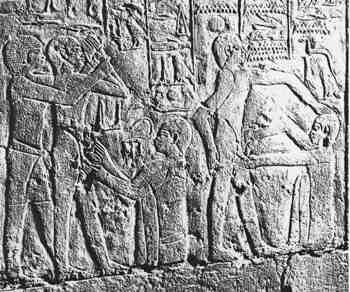
How promises were actually sealed in the ancient Near East, and the carving that predates Genesis 17
Chapter Summary
Ch.
What happens
15
A Promise Confirmed in the Dark — The LORD tells Abram that his own son, not a servant, will be his heir, and takes him outside to count the stars. Abram believes the LORD, and it is counted to him as righteousness. The covenant is then confirmed by a ceremony: animals cut in half, a deep sleep, and after dark a smoking fire pot and a blazing torch passing between the pieces. Abram is also told his family line will live as strangers in a land not their own for four hundred years.
16
Hagar and Ishmael — Sarai is still childless and gives her servant Hagar to Abram. Hagar conceives, the household turns bitter, and Hagar runs into the wilderness. There the angel of the LORD finds her by a spring, tells her to return, and promises to multiply her offspring too. She bears a son and he is named Ishmael.
17
New Names, and a Sign — God appears again and establishes the covenant as everlasting. Abram becomes Abraham and Sarai becomes Sarah, and God says plainly that Sarah herself will bear a son within the year, to be named Isaac. Circumcision is given as the sign of the covenant, and Abraham circumcises every male of his household that same day.
18
Three Visitors, and a Laugh — Three men appear at the oaks of Mamre in the heat of the day. Abraham runs to meet them, hurries Sarah into baking and a servant into preparing a calf, and stands by while they eat. One of them says Sarah will have a son by this time next year. Sarah, listening at the tent door, laughs to herself — and is asked why. The chapter then turns toward Sodom, which is where the next part picks it up.
Part 1 · Abraham · Genesis 15–18
Word Study
Study 7 key words from Genesis 15–18, then answer each question.
📜
💎 Lokosmos Treasure Wisdom · a true fact behind the storyHow a Promise Was Really Sealed
Open your Bible atGenesis 15:9–10, then 15:17
Word Study · Cutting a CovenantGenesis 15 has Abram cut animals in half. Then something passes between the pieces after dark. That is not a strange private ritual. It is how serious promises were closed all over that part of the world. A letter from the city of Mari, about 1770 BC, tells of a young donkey killed to settle peace between two rulers. A stone treaty from a place called Sefire spells out what the killing meant. What happens to the animal is what should happen to whoever breaks the deal. Hebrew even has one phrase for both, karat berit, which means to cut a covenant.
The word
Say it
What it means
Where it is
karat berit
kah-RAHT beh-REET
to cut a covenant
Genesis 15:18
Written the way the word sounds, not in its own alphabet — this is here to let you hear it, not to teach you to spell it.
Why this helps you read the BibleAbram is not being shown a puzzle. He is being shown a promise closed in the strongest way his world knew. Knowing the custom lets you feel the weight the first readers felt.
⚖ Still argued aboutWhether Genesis 15:6 says God credited Abram, or Abram credited God. The Hebrew leaves both readings open, and a large amount of later argument rests on which one is taken.
🗣 Say itHagarHAY-gar(hā-gär)IshmaelISH-may-el(ish-mā-el)MamreMAM-ree(mam-rē)Eliezerel-ih-EE-zer(e-lē-ē-zər)SarahSAIR-uh(ser-ə)IsaacEYE-zik(ī-zək)
righteousadj.Gen 15:6
Right or good in God's sight
“Genesis 15 uses this word for what Abram's trust is counted as.”
offspringn.Gen 15:5
A person's children, and their children after them
“Genesis 15 compares the number of Abram's family to the stars.”
heirn.Gen 15:4
The person who will receive what belongs to someone else
“Genesis 15 says the one who inherits will be Abram's own son.”
covenantn.Gen 15:18; 17:2
A solemn binding agreement, especially one made with God
“Genesis 17 uses this word for the binding promise made to Abraham's line.”
establishv.Gen 17:7
To set something up so that it lasts
“Genesis 17 says the promise is set up to last.”
circumcisionn.Gen 17:11
The mark in the body given as the sign of God's covenant with Abraham's household
“Genesis 17 makes this the mark that goes with the promise.”
laughv.Gen 18:12
To make the sound and movement that amusement or disbelief brings
“Genesis 18 has Sarah doing this quietly, just inside the tent.”
ⓘ The vocabulary words in this list are selected to help you understand and complete this workbook. Some may not appear word-for-word in your Bible. The example sentences are our own wording, written to make the verse clearer — they are not quotations from it. Read each verse in your own Bible.
1Someone who is right or good in God's sight is ___.Gen 15:6
2In Genesis 15, ‘offspring’ means a person's children and their children after them.Gen 15:5
3Fill in each blank with the correct word.Gen 15:4; 17:11
Word choices:heircircumcisionlaughcovenant- some words will not be used
The person who will receive what belongs to someone else is the . Gen 15:4
The sign given in Genesis 17 is . Gen 17:11
4To set something up so that it lasts is to ___ it.Gen 17:7
5In Abraham's world, a serious agreement was often sealed by cutting an animal in half.💎 Uses the box aboveGen 15:9–10
6In Genesis 18, Sarah laughs out loud so that everyone at the tent can hear her.Gen 18:12
7Fill in each blank with the correct word.Gen 15–18
Word choices:offspringcovenantestablishlaugh- some words will not be used
Abram's children and their children after them are his . Gen 15:5
A solemn binding agreement with God is a . Gen 15:18; 17:2
Part 2 · Abraham · Genesis 15–18
Understanding
Show you understood what happens in Genesis 15–18.
🧠
💎 Lokosmos Treasure Wisdom · a true fact behind the storyThe Same Promise, Told a Second Time
Open your Bible atGenesis 15, then Genesis 17
Close Reading · One Promise, Two ScenesGenesis 15 and Genesis 17 both have God binding himself to Abram. They are not the same chapter twice. Read them side by side. Then sort what you find into three piles. What is in both? What is only in 15? What is only in 17? Offspring and land go in the middle pile. The ceremony with the animals belongs to 15 alone. The new names belong to 17. So does the sign in the body. So does Sarah being named as the mother. Ask what the second telling adds. That habit works on any book you will ever read.
Why this helps you read the BibleA story told twice is not a mistake. The second telling is usually where the new thing is. Comparing them is how you hear all of what God said, not only the first part.
Two covenant scenes, laid side by side
Diagram comparing two chapters · every item in the three boxes is stated in Genesis 15 or Genesis 17. Sorting them into shared and new is a way of reading the two together; Genesis does not label either chapter as a repeat of the other.
Verses: Genesis 15:1–21 and 17:1–22. Drawn for Lokosmos Academy.
1What does the LORD promise Abram at the start of Genesis 15?Gen 15:1–5
2What passes between the pieces of the cut animals after dark?Gen 15:17
3Which of these is in Genesis 17 but NOT in Genesis 15?💎 Uses the box aboveGen 15; 17
4What do the three visitors say at Mamre?Gen 18:10
5Write the numbers 1–5 in the boxes to show the correct order across Genesis 15–18. Number 1 = what happens first.Gen 15–18
Abram becomes Abraham, and Sarai becomes Sarah.
Three visitors at Mamre say Sarah will have a son.
Abram is taken outside and told to count the stars.
Abraham circumcises every male of his household.
Sarai gives Hagar to Abram, and Ishmael is born.
6In Genesis 17, God says Sarah herself will bear a son.Gen 17:16–19
7Abram is told his offspring will live in a land that is not their own.Gen 15:13
Part 3 · Abraham · Genesis 15–18
Literary Craft
Understanding HOW and WHY the story is told across Genesis 15–18.
📖
💎 Lokosmos Treasure Wisdom · a true fact behind the storyWhen a Person Gets a New Name
Open your Bible atGenesis 17:5, then Genesis 17:15
Literary Craft · Significant NamingIn Genesis 17 Abram becomes Abraham. Sarai becomes Sarah. Names in this book are rarely just labels. A changed name usually sits at a turning point. Often the text explains part of it itself. Here, Abraham's new name is tied to being father of many nations. That is the promise God has just made bigger. Notice two more things. Both names change in the same chapter. And a year is put on the birth in that same chapter too. A writer who renames someone is telling you the story has moved. It is worth asking what has changed.
Why this helps you read the BibleWhen a name changes, stop and ask what just happened. The writer is marking the place for you. Scripture puts its own signposts in, and reading well means following them.
Significant naming
A name change placed at a turning point, carrying meaning tied to it. Abram becomes Abraham as the covenant is enlarged, and the chapter explains part of the new name itself.
Ceremony
A formal set of actions that makes something binding. The animals cut in half in Genesis 15 are a ceremony, not a private ritual invented for the occasion.
Parallel scene
Two passages describing a similar event, so a reader can compare them. Genesis 15 and Genesis 17 both record God binding himself to Abram.
1Both names change in Genesis 17. What else does that same chapter do, which the box points out?💎 Uses the box aboveGen 17
2Fill in each blank with the correct word.Gen 15–17
Word choices:ceremonynamingparallelcovenant- some words will not be used
A formal set of actions that makes something binding is a .
A name change at a turning point is significant .
3What makes the scene with the cut animals a ceremony?Gen 15:9–17
4Genesis 15 and Genesis 17 both record God binding himself to Abram.Gen 15–17
5A parallel scene is useful because it shows a reader two completely unrelated stories.Gen 15–17
6Fill in each blank with the correct word.Gen 15–17
Word choices:parallelceremonynamingheir- some words will not be used
Two passages describing a similar event are a scene.
The formal actions that seal a promise are a .
7Genesis 17 repeats the covenant of Genesis 15 and adds two things. What are they?Gen 15–17
Part 4 · Abraham · Genesis 15–18
Wisdom
Three deeper challenges — no single-word recall. Read, weigh the evidence, and reason it out.
🏛️
💎 Lokosmos Treasure Wisdom · a true fact behind the storyA Practice Older Than the Chapter
Open your Bible atGenesis 17:10–11
Egyptian Evidence · Older Than Genesis 17Circumcision is not invented in Genesis 17. The oldest picture of it we still have is Egyptian. It is a carved relief in a tomb at Saqqara, from about 2350 BC. That is hundreds of years before Abraham. Egyptian writing links the rite with entering a certain standing among men. More than one ancient people did it. Egypt simply happens to have left us the earliest picture that survived. So what does Genesis 17 actually do? It does not invent the act at all. It takes something already old and gives it a new meaning.
Why this helps you read the BibleA practice can be old and still be given a new meaning. Those are two different claims, and this chapter makes only the second. Reading only what a chapter claims is how you avoid adding to the Bible.
Carved centuries before Genesis 17
A relief — a carving whose figures stand out from a flat background — from the tomb of Ankhmahor at Saqqara in Egypt, around 2350 BC. It is the oldest surviving picture of the rite, and it is centuries older than Genesis 17. That is exactly why it belongs here: the practice is not being invented in that chapter. The carving is Egyptian and says nothing about the covenant Genesis describes.
Circumcision scene, Tomb of Ankhmahor, Saqqara, Egypt, Sixth Dynasty, c. 2350 BC. Public domain. Source: Wikimedia Commons.
Read Genesis 15–18 in your Bible first. Notice what exactly Abram believes in Genesis 15:6, and what is said about it. Then follow the ceremony carefully: what Abram does with the animals, and what moves between the pieces once it is dark. In Genesis 17, watch which names change and what sign is given, and hold that chapter up against Genesis 15 — what is the same, and what is genuinely new. Then read Genesis 18:1–15 and notice how much of it is Abraham hurrying, and what Sarah does when she hears a year put on the promise.
Original passage written for this workbook — not a quotation from Scripture.
1Stated in Genesis 15–18, or Not stated there? Tap each detail to send it left or right.💎 Uses the box aboveSort into two
◄ Stated in Genesis 15–18Not stated there ►
2Match each first detail with the detail paired with it.Match the Pairs
Abram in Genesis 15→
Hagar→
Abraham→
Circumcision→
Sarah at the tent door→
3Fill both blanks to complete the reasoning.Build the Argument
Letters from Mari, Alalakh and Sefire show promises being sealed by cutting an animal, so the ceremony in Genesis 15 , which shows .
That is the whole workbook. The standardized test is optional and is scored separately.
Optional · Abraham · Genesis 15–18
Standardized Test
Reading passage · Promises Closed With a Knife · Ancient Legal Custom and Careful Evidence · ten questions in the shapes a standardized reading test uses: main idea, detail, vocabulary in context, inference, evidence, synthesis, insert text, prose summary and fill in a table.
Optional. This section is not counted in your workbook score. It gets a report card of its own, and skipping it still leaves your workbook complete.
Original passage written for this workbook — not a quotation from Scripture.
Promises Closed With a Knife
Long before written contracts were ordinary, an agreement in the ancient Near East was often closed by killing an animal rather than by signing anything. A letter from the city of Mari, written about 1770 BC, describes a donkey foal killed to settle peace between two rulers. A text from Alalakh records a king cutting a sheep's neck as he swore. Centuries later a treaty carved in stone at Sefire spells out what the act meant: what happened to the animal was what should happen to whoever broke the agreement. Ancient Hebrew even uses one verb for cutting and for making a covenant, a small detail that hints how closely the two ideas sat together. These documents come from different kingdoms and different centuries, which is what makes the pattern worth trusting. One archive could be a local habit; several, spread wide, is a custom. What they cannot do is date any particular agreement, or prove that every promise everywhere was closed this way.
1What is the passage mostly about?Main Idea
2What does the Mari letter describe?Detail
3In this passage, a “covenant” is ___.Vocabulary in Context
4What does the Sefire treaty spell out?Detail
5Why does the passage say the pattern is worth trusting?Inference
6Which detail best supports the idea that cutting and covenant were linked?Evidence
7What does the passage say these documents cannot do?Synthesis
8Insert Text. Look at the four squares [1]–[4] in the passage below. They mark the places this sentence could be added: “Two letters record the same kind of act.”
Long before written contracts were ordinary, an agreement in the ancient Near East was often closed by killing an animal rather than by signing anything. [1] A letter from the city of Mari, written about 1770 BC, describes a donkey foal killed to settle peace between two rulers. [2] A text from Alalakh records a king cutting a sheep's neck as he swore. [3] Centuries later a treaty carved in stone at Sefire spells out what the act meant: what happened to the animal was what should happen to whoever broke the agreement. [4]
Where does the sentence fit best?Insert Text
9Prose Summary.The passage gathers evidence for how an agreement was closed. Six statements are listed below. Choose the THREE that best capture what the passage is saying. The other three do not belong — they are small details, or ideas the passage never puts forward. Each correct choice earns a mark of its own.Prose Summary
10Fill in a Table. Sort what these documents settle from what they leave open. Tap each statement to send it to the left column or the right one. Three belong in each.Fill in a Table
◄ The documents show thisThe documents cannot show this ►
Independent study guide by Lokosmos Academy. Not affiliated with or endorsed by Crossway or any Bible publisher. Contains original retelling and analysis only; no Scripture text is reproduced in full. Reference edition: keyed to the ESV® Bible — read Genesis 15–18 in your own Bible alongside this workbook; any Bible works for reading, and the vocabulary and questions follow the ESV’s wording. No ESV® text is quoted in this workbook. ESV® and the English Standard Version® are registered trademarks of Crossway.
Lokosmos Academy is an independent study resource, not affiliated with or endorsed by Crossway or any Bible publisher. This workbook is keyed to the wording of the ESV® Bible; any Bible works for reading — the vocabulary and quiz answers simply follow the ESV’s wording. These workbooks reprint no text of the ESV® Bible; every passage summary, question and example sentence is original wording. ESV® and the English Standard Version® are registered trademarks of Crossway.