Where we left offThree visitors have eaten at Abraham's tent and named the year Sarah's son will be born.
Abraham has just fed three strangers. Before the day is out he is arguing with God about how few good people it takes to save a whole city — and the number keeps falling.
Why these chapters go togetherGenesis 18 and 19 are one question asked twice: who gets spared, and on what grounds. The bargaining sets the terms, and the next chapter runs them.
What We Will Learn
Section
What you will practice
Word Study
Words for welcome, protest and rescue: favor, outcry, judge, spare, escape, pillar, remembered
Bible Study
How to read a question repeated with one detail moving, and where a writer chooses to stop
Lokosmos Treasure Wisdom
What Abraham's welcome actually cost, the salt geology of the Dead Sea, and why Sodom has never been located
Chapter Summary
Ch.
What happens
18
The Bargain — After the visitors have eaten and the promise of a son has been given, they look toward Sodom. The LORD tells Abraham about the outcry against the city. Abraham then asks the same question six times over: will the city be spared for the sake of fifty righteous people in it? Then forty-five, forty, thirty, twenty, ten. Each time the answer is yes, and at ten Abraham stops asking.
19
Out of the City — Two of the visitors reach Sodom in the evening, and Lot presses them to stay with him. The men of the city surround the house and threaten the guests, who strike them with blindness and tell Lot to get his household out. Lot hesitates and is taken by the hand. The family is told to escape and not look back. Lot's wife looks back and becomes a pillar of salt, and the cities of the plain are destroyed. Genesis adds that God remembered Abraham when he brought Lot out.
Part 1 · Abraham · Genesis 18–19
Word Study
Study 7 key words from Genesis 18–19, then answer each question.
🍞
💎 Lokosmos Treasure Wisdom · a true fact behind the storyHow Much Flour That Really Was
Open your Bible atGenesis 18:6–7
Word Study · Bread and HospitalityAbraham tells Sarah to take three seahs of fine flour and bake, quickly. A seah is not a spoonful. It is a container. Scholars size it in different ways. Some use eggs. Some use old storage jars. So one seah lands between seven and fourteen liters. Take the smallest guess. Three seahs is over twenty liters of flour. That is bread for dozens of people, not for three. Then he runs to the herd and has a calf prepared as well. An ancient reader measured a welcome by its size.
The word
Say it
What it means
Where it is
seah
SAY-uh
a dry measure, about 7 to 14 liters
Genesis 18:6
Written the way the word sounds, not in its own alphabet — this is here to let you hear it, not to teach you to spell it.
Why this helps you read the BibleThe passage never says Abraham was generous. It gives you the amount and lets you work it out. Scripture often shows a person's heart through what they do, not through a label.
⚖ Still argued aboutWhere Sodom stood. Bab edh-Dhra and Tall el-Hammam each have serious advocates, neither identification is settled, and some hold that the cities are not recoverable at all.
🗣 Say itMamreMAM-ree(mam-rē)SodomSOD-um(sä-dəm)Gomorrahguh-MOR-uh(gə-mȯr-ə)ZoarZOH-ar(zō-är)seahSAY-uh(sā-ə)karstKARST(kärst)
favorn.Gen 18:3
Kindness or good will shown toward someone
“Genesis 18 has Abraham use this word when he asks the visitors to stay.”
outcryn.Gen 18:20
A loud cry, especially one protesting something wrong
“Genesis 18 uses this word for what has been raised against the city.”
judgen.Gen 18:25
Someone who decides what is right and fair
“Genesis 18 has Abraham use this title in the question he puts.”
sparev.Gen 18:26
To let something go unharmed
“Genesis 18 has Abraham ask this six times, with a smaller number each time.”
escapev.Gen 19:17
To get away from danger
“Genesis 19 has the visitors tell Lot to get out and keep going.”
pillarn.Gen 19:26
A tall upright column standing on its own
“Genesis 19 says Lot's wife turned into one of these.”
rememberedv.Gen 19:29
Kept in mind, and acted on behalf of
“Genesis 19 uses this word for God acting on Abraham's behalf.”
ⓘ The vocabulary words in this list are selected to help you understand and complete this workbook. Some may not appear word-for-word in your Bible. The example sentences are our own wording, written to make the verse clearer — they are not quotations from it. Read each verse in your own Bible.
1The box works out how much three seahs of flour really is. Who was that much bread for?💎 Uses the box aboveGen 18:6
2In Genesis 18, an ‘outcry’ is a quiet whisper heard by only one person.Gen 18:20
3Fill in each blank with the correct word.Gen 18:25–26
Word choices:judgesparepillarfavor- some words will not be used
Abraham asks whether the of all the earth will do what is just. Gen 18:25
He asks whether God will the city for the sake of the righteous. Gen 18:26
4To get away from danger is to ___.Gen 19:17
5A ‘pillar’ is a tall upright column standing on its own.Gen 19:26
6Genesis says God remembered Abraham when Lot was brought out of the city.Gen 19:29
7Fill in each blank with the correct word.Gen 18–19
Word choices:outcryfavorescapejudge- some words will not be used
A loud cry protesting something wrong is an . Gen 18:20
Kindness or good will shown to someone is . Gen 18:3
Part 2 · Abraham · Genesis 18–19
Understanding
Show you understood what happens in Genesis 18–19.
🧠
💎 Lokosmos Treasure Wisdom · a true fact behind the storyOne Question, Asked Six Times
Open your Bible atGenesis 18:24–32
Close Reading · A Bargain in StepsAbraham puts the same question to the LORD six times. Will the city be spared for this many good people in it? Only one thing moves. The number steps down. Fifty, then forty-five, then forty, thirty, twenty, ten. Handle a repeated pattern like this in two steps. First ask what is being held still. Then ask what single thing is being changed. The part that moves is usually where the meaning is. Now notice where the counting stops. Abraham halts at ten and asks no lower. In a repeated question, the place a writer stops is itself a signal.
Why this helps you read the BibleCount the steps in a repeated question. Then look at the one the writer chose not to take. Where Scripture stops is often as meaningful as where it goes.
Six asks, and one number moving
Diagram of a stated sequence · all six numbers and their order are in Genesis 18:24–32. The drop sizes are arithmetic on those numbers. That Abraham stops at ten is what the chapter reports; why he stops it does not say, and neither does the drawing.
Numbers and order: Genesis 18:24–32. Drawn for Lokosmos Academy.
1What does the LORD tell Abraham about Sodom?Gen 18:20
2Abraham stops asking at ten. What does the box say about where a writer chooses to stop?💎 Uses the box aboveGen 18:32
3What do the visitors do to the men who surround Lot's house?Gen 19:11
4What happens to Lot's wife as the family flees?Gen 19:26
5Write the numbers 1–5 in the boxes to show the correct order across Genesis 18–19. Number 1 = what happens first.Gen 18–19
The visitors strike the men at Lot's door with blindness.
Lot's wife looks back, and the cities are destroyed.
Lot's household is led out of the city.
Abraham bargains the number down to ten.
The LORD tells Abraham of the outcry against Sodom.
6Every time Abraham lowers the number, the answer he gets is yes.Gen 18:26–32
7Lot leaves the city immediately, without any hesitation at all.Gen 19:16
Part 3 · Abraham · Genesis 18–19
Literary Craft
Understanding HOW and WHY the story is told across Genesis 18–19.
📖
💎 Lokosmos Treasure Wisdom · a true fact behind the storySay It First, Then Let It Happen
Open your Bible atGenesis 19:17, then Genesis 19:26
Literary Craft · Warning and ConsequenceGenesis 19 gives a caution, then reports a result. They come in that order, and they come close together. Do not look back, the visitors say. Then Lot's wife looks back. That shape has a name, or rather two. A warning is a caution a story gives before the thing it warns about. A consequence is a result the story ties to something already told. The tie has to be made by the passage, not added by the reader. And here Genesis makes it. The looking and the salt are in the same verse.
Why this helps you read the BibleWatch for a story that tells you what is coming and then shows it arrive. Notice who makes the link: the text, or you. Only the first is what Scripture teaches.
Stepped repetition
A question or action repeated several times with one small detail changing each time. Abraham's six questions are identical except for the number.
Warning
A caution a story states before the thing it cautions about happens. The visitors tell Lot's family not to look back.
Consequence
A result the passage itself ties to an earlier action. Genesis 19 connects looking back with becoming a pillar of salt, in one verse.
1What is stepped repetition?Gen 18
2Fill in each blank with the correct word.Gen 18–19
Word choices:repetitionwarningconsequencefavor- some words will not be used
A question repeated with a falling number is stepped .
A caution given before the thing happens is a .
3What makes something a consequence in a passage?Gen 19
4Genesis 19 directly connects looking back with becoming a pillar of salt.💎 Uses the box aboveGen 19:26
5A warning in a story is only a warning if nothing ever comes of it.Gen 19
6Fill in each blank with the correct word.Gen 19
Word choices:consequencewarningrepetitionoutcry- some words will not be used
A result the passage ties to an earlier action is a .
The caution given before it is the .
7Abraham's numbers run 50, 45, 40, 30, 20, 10. What changes about the size of each drop?Gen 18:24–32
Part 4 · Abraham · Genesis 18–19
Wisdom
Three deeper challenges — no single-word recall. Read, weigh the evidence, and reason it out.
🔍
💎 Lokosmos Treasure Wisdom · a true fact behind the storyNobody Can Point to Sodom on a Map
Open your Bible atGenesis 19:24–25
Archaeology · The Cities of the PlainTwo places have serious support. One is Bab edh-Dhra, southeast of the Dead Sea. It is a Bronze Age town with a huge cemetery and a burnt layer. The other is Tall el-Hammam, to the northeast. Its own diggers argue for it. Other scholars have argued back, hard, in print. Neither name is settled. Some scholars think the cities simply cannot be found now. Genesis gives a region and no map reference. That is worth sitting with for a moment. A text can be clear that a place matters and still leave the map wide open.
Why this helps you read the BibleBeing sure a place mattered is not the same as knowing where it was. The Bible often gives the first without the second. Accepting that is part of taking Scripture at its own word.
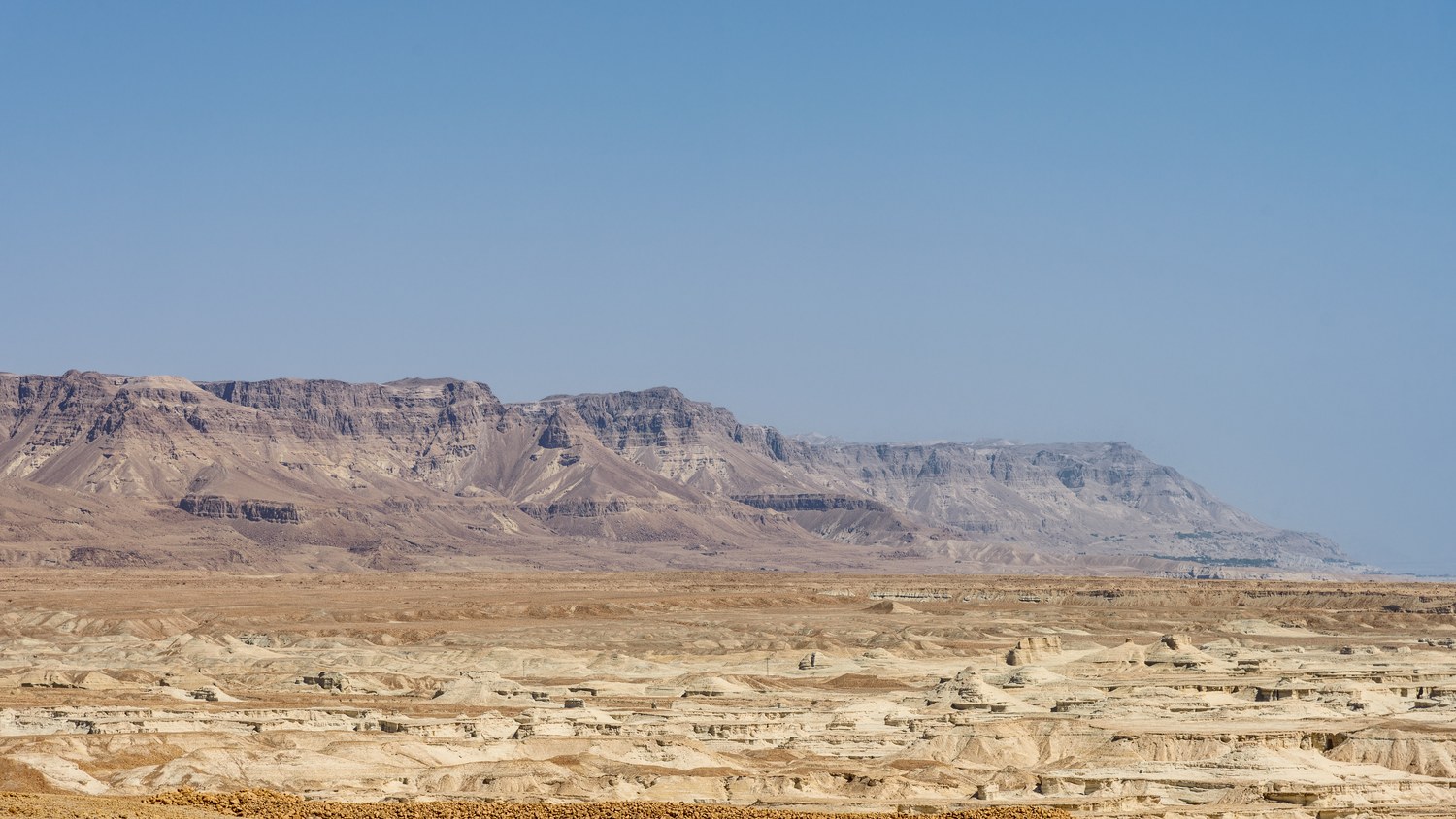
The shore the story is set beside
The Dead Sea shore, with salt crusting the rocks and the shallows. This is the region Genesis puts the cities of the plain in, and the region is not in doubt. The city is. Nothing in this photograph has been identified with Sodom, no excavated site anywhere has been settled on, and Genesis gives a region and never a location. A picture of the right area is not a picture of the place.
The Dead Sea shore, Israel. Photograph by Mustang Joe. CC0 public domain dedication. Source: Wikimedia Commons.
Read Genesis 18:16–33 and Genesis 19 in your Bible first. Count Abraham's questions and write the six numbers down in order — then look at the gaps between them, and at where he stops. In Genesis 19, find the exact wording of the warning the visitors give, and then find the verse that reports what happens after it is not followed; notice how close together the two sit. Keep what the chapter states apart from what it leaves alone: it never says why Abraham stopped at ten, and it gives the cities a region but never a location.
Original passage written for this workbook — not a quotation from Scripture.
1Stated in Genesis 18–19, or Not stated there? Tap each detail to send it left or right.💎 Uses the box aboveSort into two
◄ Stated in Genesis 18–19Not stated there ►
2Match each first detail with the detail paired with it.Match the Pairs
Fifty→
Ten→
The outcry→
Lot→
A pillar of salt→
3Fill both blanks to complete the reasoning.Build the Argument
Mount Sodom really is a ridge of salt, and pillars really do stand up there, so the landscape of Genesis 19 , which shows .
That is the whole workbook. The standardized test is optional and is scored separately.
Optional · Abraham · Genesis 18–19
Standardized Test
Reading passage · A Ridge Made Mostly of Salt · Geology and Careful Evidence · ten questions in the shapes a standardized reading test uses: main idea, detail, vocabulary in context, inference, evidence, synthesis, insert text, prose summary and fill in a table.
Optional. This section is not counted in your workbook score. It gets a report card of its own, and skipping it still leaves your workbook complete.
Original passage written for this workbook — not a quotation from Scripture.
A Ridge Made Mostly of Salt
On the southwest shore of the Dead Sea runs Mount Sodom, a ridge about eight kilometers long that is roughly four-fifths salt beneath a cap of limestone and clay. It is not a hill with salt in it; it is a body of salt squeezed slowly upward from deep underground, and it is still rising. Salt behaves unlike ordinary rock when water reaches it. It dissolves quickly, so caves open inside the ridge far faster than caves form in limestone, and the ground above them is left unsupported. One pillar on the ridge has long been nicknamed Lot's Wife. A 2009 study by the geologist Amos Frumkin found that it was not carved out by rainfall, as earlier writers had assumed, but left standing when a cave beneath it collapsed. Radiocarbon dates on wood washed into that cave put a stream running through it about four thousand years ago. None of this identifies a city or dates a story. It describes a landscape in which a standing pillar of salt is an ordinary thing to see.
1What is the passage mostly about?Main Idea
2What is Mount Sodom mostly made of?Detail
3In this passage, a “pillar” is ___.Vocabulary in Context
4What did the 2009 study find about the pillar?Detail
5You can infer from the passage that caves form in salt ___.Inference
6What evidence gave a date for water running in the cave?Evidence
7What does the passage say the geology does not do?Synthesis
8Insert Text. Look at the four squares [1]–[4] in the passage below. They mark the places this sentence could be added: “The nickname is old; the explanation is new.”
One pillar on the ridge has long been nicknamed Lot's Wife. [1] A 2009 study by the geologist Amos Frumkin found that it was not carved out by rainfall, as earlier writers had assumed, but left standing when a cave beneath it collapsed. [2] Radiocarbon dates on wood washed into that cave put a stream running through it about four thousand years ago. [3] None of this identifies a city or dates a story. [4]
Where does the sentence fit best?Insert Text
9Prose Summary.The passage describes the ridge called Mount Sodom. Six statements are listed below. Choose the THREE that best capture what the passage is saying. The other three do not belong — they are small details, or ideas the passage never puts forward. Each correct choice earns a mark of its own.Prose Summary
10Fill in a Table. Sort what this geology settles from what it leaves open. Tap each statement to send it to the left column or the right one. Three belong in each.Fill in a Table
◄ The geology shows thisThe geology cannot show this ►
Independent study guide by Lokosmos Academy. Not affiliated with or endorsed by Crossway or any Bible publisher. Contains original retelling and analysis only; no Scripture text is reproduced in full. Reference edition: keyed to the ESV® Bible — read Genesis 18–19 in your own Bible alongside this workbook; any Bible works for reading, and the vocabulary and questions follow the ESV’s wording. No ESV® text is quoted in this workbook. ESV® and the English Standard Version® are registered trademarks of Crossway.
Lokosmos Academy is an independent study resource, not affiliated with or endorsed by Crossway or any Bible publisher. This workbook is keyed to the wording of the ESV® Bible; any Bible works for reading — the vocabulary and quiz answers simply follow the ESV’s wording. These workbooks reprint no text of the ESV® Bible; every passage summary, question and example sentence is original wording. ESV® and the English Standard Version® are registered trademarks of Crossway.