Where we left offSodom is destroyed, Lot is spared, and Abraham is still waiting for the son named for the year that has now arrived.
The promised son arrives, and is named for laughter. Then Abraham is told to take him up a mountain. By the end of the book he is paying full price for a field, and being buried in it.
Why these chapters go togetherGenesis 21 to 25 is the promise finally landing and then being handed on — a son, a well, a burial plot, a wife for the son. Each is something held rather than something merely promised.
What We Will Learn
Section
What you will practice
Word Study
Words for water, worship, grief and property: well, provide, obeyed, offering, mourn, purchase, tomb
Bible Study
How a repeated line can frame a conversation, and how a place name keeps a story
Lokosmos Treasure Wisdom
The double meaning inside Beersheba, and how a land sale was actually closed at a city gate
Chapter Summary
Ch.
What happens
21
Isaac, and a Well at Beersheba — Isaac is born to Sarah exactly as promised, and Abraham circumcises him at eight days old. Hagar and Ishmael are sent away; in the wilderness God hears the boy and shows Hagar a well. Abraham and Abimelech then settle a dispute over a well and swear a pact, sealed with seven ewe lambs, and the place is called Beersheba.
22
The Mountain in Moriah — God tells Abraham to take Isaac and offer him on a mountain in Moriah. They travel three days. On the way up Isaac asks where the lamb is, and Abraham says God will provide it. At the last moment the angel of the LORD stops him, and a ram caught in a thicket is offered instead. Abraham names the place “The LORD will provide.”
23
A Grave Bought at Full Price — Sarah dies at Kiriath-arba. Abraham mourns and weeps for her, then negotiates at the city gate with Ephron the Hittite. Ephron offers the field and its cave as a gift; Abraham insists on paying, and weighs out four hundred shekels of silver. The cave of Machpelah becomes his by purchase, and he buries Sarah there.
24–25
A Wife for Isaac, and a Burial — Abraham sends his senior servant back to his own kindred to find a wife for Isaac. At a well outside the city the servant asks for a sign and Rebekah waters his camels; she agrees to go, and Isaac takes her into his mother's tent. Abraham dies at a great age, and Isaac and Ishmael together bury him beside Sarah in the cave of Machpelah.
Part 1 · Abraham · Genesis 21–25
Word Study
Study 7 key words from Genesis 21–25, then answer each question.
⛺
💎 Lokosmos Treasure Wisdom · a true fact behind the storyBeersheba Is Two Words at Once
Open your Bible atGenesis 21:28–31
Word Study · Wells and OathsGenesis 21 ends with Abraham and Abimelech swearing a deal over a well. Seven ewe lambs seal it. From then on the place is called Beersheba. That name is built from two Hebrew pieces. Be'er means a well. The root sheva carries two ideas: seven, and oath. The word for seven sits right beside the verb for swearing. So the name can be read as well of seven, or as well of the oath. The seven lambs hold both. Read verse 31 and both ideas sit in the one line. A whole scene is folded into a single name.
The word
Say it
What it means
Where it is
be'er
beh-EHR
a well
Genesis 21:30
sheva
sheh-VAH
seven; and also, an oath
Genesis 21:31
Written the way the word sounds, not in its own alphabet — this is here to let you hear it, not to teach you to spell it.
Why this helps you read the BibleGenesis often builds a place name out of what happened there. Read the name and the story comes back. The Bible remembers on purpose, and the names are part of how.
⚖ Still argued aboutWhere Moriah is. 2 Chronicles 3:1 attaches the name to the temple mount in Jerusalem; Genesis 22 gives only a three-day journey, and Samaritan tradition points to Gerizim.
🗣 Say itBeershebabeer-SHEE-buh(bir-shē-bə)Moriahmoh-RYE-uh(mə-rī-ə)Machpelahmak-PEE-luh(mak-pē-lə)EphronEE-fron(ē-frän)Rebekahruh-BEK-uh(rə-be-kə)shekelSHEK-ul(she-kəl)
welln.Gen 21:19, 30
A deep hole dug to reach water underground
“Genesis 21 has one of these opened for Hagar, and another sworn over.”
providev.Gen 22:8
To give what is needed
“Genesis 22 has Abraham use this word in answer to Isaac's question.”
obeyedv.Gen 22:18
Did what one was told to do
“Genesis 22 gives this as the reason the blessing is repeated.”
offeringn.Gen 22:13
Something given up and presented to God
“Genesis 22 says the ram took Isaac's place on the altar.”
mournv.Gen 23:2
To grieve, especially over a death
“Genesis 23 opens with Abraham doing this for his wife.”
purchasen.Gen 23:18
Something bought for an agreed price
“Genesis 23 makes the field and its cave Abraham's, bought and paid for.”
tombn.Gen 23:6
A place where a dead body is buried
“Genesis 23 has the Hittites offer Abraham the best of these.”
ⓘ The vocabulary words in this list are selected to help you understand and complete this workbook. Some may not appear word-for-word in your Bible. The example sentences are our own wording, written to make the verse clearer — they are not quotations from it. Read each verse in your own Bible.
1Beersheba is built from two Hebrew pieces. What does the second piece mean?💎 Uses the box aboveGen 21:31
2In Genesis 22, Genesis 22 has Abraham use this word in answer to Isaac's question.Gen 22:8
3Fill in each blank with the correct word.Gen 22:13–18
Word choices:offeringobeyedmournpurchase- some words will not be used
The ram is presented to God as an . Gen 22:13
Abraham is blessed because he the LORD's voice. Gen 22:18
4To grieve, especially over a death, is to ___.Gen 23:2
5A ‘purchase’ is something bought for an agreed price.Gen 23:18
6In Genesis 23, Abraham accepts the cave as a free gift from Ephron.Gen 23:12–16
7Fill in each blank with the correct word.Gen 21–23
Word choices:tombwellprovidemourn- some words will not be used
A place where a dead body is buried is a . Gen 23:6
A deep hole dug down to water is a . Gen 21:19, 30
Part 2 · Abraham · Genesis 21–25
Understanding
Show you understood what happens in Genesis 21–25.
🧠
💎 Lokosmos Treasure Wisdom · a true fact behind the storyThe Shortest Conversation in the Book
Open your Bible atGenesis 22:6, 22:7–8
Close Reading · A Line That Frames a SceneWalking up the mountain, Isaac asks where the lamb is. Abraham says God will provide it. That is the whole conversation. Genesis describes no face. It reports no feeling. But it does give one line twice. The line closes verse 6, and it closes verse 8 again: the two of them went on together. A sentence repeated at both ends of a conversation frames it, the way a border frames a picture. Slow down at the shortest lines in a passage. A writer who holds back every feeling is trusting plain words to carry the weight.
Why this helps you read the BibleRead what is repeated around a conversation, not only what is said inside it. Scripture carries meaning in its shape. It does not carry it in the words alone.
One line, said twice, with the question inside it
Diagram of a repeated line · the sentence at top and bottom closes both Genesis 22:6 and 22:8, and the words between are the only speech in the scene. Calling it a frame is a way of describing that shape; Genesis does not comment on it, and neither does the drawing.
Verses: Genesis 22:6–8. Drawn for Lokosmos Academy.
1How does Genesis 21 open?Gen 21:1–2
2One short line closes verse 6, and then closes verse 8 again. What does it say?💎 Uses the box aboveGen 22:6–8
3What does Abraham find once the angel stops him?Gen 22:13
4What does Abraham insist on when Ephron offers him the cave?Gen 23:12–16
5Write the numbers 1–5 in the boxes to show the correct order across Genesis 21–25. Number 1 = what happens first.Gen 21–25
An angel stops Abraham, and a ram is offered instead.
A servant meets Rebekah at a well and brings her back.
Isaac is born, and a pact is sworn at Beersheba.
Abraham dies, and Isaac and Ishmael bury him.
Sarah dies, and Abraham buys the cave of Machpelah.
6God hears Ishmael in the wilderness and shows Hagar a well.Gen 21:17–19
7Isaac and Ishmael bury Abraham together.Gen 25:9
Part 3 · Abraham · Genesis 21–25
Literary Craft
Understanding HOW and WHY the story is told across Genesis 21–25.
📖
💎 Lokosmos Treasure Wisdom · a true fact behind the storyA Place Left Holding What Happened
Open your Bible atGenesis 22:14, then Genesis 21:31
Literary Craft · Place NamingOnce the ram is caught in the thicket, Abraham gives the place a name. It means the LORD will provide. Genesis does this again and again. A place is left holding the name of the thing that happened on it. So the name itself keeps telling the story. Beersheba works the same way, one chapter earlier. A place name is a marker that outlives everybody who saw the event. It travels, too. Anyone who says the name repeats the story without meaning to. Watch where a text stops to name something. That shows you what it wants remembered.
Why this helps you read the BibleA name on a map can be a story someone left behind. Ask what a place name is remembering. Scripture keeps its own record this way, long after the people are gone.
Dialogue
A spoken exchange that carries something important. Isaac's question and Abraham's answer are the only words spoken on the mountain, and they hold the whole scene.
Place naming
A place given a name that records what happened there. Abraham names the mountain “The LORD will provide.”
Courteous bargaining
A polite exchange in which an offer is made and declined as a formality before a real price is agreed. Ephron offers the cave as a gift; Abraham insists on paying.
1What is dialogue, as a literary term?Gen 22
2Fill in each blank with the correct word.Gen 22–23
Word choices:dialoguenamingbargainingoffering- some words will not be used
A spoken exchange between characters is .
Giving a place a name that records an event is place .
3What does place naming do in a passage like Genesis 22?💎 Uses the box aboveGen 22:14
4Abraham names the mountain in Moriah after himself.Gen 22:14
5In courteous bargaining, the first offer made is always the one finally accepted.Gen 23
6Fill in each blank with the correct word.Gen 23
Word choices:bargainingdialoguenamingpurchase- some words will not be used
A polite exchange before a price is settled is courteous .
What Abraham insists the cave must be is a . Gen 23:18
7One short line appears just before and just after the exchange on the mountain. What does it do?Gen 22:6–8
Part 4 · Abraham · Genesis 21–25
Wisdom
Three deeper challenges — no single-word recall. Read, weigh the evidence, and reason it out.
⚖
💎 Lokosmos Treasure Wisdom · a true fact behind the storyThe Gate Was the Courthouse
Open your Bible atGenesis 23:10, then Genesis 23:16
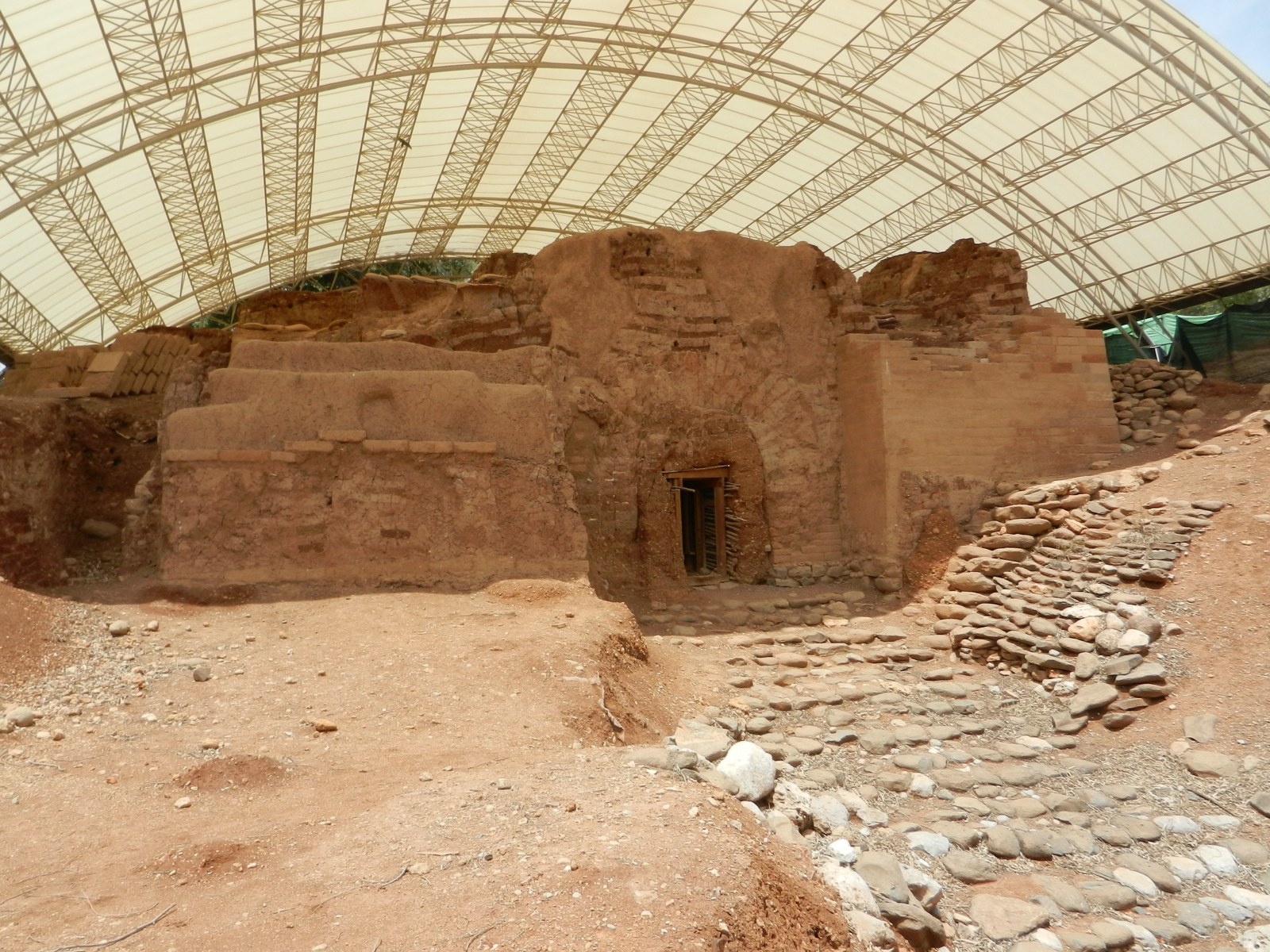
Ancient Law · Business at the City GateAbraham buys the cave at the city gate, in front of everyone going in and out. That is where business was done. Gateways dug at Megiddo, Gezer, Lachish and Tel Dan have stone seats built into their walls. Elders are thought to have sat there through the day. Ruth records a field changing hands in exactly such a place, before ten witnesses. Then one small phrase tells you what money was. Silver is weighed here, not counted. In this world a shekel is a weight, not a coin. Struck coins are not invented anywhere until long after. So the sale closes on a balance.
Why this helps you read the BibleA deal in public had witnesses. Genesis 23 reports the gate and never says why it mattered. Knowing the custom helps you picture what a crowd at a gate meant for a sale.
A city gate somebody could actually walk through
The Middle Bronze Age mudbrick gate at Tel Dan, in northern Israel, with its stone approach ramp; the pale roof above it is a modern shelter put there to keep the rain off. A gate like this is the setting Genesis 23 describes — the place everyone passed through, which is exactly why a sale closed there had witnesses. This gate is not the one in Genesis, it is not at Hebron, and no bench is visible in this view.
The Canaanite gate at Tel Dan, Israel. CC0 public domain dedication. Source: Wikimedia Commons, File:Tel Dan Canaanite Gate.JPG.
Read Genesis 21–25 in your Bible first. Start with the well dispute and the pact at Beersheba, and notice what the seven lambs are for. Then read Genesis 22 slowly. Find the short exchange on the way up, and then find the line that closes verse 6 and the line that closes verse 8 — read them one after the other and see what they do to the conversation between them. In Genesis 23, follow the negotiation at the gate closely: what Ephron offers first, and what Abraham insists on instead, and why a public place matters for a sale.
Original passage written for this workbook — not a quotation from Scripture.
1Stated in Genesis 21–25, or Not stated there? Tap each detail to send it left or right.Sort into two
◄ Stated in Genesis 21–25Not stated there ►
2Match each first detail with the detail paired with it.Match the Pairs
Beersheba→
The ram→
Machpelah→
Rebekah→
Isaac and Ishmael→
3Fill both blanks to complete the reasoning.💎 Uses the box aboveBuild the Argument
Excavated gates carry stone benches and Ruth shows a land deal closed at one, so Genesis 23's setting , which shows .
That is the whole workbook. The standardized test is optional and is scored separately.
Optional · Abraham · Genesis 21–25
Standardized Test
Reading passage · A Deal Closed Where Everyone Could See · Ancient Law and Careful Evidence · ten questions in the shapes a standardized reading test uses: main idea, detail, vocabulary in context, inference, evidence, synthesis, insert text, prose summary and fill in a table.
Optional. This section is not counted in your workbook score. It gets a report card of its own, and skipping it still leaves your workbook complete.
Original passage written for this workbook — not a quotation from Scripture.
A Deal Closed Where Everyone Could See
Long before deeds and registries as we know them, a land sale in the ancient Near East was often settled in the most public place a town had: the gate. Excavators have found stone benches built into the gateways of several cities, among them Tel Dan, Megiddo, Gezer and Lachish — seats where the elders are thought to have sat through the day's business. A sale agreed there came with witnesses already in place, people who could later say what had been agreed. The Bible preserves a second example of the same custom: in the book of Ruth, Boaz settles his purchase of a field at the gate in front of ten witnesses. There is a polite pattern to these exchanges too. A seller may first offer the property as a gift, and the buyer declines before a real price is named. One set of benches and one other account cannot show how every sale everywhere was closed. Together they do show that a public place, and people watching, were what made an agreement hold.
1What is the passage mostly about?Main Idea
2What have excavators found built into several city gateways?Detail
3In this passage, a “purchase” is ___.Vocabulary in Context
4Which other biblical example does the passage give?Detail
5You can infer that a sale made at the gate was hard to dispute because ___.Inference
6Which detail best supports the idea that the gate was used for business?Evidence
7What does the passage say its evidence cannot show?Synthesis
8Insert Text. Look at the four squares [1]–[4] in the passage below. They mark the places this sentence could be added: “The refusal is part of the ceremony, not a real refusal.”
There is a polite pattern to these exchanges too. [1] A seller may first offer the property as a gift, and the buyer declines before a real price is named. [2] One set of benches and one other account cannot show how every sale everywhere was closed. [3] Together they do show that a public place, and people watching, were what made an agreement hold. [4]
Where does the sentence fit best?Insert Text
9Prose Summary.The passage explains where and how a land sale was closed. Six statements are listed below. Choose the THREE that best capture what the passage is saying. The other three do not belong — they are small details, or ideas the passage never puts forward. Each correct choice earns a mark of its own.Prose Summary
10Fill in a Table. Sort what this evidence settles from what it leaves open. Tap each statement to send it to the left column or the right one. Three belong in each.Fill in a Table
◄ The evidence shows thisThe evidence cannot show this ►
Independent study guide by Lokosmos Academy. Not affiliated with or endorsed by Crossway or any Bible publisher. Contains original retelling and analysis only; no Scripture text is reproduced in full. Reference edition: keyed to the ESV® Bible — read Genesis 21–25 in your own Bible alongside this workbook; any Bible works for reading, and the vocabulary and questions follow the ESV’s wording. No ESV® text is quoted in this workbook. ESV® and the English Standard Version® are registered trademarks of Crossway.
Lokosmos Academy is an independent study resource, not affiliated with or endorsed by Crossway or any Bible publisher. This workbook is keyed to the wording of the ESV® Bible; any Bible works for reading — the vocabulary and quiz answers simply follow the ESV’s wording. These workbooks reprint no text of the ESV® Bible; every passage summary, question and example sentence is original wording. ESV® and the English Standard Version® are registered trademarks of Crossway.