Where we left offJoseph has been sold to a caravan going down to Egypt, and his father believes he is dead.
Joseph does well, and is put in charge. Then he is accused of something he did not do, and put in prison. He does well there too. Then the one man who could speak for him forgets.
Why these chapters go togetherGenesis 39 and 40 run the same shape twice: Joseph is trusted, Joseph loses everything, Joseph is trusted again. Reading them together is how you see the pattern.
What We Will Learn
Section
What you will practice
Word Study
Words for service, accusation and dreams: refused, prison, charge, interpret, cupbearer, baker, forgot
Bible Study
How to find a repeated pattern that runs across two chapters
Lokosmos Treasure Wisdom
What an Egyptian household was like, and what a cupbearer actually did
Chapter Summary
Ch.
What happens
39
Trusted, Accused, Imprisoned — Joseph is bought by Potiphar, an officer of Pharaoh, and does so well that everything is put in his charge. Potiphar's wife tries to make him sin and he refuses. She keeps his garment and accuses him, and Joseph is put into the prison where the king's prisoners are kept. There the keeper puts everything in his charge as well.
40
Two Dreams and One Forgotten Man — Pharaoh's cupbearer and baker are put in the same prison, and each dreams a dream on the same night. Joseph asks why they look troubled and says that interpretations belong to God. He tells the cupbearer he will be restored in three days, and the baker that he will not. It happens as he said, and he asks the cupbearer to remember him. The cupbearer forgets.
Part 1 · Joseph · Genesis 39–40
Word Study
Study 7 key words from Genesis 39–40, then answer each question.
🍷
💎 Lokosmos Treasure Wisdom · a true fact behind the storyThe Cupbearer Was Not a Waiter
Open your Bible atGenesis 40:1, then Genesis 40:13
Word Study · A Job at CourtThe word cupbearer sounds like a servant who carries drinks. The job was much bigger. A cupbearer handed the king his cup. That meant he stood close to the king every day. It also meant the king had to trust him. Records from Egypt and from Mesopotamia list cupbearers among officials. Some of them carried messages. Some of them held real power at court. So when Joseph asks this man to remember him, he is not asking a kitchen servant. He is asking a man who will soon stand beside Pharaoh. That is why the forgetting matters.
Why this helps you read the BibleA title in the Bible carries the weight it had in its own world. Learn what the job was, and you can see how much Joseph lost when this man forgot him. Reading that way keeps you from making a moment smaller than the Bible means it to be.
⚖ Still argued aboutWhich pharaoh Joseph served. Genesis never names him, and the datings proposed for the story spread across several centuries.
🗣 Say itPotipharPOT-ih-far(pä-ti-fär)cupbearerKUP-bair-er(kəp-ber-ər)PharaohFAIR-oh(fer-ō)EgyptEE-jipt(ē-jipt)JosephJOH-zef(jō-zəf)CanaanKAY-nun(kā-nən)
refusedv.Gen 39:8
Said no to something
“Genesis 39 says Joseph said no, and gives his reason in his own words.”
chargen.Gen 39:4
Care and responsibility for something
“Genesis 39 says Potiphar handed the whole household over to Joseph.”
prisonn.Gen 39:20
A place where people are kept locked up
“Genesis 39 has Joseph shut up where the king's prisoners were held.”
interpretv.Gen 40:8
To explain what something means
“Genesis 40 has Joseph use this word, and credit God before he hears a thing.”
cupbearern.Gen 40:1
A trusted official who served the king his cup
“Genesis 40 puts a man with this job in the same prison.”
bakern.Gen 40:1
Someone who bakes bread
“Genesis 40 puts a man with this job there too.”
forgotv.Gen 40:23
Did not remember
“Genesis 40 ends by saying the cupbearer let Joseph slip his mind.”
ⓘ The vocabulary words in this list are selected to help you understand and complete this workbook. Some may not appear word-for-word in your Bible. The example sentences are our own wording, written to make the verse clearer — they are not quotations from it. Read each verse in your own Bible.
1To explain what something means is to ___ it.Gen 40:8
2To have ‘refused’ is to have said no to something.Gen 39:8
3Fill in each blank with the correct word.Gen 39:4, 20
Word choices:chargeprisonbakerforgot- some words will not be used
Potiphar put everything he had in Joseph's . Gen 39:4
Joseph was put into the where the king's prisoners were kept. Gen 39:20
4Genesis calls one of the two men a cupbearer. What kind of job was that?💎 Uses the box aboveGen 40:1
5To have ‘forgot’ someone is to have remembered them well.Gen 40:23
6A ‘baker’ is someone who bakes bread.Gen 40:1
7Fill in each blank with the correct word.Gen 40:1, 23
Word choices:cupbearerforgotrefusedinterpret- some words will not be used
Pharaoh's is put into the same prison. Gen 40:1
He did not remember Joseph, but him. Gen 40:23
Part 2 · Joseph · Genesis 39–40
Understanding
Show you understood what happens in Genesis 39–40.
🧠
💎 Lokosmos Treasure Wisdom · a true fact behind the storyThe Same Three Steps, Twice Over
Open your Bible atGenesis 39:4–6, 39:20–23, then 40:5–23
Close Reading · A Pattern Across Two ChaptersRead the two chapters with three columns. In Potiphar's house Joseph is trusted with everything, then accused, then trusted again by the keeper of the prison. In the prison he is trusted with two dreams, then proved right, then forgotten. Both rows begin well. Both rows end with him exactly where he started. A pattern that runs across two chapters is easy to miss, because you meet the steps a long way apart. Lining them up is what makes it visible, and it changes how the ending of chapter 40 reads.
Why this helps you read the BibleSome patterns in the Bible are too long to notice in one sitting. Writing the steps down is how you find them. The Bible often teaches through a shape it repeats, so the reader who finds the shape hears more of what is being said.
The same three steps, run twice
Diagram of two stated sequences · every step in both rows is reported in Genesis 39 or 40. Laying the two out in the same three columns is a way of reading them together. Genesis does not number the steps or say the two chapters share a shape.
Verses: Genesis 39:4–6, 39:20–23, 40:5–23. Drawn for Lokosmos Academy.
1What does Potiphar put in Joseph's charge?Gen 39:4–6
2What is kept and used to accuse Joseph?Gen 39:12–18
3What happens to Joseph inside the prison?Gen 39:22
4What does Joseph say about interpretations?Gen 40:8
5Write the numbers 1–5 in the boxes to show the correct order across Genesis 39–40. Number 1 = what happens first.💎 Uses the box aboveGen 39–40
Joseph is accused, and put into the prison.
The cupbearer is restored, and forgets Joseph.
Potiphar puts everything he has in Joseph's charge.
The keeper of the prison puts Joseph in charge.
Two prisoners dream on the same night.
6The cupbearer and the baker dream on the same night.Gen 40:5
7The cupbearer speaks to Pharaoh about Joseph as soon as he is restored.Gen 40:23
Part 3 · Joseph · Genesis 39–40
Literary Craft
Understanding HOW and WHY the story is told across Genesis 39–40.
📖
💎 Lokosmos Treasure Wisdom · a true fact behind the storyThe Verse That Ends on the Wrong Word
Open your Bible atGenesis 40:23
Literary Craft · Where a Chapter StopsLook at the last verse of Genesis 40. Notice where the chapter chooses to stop. Everything Joseph said came true. The cupbearer is back at court, just as promised. Then the chapter tells you one more thing. He did not remember Joseph. He forgot him. And there the chapter ends. Chapters do not end by accident. A writer decides where to stop, and this writer stops on the forgetting. That leaves you holding it through everything that comes next. So watch the last verse of any chapter. It is a choice somebody made.
Why this helps you read the BibleA chapter ends where the writer chose to end it. Read that last line on purpose. It shows you what the writer wants you to carry to the next page. That is part of hearing what the passage is saying.
Pattern across chapters
The same shape of events happening more than once, far enough apart that a reader must look for it. Joseph is trusted, loses it, and is trusted again, twice.
Where a chapter stops
The last line is a choice. Genesis 40 could have ended with the cupbearer restored, and ends with him forgetting instead.
Delayed fulfilment
Something promised or dreamed that does not happen for a long time. Joseph asks to be remembered, and nothing comes of it for two full years.
1Genesis 40 could end with the cupbearer restored. It ends with him forgetting. Why does that matter?💎 Uses the box aboveGen 40:23
2Fill in each blank with the correct word.Gen 39–40
Word choices:patternfulfilmentchargeprison- some words will not be used
The same shape happening twice is a .
Something promised that takes a long time is delayed .
3What makes the pattern in these two chapters hard to notice?Gen 39–40
4Joseph is trusted with everything twice in these two chapters.Gen 39:4, 22
5Delayed fulfilment means a promise that never comes true at all.Gen 40:14–23
6Fill in each blank with the correct word.Gen 40:23
Word choices:forgotpatternfulfilmentinterpret- some words will not be used
The last verse says the cupbearer him. Gen 40:23
A shape repeated across chapters is a .
7Both rows of the pattern end the same way. How?Gen 39:20; 40:23
Part 4 · Joseph · Genesis 39–40
Wisdom
Three deeper challenges — no single-word recall. Read, weigh the evidence, and reason it out.
🏭
💎 Lokosmos Treasure Wisdom · a true fact behind the storyInside a Great Egyptian House
Open your Bible atGenesis 39:4–6
Daily Life · Egyptian HouseholdsGenesis says Potiphar put everything he had into Joseph's hand. That is a real arrangement, not a story shortcut. Egyptian tomb paintings show how a great house ran. One trusted man kept the accounts. He ran the store rooms. He managed the other workers. Scribes wrote down what came in and what went out. So the job needed a man whose numbers could be checked and still come out clean. A steward held a real place, with real power. An Egyptian reading Genesis 39 would have known this house at once. It is a picture drawn from somewhere real.
Why this helps you read the BibleThe detail fits the place the story is set in. That is worth knowing, and it is all it shows. It does not date the story. It does not name the household. Seeing where the evidence stops is how you read the Bible carefully.
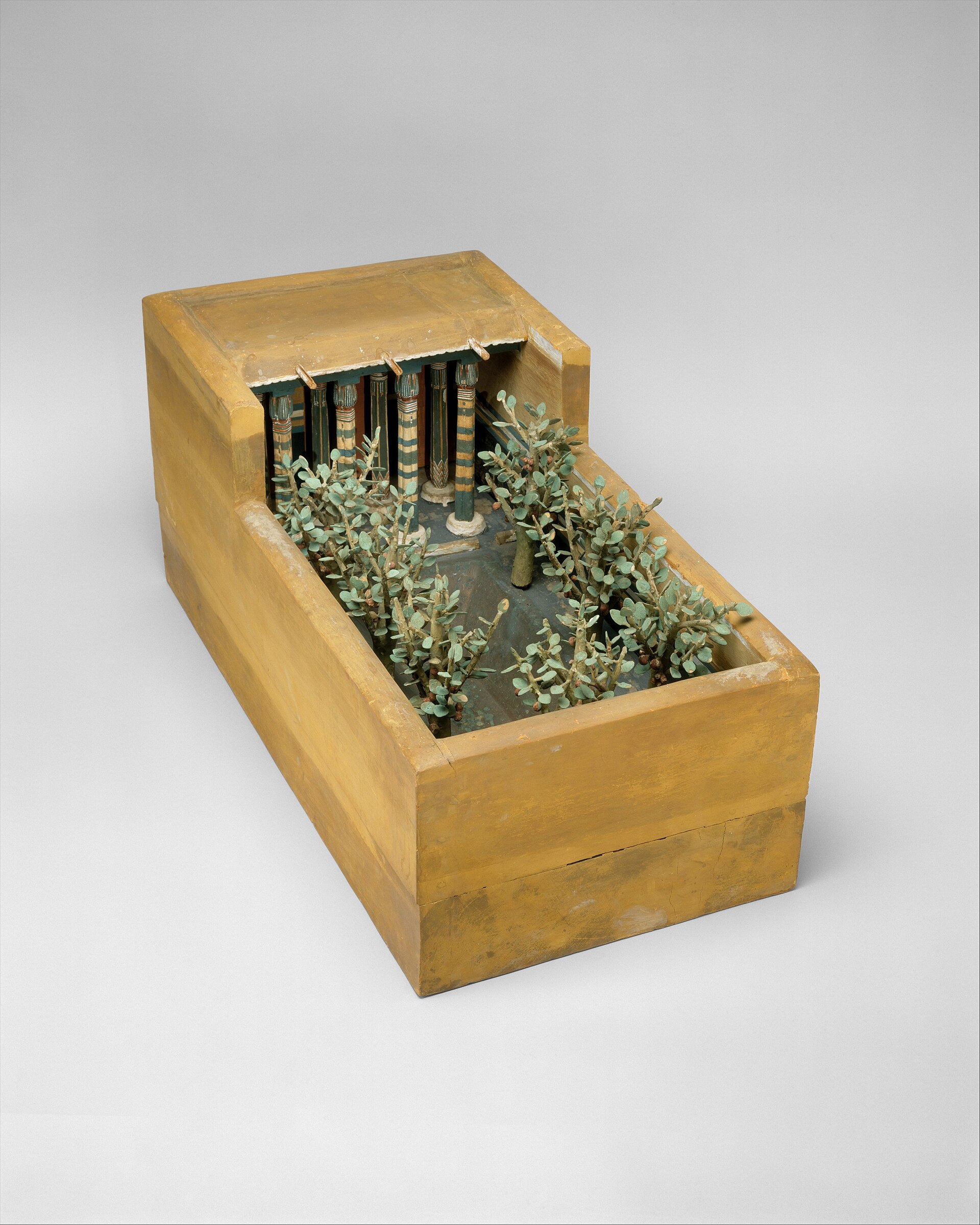
The kind of house that needed a steward
A painted wooden model of the porch and garden of a great Egyptian house, made to be placed in a tomb. The columns, the row of fig trees and the lined pool all belong to one wealthy household. A house on this scale is the kind that ran on a steward, which is the arrangement Genesis 39 describes. The model is not Potiphar's house, and it was made for a burial rather than built to live in.
Model of a Porch and Garden, from the tomb of Meketre, Egypt, Middle Kingdom. The Metropolitan Museum of Art, 20.3.13. Source: Wikimedia Commons, File:Model of a Porch and Garden MET DT202827.jpg. CC0 public domain dedication.
Read Genesis 39 and 40 in your Bible. Draw three columns on a page and head them trusted, lost, and trusted again. Fill the columns in from chapter 39, then do it again from chapter 40 underneath. Look at what the second row ends with. Then read Genesis 40:23 on its own, out loud, and ask why the chapter stops there. Keep what the chapters state apart from what you might add: Genesis never says why the cupbearer forgot.
Original passage written for this workbook — not a quotation from Scripture.
1Stated in Genesis 39–40, or Not stated there? Tap each detail to send it left or right.Sort into two
◄ Stated in Genesis 39–40Not stated there ►
2Match each first detail with the detail paired with it.Match the Pairs
Potiphar→
The garment→
The prison keeper→
The cupbearer→
The baker→
3Fill both blanks to complete the reasoning.💎 Uses the box aboveBuild the Argument
Egyptian records show large households run by a single trusted steward who kept the accounts, so Genesis putting everything in Joseph's charge , which shows .
That is the whole workbook. The standardized test is optional and is scored separately.
Optional · Joseph · Genesis 39–40
Standardized Test
Reading passage · Standing Next to the King · Ancient Court Life and Careful Evidence · ten questions in the shapes a standardized reading test uses: main idea, detail, vocabulary in context, inference, evidence, synthesis, insert text, prose summary and fill in a table.
Optional. This section is not counted in your workbook score. It gets a report card of its own, and skipping it still leaves your workbook complete.
Original passage written for this workbook — not a quotation from Scripture.
Standing Next to the King
A modern reader hears cupbearer and pictures a waiter. Ancient records point somewhere else. In Egypt and in Mesopotamia, the men who handed a ruler his cup appear in lists of officials, not in lists of kitchen staff. Some carried messages for the king. Some were given land of their own. A few turn up later holding senior posts at court. The reason is not hard to see: anyone who hands a king his drink stands near him every day, so the post went only to a man the king could leave in charge of something that mattered. Being close to power was itself a kind of power. What the records cannot do is tell us what any single cupbearer did on any single day. They tell us what the job was, and that is enough to change how a story sounds when one walks into it.
1What is the passage mostly about?Main Idea
2Where do cupbearers appear in ancient records?Detail
3In this passage, to leave a man in “charge” of something means to ___.Vocabulary in Context
4What did some cupbearers do besides handing the cup?Detail
5You can infer that the post was given only to ___.Inference
6Which detail best shows a cupbearer could be powerful?Evidence
7What does the passage say the records cannot do?Synthesis
8Insert Text. Look at the four squares [1]–[4] in the passage below. They mark the places this sentence could be added: “Their work did not stop at the cup.”
In Egypt and in Mesopotamia, the men who handed a ruler his cup appear in lists of officials, not in lists of kitchen staff. [1] Some carried messages for the king. [2] Some were given land of their own. [3] A few turn up later holding senior posts at court. [4]
Where does the sentence fit best?Insert Text
9Prose Summary.The passage explains what a cupbearer's job really was. Six statements are listed below. Choose the THREE that best capture what the passage is saying. The other three do not belong — they are small details, or ideas the passage never puts forward. Each correct choice earns a mark of its own.Prose Summary
10Fill in a Table. Sort what these records can settle from what they cannot. Tap each statement to send it to the left column or the right one. Three belong in each.Fill in a Table
◄ The records show thisThe records cannot show this ►
Independent study guide by Lokosmos Academy. Not affiliated with or endorsed by Crossway or any Bible publisher. Contains original retelling and analysis only; no Scripture text is reproduced in full. Reference edition: keyed to the ESV® Bible — read Genesis 39–40 in your own Bible alongside this workbook; any Bible works for reading, and the vocabulary and questions follow the ESV’s wording. No ESV® text is quoted in this workbook. ESV® and the English Standard Version® are registered trademarks of Crossway.
Lokosmos Academy is an independent study resource, not affiliated with or endorsed by Crossway or any Bible publisher. This workbook is keyed to the wording of the ESV® Bible; any Bible works for reading — the vocabulary and quiz answers simply follow the ESV’s wording. These workbooks reprint no text of the ESV® Bible; every passage summary, question and example sentence is original wording. ESV® and the English Standard Version® are registered trademarks of Crossway.