Where we left offTwo years have passed since the cupbearer walked out of prison and forgot the man who had explained his dream.
Pharaoh dreams twice and nobody can explain it. Joseph can. He is raised over all Egypt, and stores grain for seven years. Then the famine reaches Canaan, and his brothers come down to buy food.
Why these chapters go togetherGenesis 41 puts Joseph in charge of the food. Genesis 42 brings the hungry to the man in charge of it. Read apart, they are two stories. Read together, the second is the first one paying out.
What We Will Learn
Section
What you will practice
Word Study
Words for feast, famine and office: plenty, famine, store, signet, grain, spies, bowed
Bible Study
How a story can pay off a scene set two chapters earlier
Lokosmos Treasure Wisdom
What a signet ring did, and how Egypt actually stored grain
Chapter Summary
Ch.
What happens
41
Two Dreams and a New Name — Pharaoh dreams of seven fat cows eaten by seven thin ones, and then of seven good ears of grain swallowed by seven thin ones. His magicians cannot explain it. The cupbearer finally remembers Joseph. Joseph says that God will give Pharaoh an answer, and tells him the dreams mean seven years of plenty followed by seven years of famine. Pharaoh sets him over all Egypt, gives him his signet ring, and Joseph stores grain until it cannot be measured.
42
Ten Brothers Bow — The famine reaches Canaan, and Jacob sends ten sons to Egypt to buy grain. They bow before the governor and do not know him. Joseph knows them. He calls them spies, keeps Simeon, and sends the rest home with their silver returned in their sacks. He tells them not to come back without their youngest brother.
Part 1 · Joseph · Genesis 41–42
Word Study
Study 7 key words from Genesis 41–42, then answer each question.
💎
💎 Lokosmos Treasure Wisdom · a true fact behind the storyThe Ring That Signed for the King
Open your Bible atGenesis 41:42
Word Study · Seals and OfficePharaoh takes his signet ring off and puts it on Joseph. That is not a present. A signet ring carried a carved mark. Pressed into wet clay or soft wax, it left that mark behind. The mark stood for the man who owned the ring. So whoever wore it could seal an order, and the order counted as the king's own. Thousands of Egyptian and Mesopotamian seals have been dug up, along with the clay lumps they were pressed into. Handing the ring over is handing over the right to speak for Pharaoh. It is the whole promotion in one small object.
Why this helps you read the BibleThe Bible often shows power by showing an object. Learn what the object did, and the verse stops being decoration. Genesis 41:42 is not describing jewelry. It is telling you exactly how much Joseph was just given.
⚖ Still argued aboutWhether any surviving Egyptian record mentions this famine. Several texts describe hard years and low floods, and none of them names Joseph or lines up with these seven.
🗣 Say itZaphenath-paneahZAF-uh-nath puh-NEE-uh(za-fə-nath-pə-nē-ə)AsenathASS-uh-nath(a-sə-nath)signetSIG-net(sig-nət)Manassehmuh-NASS-uh(mə-na-sə)EphraimEE-fray-im(ē-frā-im)SimeonSIM-ee-un(si-mē-ən)
plentyn.Gen 41:29
A time when there is more than enough
“Genesis 41 uses this word for the seven good years ahead.”
faminen.Gen 41:30
A time when there is very little food
“Genesis 41 says seven years of this follow the good ones.”
storev.Gen 41:35
To keep something safe for later
“Genesis 41 has Joseph advise doing this with the food of the good years.”
signetn.Gen 41:42
A ring with a carved mark used to seal orders
“Genesis 41 has Pharaoh hand one of these straight to Joseph.”
grainn.Gen 41:49
The seed of plants like wheat, used for food
“Genesis 41 says so much of this was gathered that counting stopped.”
bowedv.Gen 42:6
Bent low to show respect
“Genesis 42 has the brothers do this in front of a man they do not know.”
spiesn.Gen 42:9
People sent secretly to learn about a land
“Genesis 42 has Joseph accuse his brothers of being these.”
ⓘ The vocabulary words in this list are selected to help you understand and complete this workbook. Some may not appear word-for-word in your Bible. The example sentences are our own wording, written to make the verse clearer — they are not quotations from it. Read each verse in your own Bible.
1A time when there is very little food is a ___.Gen 41:30
2To ‘store’ something is to keep it safe for later.Gen 41:35
3Fill in each blank with the correct word.Gen 41:29, 42:6
Word choices:plentybowedspiessignet- some words will not be used
Seven years of great are coming through all the land. Gen 41:29
His brothers came and low in front of him, faces down. Gen 42:6
4What is a ‘signet’?💎 Uses the box aboveGen 41:42
5‘Spies’ are people sent openly to trade in a land.Gen 42:9
6‘Grain’ is the seed of plants like wheat, used for food.Gen 41:49
7Fill in each blank with the correct word.Gen 41:35, 41:49
Word choices:storegrainfaminebowed- some words will not be used
Joseph tells Pharaoh to up food in the cities. Gen 41:35
He gathered past the point of counting it. Gen 41:49
Part 2 · Joseph · Genesis 41–42
Understanding
Show you understood what happens in Genesis 41–42.
🧠
💎 Lokosmos Treasure Wisdom · a true fact behind the storyChapter 41 Loads It, Chapter 42 Fires It
Open your Bible atGenesis 41:41, 41:57, then 42:1–6
Close Reading · Setup and PayoffRead Genesis 41 asking what it puts in place. Joseph is set over Egypt. Grain is stored for seven years. The famine spreads to every land. Now read Genesis 42. Jacob hears there is grain in Egypt. He sends his sons down to buy some. They bow to the governor without knowing who he is. Each of those events needs one from the chapter before it. That is called setup and payoff, and a reader who watches for it stops being surprised by the wrong things. Ask what a chapter is loading before you ask what it means.
Why this helps you read the BibleThe Bible builds across chapters, not just inside them. Watching what a chapter puts in place shows you why the next one happens the way it does. That is a large part of reading a book as a book.
What Genesis 41 sets up, Genesis 42 collects
Diagram of stated events · each box quotes the verse it comes from. The pairing across the middle is a way of reading the two chapters together. Genesis does not draw the lines or say the chapters are built this way.
1What does Pharaoh see in his first dream?Gen 41:1–4
2Who finally remembers Joseph?Gen 41:9
3What does Joseph say when Pharaoh asks him to interpret?Gen 41:16
4What does Pharaoh give Joseph along with the signet ring?Gen 41:42
5Write the numbers 1–5 in the boxes to show the correct order across Genesis 41–42. Number 1 = what happens first.💎 Uses the box aboveGen 41–42
The cupbearer finally remembers Joseph.
Pharaoh dreams two dreams in one night.
Ten brothers bow before the governor of Egypt.
The famine spreads beyond Egypt to other lands.
Joseph is set over Egypt and stores grain.
6Joseph keeps Simeon in Egypt when he sends the others home.Gen 42:24
7The brothers recognize Joseph when they bow before him.Gen 42:8
Part 3 · Joseph · Genesis 41–42
Literary Craft
Understanding HOW and WHY the story is told across Genesis 41–42.
📖
💎 Lokosmos Treasure Wisdom · a true fact behind the storyWhen a Dream Comes Twice
Open your Bible atGenesis 41:32, then 37:5–9
Literary Craft · DoublingPharaoh dreams two dreams in one night. Cows in the first. Ears of grain in the second. Two pictures, one meaning. Joseph says the doubling is itself part of the message: the thing is fixed, and it will happen soon. Now look back at Genesis 37. Joseph also dreamed twice, sheaves and then stars, and the second said what the first said. Both pairs work the same way. A story that repeats a thing is not running out of ideas. When this story says a thing twice, it is telling you the thing is settled.
Why this helps you read the BibleRepetition in the Bible is a signal, not a stumble. When you see something said twice, ask what the second one adds. Genesis 41:32 answers that question out loud. It teaches you what to listen for everywhere else.
Dreams come in pairs in this story
Diagram of stated dreams · all four are reported in Genesis 37 and 41, with the verses given. Genesis 41:32 does say the doubling means something. It does not pair Joseph's dreams with Pharaoh's; that is our arrangement.
The same meaning told twice in different pictures. Pharaoh dreams of cows and then of ears of grain, and Genesis 41:32 says the repeat is part of the message.
Setup and payoff
Something put in place early that a later scene needs. Genesis 41 stores the grain; Genesis 42 brings the hungry to it.
Dramatic irony
When the reader knows something a character does not. We know who the governor is. The ten men bowing do not.
1Genesis 41:32 says Pharaoh's dream came twice for a reason. What reason?💎 Uses the box aboveGen 41:32
2Fill in each blank with the correct word.Gen 41–42
Word choices:doublingpayoffsignetirony- some words will not be used
The same meaning told twice in different pictures is .
A scene that collects what an earlier one set up is a .
3Why does the reader feel the weight of Genesis 42:6 more than the brothers do?Gen 42:6–8
4Joseph's two dreams in Genesis 37 also said one thing twice.Gen 37:7, 37:9
5Setup and payoff means an event that is never mentioned again.Gen 41–42
6Fill in each blank with the correct word.Gen 42:8
Word choices:ironydoublingpayofffamine- some words will not be used
When the reader knows what a character does not, that is dramatic .
One meaning told twice in two pictures is .
7What does Genesis 41 put in place that Genesis 42 needs?Gen 41:41, 41:48–49
Part 4 · Joseph · Genesis 41–42
Wisdom
Three deeper challenges — no single-word recall. Read, weigh the evidence, and reason it out.
🌾
💎 Lokosmos Treasure Wisdom · a true fact behind the storyWhere Egypt Kept Its Grain
Open your Bible atGenesis 41:47–49
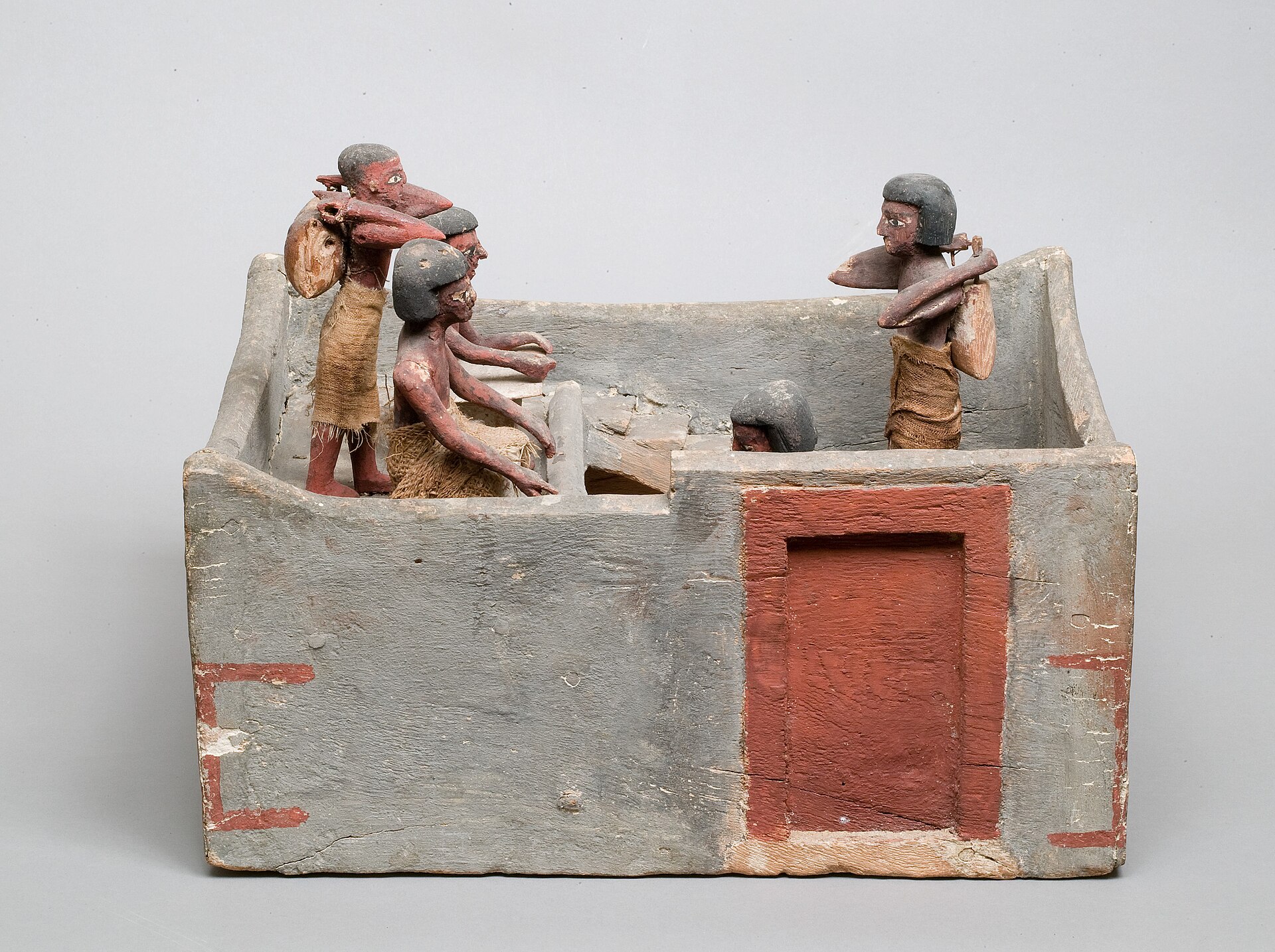
Daily Life · Storing Food in EgyptGenesis says Joseph gathered grain city by city and stored it. Egyptian records describe that practice. Painted tomb models show mud-brick granaries. They are rows of storage rooms inside a walled yard. Each room was filled through a hole in the roof. Each was emptied through a hatch near the ground. Scribes counted every sack. Written records list what came in and what went back out. A dry climate helps grain keep. The state ran storehouses because the Nile flood was not the same every year. Some years gave more; some gave less. Genesis is describing a practice Egyptian sources document.
Why this helps you read the BibleThe detail fits the country the story is set in. That is worth knowing, and it is all it shows. No Egyptian record names Joseph or these seven years. Reading well means holding both of those at once.
A granary, with the man who counted it
A painted wooden model of a granary, made to be placed in an Egyptian tomb. Figures carry sacks in over the wall, and one sits apart with the count. Models like this one are the reason we can say the storing and the counting went together in Egypt. It was made for a burial, not built to hold grain, and it has no connection to Joseph.
Model of a granary with scribe and overseer, Egypt, Middle Kingdom. The Metropolitan Museum of Art, 11.150.3. Source: Wikimedia Commons. CC0 public domain dedication.
Read Genesis 41 and 42 in your Bible. As you read chapter 41, write down every fact the chapter puts in place: who is in charge, what is stored, how far the famine reaches. Then read chapter 42 and draw a line from each event back to the fact it needed. Stop at Genesis 42:6 and read it beside Genesis 37:7. Keep what the chapters state apart from what you might add: Genesis never tells us what Joseph was thinking as they bowed.
Original passage written for this workbook — not a quotation from Scripture.
1Stated in Genesis 41–42, or Not stated there? Tap each detail to send it left or right.Sort into two
◄ Stated in Genesis 41–42Not stated there ►
2Match each first detail with the detail paired with it.Match the Pairs
The two dreams→
The signet ring→
The stored grain→
Simeon→
The silver→
3Fill both blanks to complete the reasoning.💎 Uses the box aboveBuild the Argument
Egyptian tomb models and written records show a state that stored grain in city granaries, so Genesis describing Joseph gathering grain city by city , which shows .
That is the whole workbook. The standardized test is optional and is scored separately.
Optional · Joseph · Genesis 41–42
Standardized Test
Reading passage · Counting What Is in the Storehouse · Ancient Administration and Careful Evidence · ten questions in the shapes a standardized reading test uses: main idea, detail, vocabulary in context, inference, evidence, synthesis, insert text, prose summary and fill in a table.
Optional. This section is not counted in your workbook score. It gets a report card of its own, and skipping it still leaves your workbook complete.
Original passage written for this workbook — not a quotation from Scripture.
Counting What Is in the Storehouse
An ancient state that wanted to survive a bad year had to solve two problems, not one. The first was keeping grain dry. Egyptian tomb models show mud-brick granaries: storage rooms inside a walled yard, filled through a hole in the roof and emptied through a hatch near the ground, and the dry climate did much of the rest. The second problem was harder. Somebody had to know how much was actually in there. So the same models that show the granary show a scribe sitting beside it with a writing board on his knees. Surviving records list amounts received and amounts paid out, name the officials responsible, and were checked against each other. A ruler who could not store food would starve in a bad year. A ruler who could store it but could not count it would be robbed in a good one. The counting is the part that is easy to overlook, and it is the part that made the storing worth doing.
1What is the passage mostly about?Main Idea
2How were the mud-brick granaries filled and emptied?Detail
3In this passage, to “store” food means to ___.Vocabulary in Context
4Who appears beside the granary in the tomb models?Detail
5You can infer that records were checked against each other because ___.Inference
6Which detail best supports the idea that counting mattered?Evidence
7What does the last sentence claim?Synthesis
8Insert Text. Look at the four squares [1]–[4] in the passage below. They mark the places this sentence could be added: “One is a building problem. The other is a paperwork problem.”
An ancient state that wanted to survive a bad year had to solve two problems, not one. [1] The first was keeping grain dry. [2] Egyptian tomb models show mud-brick granaries: storage rooms inside a walled yard, filled through a hole in the roof and emptied through a hatch near the ground, and the dry climate did much of the rest. [3] The second problem was harder. [4]
Where does the sentence fit best?Insert Text
9Prose Summary.The passage explains what an ancient state needed in order to store food. Six statements are listed below. Choose the THREE that best capture what the passage is saying. The other three do not belong — they are small details, or ideas the passage never puts forward. Each correct choice earns a mark of its own.Prose Summary
10Fill in a Table. Sort what these models and records settle from what they leave open. Tap each statement to send it to the left column or the right one. Three belong in each.Fill in a Table
◄ The evidence shows thisThe evidence cannot show this ►
Independent study guide by Lokosmos Academy. Not affiliated with or endorsed by Crossway or any Bible publisher. Contains original retelling and analysis only; no Scripture text is reproduced in full. Reference edition: keyed to the ESV® Bible — read Genesis 41–42 in your own Bible alongside this workbook; any Bible works for reading, and the vocabulary and questions follow the ESV’s wording. No ESV® text is quoted in this workbook. ESV® and the English Standard Version® are registered trademarks of Crossway.
Lokosmos Academy is an independent study resource, not affiliated with or endorsed by Crossway or any Bible publisher. This workbook is keyed to the wording of the ESV® Bible; any Bible works for reading — the vocabulary and quiz answers simply follow the ESV’s wording. These workbooks reprint no text of the ESV® Bible; every passage summary, question and example sentence is original wording. ESV® and the English Standard Version® are registered trademarks of Crossway.