Where we left offThe Old Testament has ended, and centuries have passed. Luke opens not with a birth but with a man at work.
An old priest is chosen by lot to burn incense in the temple. An angel meets him there and promises him a son. He asks how he can be sure, and cannot speak again until the boy is born. The same angel then goes to a young woman in Nazareth.
Why these chapters go togetherLuke 1 is one chapter and two visits. Read alone, each is a promise. Read together, the two run through the same steps until the last one, and the last one is where they come apart.
What We Will Learn
Section
What you will practice
Word Study
Words for temple service and promise: division, barren, lot, incense, troubled, mute, favor
Bible Study
How to read two scenes a writer has deliberately matched
Lokosmos Treasure Wisdom
What a priestly division was, and why Luke starts by explaining his method
Chapter Summary
Ch.
What happens
1:1–25
A Preface, and a Priest Who Cannot Answer — Luke opens by explaining how he researched what follows and who he is writing for. The story then begins with Zechariah, a priest of the division of Abijah, and his wife Elizabeth, who are old and have no children. His week of temple service brings him the incense duty, and an angel meets him there with a promise of a son named John. The scene turns on a question Zechariah asks, and on what happens to his voice afterwards. Outside, a crowd is left waiting.
1:26–80
The Same Angel, a Different Answer — Six months later the angel Gabriel is sent to Nazareth, to a young woman named Mary. He tells her she has found favor with God and will have a son named Jesus. She asks how this will be, and is answered. Mary goes to the hill country to Elizabeth, and stays about three months. John is born; the neighbors expect him to be named for his father; Elizabeth and then Zechariah insist on John, and Zechariah's speech comes back.
Part 1 · The Coming of Jesus · Luke 1
Word Study
Study 7 key words from Luke 1, then answer each question.
🏺
💎 Lokosmos Treasure Wisdom · a true fact behind the storyThe Division of Abijah
Open your Bible atLuke 1:5, then 1:8–9
Word Study · Serving in TurnLuke says Luke 1 places Zechariah in one of these, the one named for Abijah. That is not a family nickname. Long before this, the priests had been sorted into twenty-four groups, and each group took its turn at the temple. A division served one week, twice a year. There were far more priests than there were jobs, so inside that week the work was handed out by lot. Zechariah drew the incense offering, in the holy place. Later Jewish sources say only priests who had never burned it could enter that lot. Luke gives you the man's group, his week and his job in a single line.
Why this helps you read the BibleA single phrase can carry a whole system. Learn what the words meant to the people who used them, and Luke 1:5 stops being a list of names. It tells you this was the one turn of an ordinary man's life.
⚖ Still argued aboutWho Theophilus was. Luke names him and calls him most excellent, and that is everything we are told. A patron, an official, a new believer and a general reader have all been argued for.
🗣 Say itZechariahzek-uh-RYE-uh(ze-kə-rī-ə)Elizabethee-LIZ-uh-beth(i-li-zə-bəth)GabrielGAY-bree-ul(gā-brē-əl)Abijahuh-BYE-juh(ə-bī-jə)Theophilusthee-OFF-ih-lus(thē-ä-fə-ləs)NazarethNAZ-uh-reth(na-zə-rəth)
divisionn.Luke 1:5
One of the groups the priests were sorted into
“Luke 1 places Zechariah in one of these, the one named for Abijah.”
barrenadj.Luke 1:7
Not able to have children
“Luke 1 uses this word of Elizabeth, and adds that both were old.”
lotn.Luke 1:9
A way of choosing by chance, not by picking
“Luke 1 says the incense duty came to Zechariah this way, not by choice.”
incensen.Luke 1:9
A mixture that is burned to make sweet smoke
“Luke 1 has Zechariah go in to burn this while a crowd waits outside.”
troubledadj.Luke 1:12
Upset and unsettled by something
“Luke 1 uses this word for how Zechariah reacts to the angel.”
muteadj.Luke 1:22
Not able to speak
“Luke 1 says he came out unable to speak, and had to use signs.”
favorn.Luke 1:30
Kindness shown to someone, especially by God
“Luke 1 has the angel use this word when he speaks to Mary.”
ⓘ The vocabulary words in this list are selected to help you understand and complete this workbook. Some may not appear word-for-word in your Bible. The example sentences are our own wording, written to make the verse clearer — they are not quotations from it. Read each verse in your own Bible.
1One of the groups the priests were sorted into was called a ___.💎 Uses the box aboveLuke 1:5
2To be ‘barren’ is to be unable to have children.Luke 1:7
3Fill in each blank with the correct word.Luke 1:9, 1:22
Word choices:incensemutedivisionfavor- some words will not be used
Zechariah went in to burn in the temple. Luke 1:9
He came out , and could only make signs. Luke 1:22
4In Luke 1, what is a ‘lot’?Luke 1:9
5To be ‘troubled’ is to feel calm and settled.Luke 1:12
6‘Favor’ means kindness shown to someone.Luke 1:30
7Fill in each blank with the correct word.Luke 1:5, 1:7
Word choices:divisionbarrenlottroubled- some words will not be used
Zechariah belonged to the of Abijah. Luke 1:5
Elizabeth was , and both of them were old. Luke 1:7
Part 2 · The Coming of Jesus · Luke 1
Understanding
Show you understood what happens in Luke 1.
📑
💎 Lokosmos Treasure Wisdom · a true fact behind the storyA Writer Who Stops to Explain Himself
Open your Bible atLuke 1:1–4
Close Reading · A Stated MethodLuke does something the other three Gospel writers never do. He stops before the story and explains how he worked. Others have already tried to set this down, he says. He has looked into it all carefully himself. He is writing an orderly account for a man named Theophilus. He wants his reader to be sure of it. Four verses, and every one is about method, not events. Some Greek writers of that time opened a serious book the same way. They named a reader and made a claim about their sources. A claim like that can be tested against the book that follows.
Why this helps you read the BibleWhen the Bible tells you how a book was made, that is information about the book. Luke invites you to check him. Reading his preface first sets you up to read the rest of him the way he asked.
1Why does Luke say he is writing?Luke 1:3–4
2How was it decided that Zechariah would burn the incense?Luke 1:9
3What happens to Zechariah after he asks his question?Luke 1:20
4Where does Gabriel go six months later?Luke 1:26
5Write the numbers 1–5 in the boxes to show the correct order in Luke Chapter 1. Number 1 = what happens first.💎 Uses the box aboveLuke 1
Zechariah asks how he can be sure of this.
An angel appears at the right side of the altar.
Fear falls on Zechariah at the sight.
Zechariah is told he will not be able to speak.
The angel says his prayer has been heard.
6Elizabeth agrees with the neighbors that the baby should be named for his father.Luke 1:59–60
7Mary stays with Elizabeth about three months.Luke 1:56
Part 3 · The Coming of Jesus · Luke 1
Literary Craft
Understanding HOW and WHY the story is told across Luke 1.
💭
💎 Lokosmos Treasure Wisdom · a true fact behind the storyTwo Visits Cut to One Shape
Open your Bible atLuke 1:11–20, then 1:26–38
Literary Craft · Parallel ScenesGabriel appears twice in Luke 1, and the two scenes are built to one shape. The angel arrives. The person is troubled. The angel says not to be afraid. A son is promised and given his name. Then the person asks a question. Set the scenes side by side and almost everything matches. The answers do not. Zechariah asks how he will know, and leaves the temple unable to speak. Mary asks how this will be, and is told. When a writer sets matched scenes side by side, the difference is put in front of you.
Why this helps you read the BibleMatched scenes are one of the Bible's plainest teaching tools. Line them up and the difference does the work. Here it shows you that the two questions were not the same question.
Two visits, cut to one shape
Diagram of two stated scenes · every step is reported in Luke 1, with the verses given for the last row. Laying the two out in matching columns is a way of reading them together. Luke does not number the steps or say the scenes are built alike.
Verses: Luke 1:11–20 and 1:26–38. Drawn for Lokosmos Academy.
Parallel scenes
Two scenes built to the same shape so a reader will compare them. Gabriel's two visits in Luke 1 run through the same five steps.
Preface
An opening in which a writer explains what he is doing and how. Luke 1:1–4 is one, and the other Gospels have none.
Foil
A character placed beside another so the difference shows. Zechariah's question and Mary's are asked in almost the same words.
1Gabriel's two visits run through the same steps until the last one. What changes?💎 Uses the box aboveLuke 1:20, 1:35
2Fill in each blank with the correct word.Luke 1
Word choices:prefaceparallellotfavor- some words will not be used
An opening where a writer explains his method is a .
Two scenes built to the same shape are scenes.
3Why does a writer build two scenes to one shape?Luke 1:11–38
4Luke 1:1–4 is about how Luke worked rather than about events.Luke 1:1–4
5A foil is a character who never appears again.Luke 1
6Fill in each blank with the correct word.Luke 1:11–38
Word choices:foilprefacedivisionmute- some words will not be used
A character set beside another to show a difference is a .
The opening four verses of Luke are his .
7What does Luke's preface let a reader do that the other Gospels do not?Luke 1:1–4
Part 4 · The Coming of Jesus · Luke 1
Wisdom
Three deeper challenges — no single-word recall. Read, weigh the evidence, and reason it out.
🏛
💎 Lokosmos Treasure Wisdom · a true fact behind the storyThe Temple Was a Working Place
Open your Bible atLuke 1:10, then 1:21–22
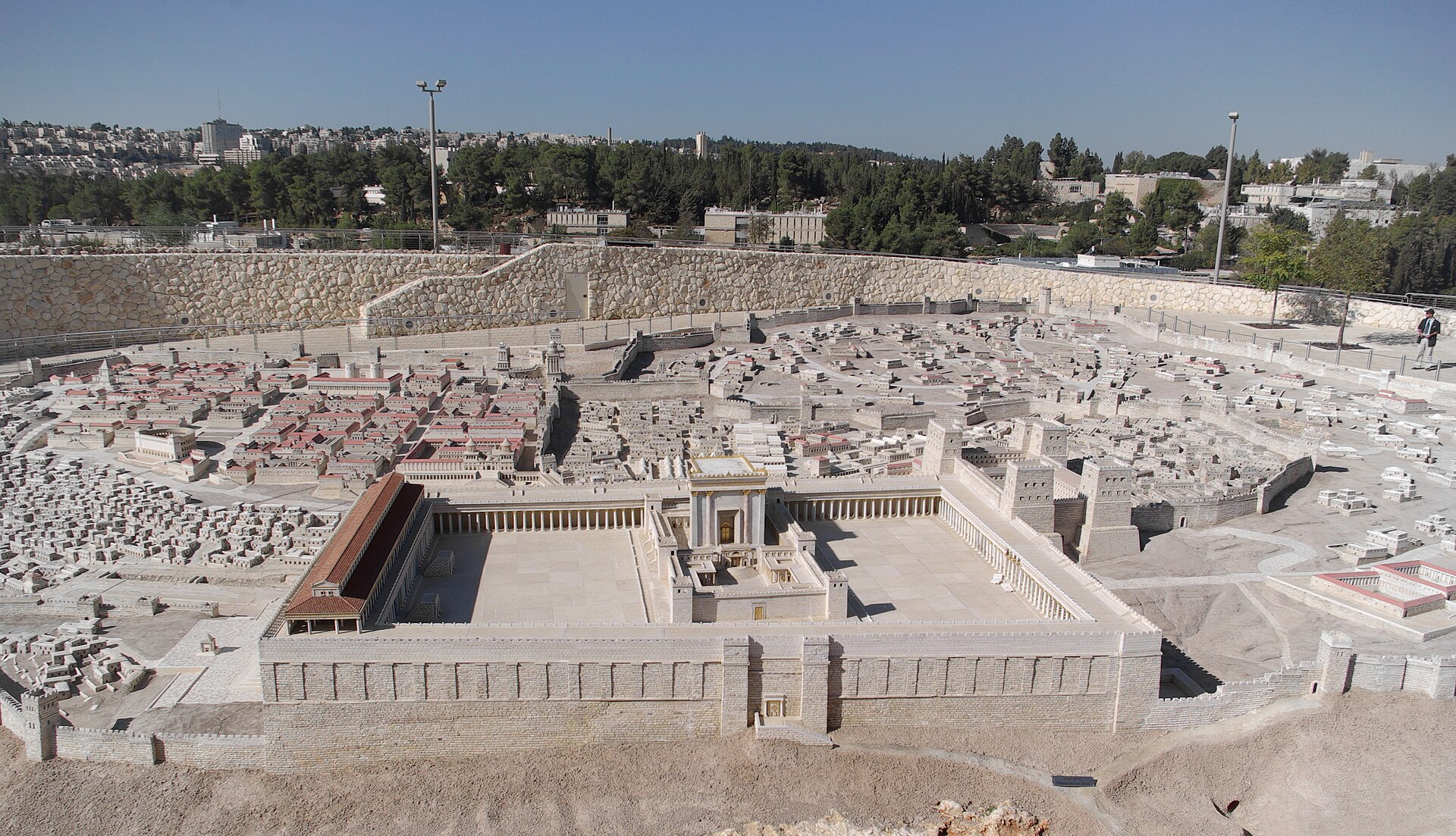
Places & Geography · Herod's TempleLuke says the whole crowd stood praying outside while the incense was offered. That tells you the temple was a working place, not an empty room. It stood on a huge stone platform that Herod built out over the hillside. Around it were courts, gates and long covered walkways. Part of the wall holding that platform up is still standing in Jerusalem today. Thousands of priests served there in turn, and crowds came to pray at set hours. So picture Zechariah walking in alone to a quiet room. Then picture him walking back out to a waiting crowd that he cannot answer.
Why this helps you read the BibleKnowing the place helps you feel the size of a small moment. It does not tell you what happened inside the holy place. Luke reports that plainly, and archaeology cannot reach it either way.
The place Zechariah walked into
A model of Jerusalem as it stood in the first century, built at 1:50 and now at the Israel Museum. The temple sits on the walled platform, with courts and covered walkways around it — the scale Luke assumes when he says a crowd was praying outside. This is a modern reconstruction, not a photograph of the building, and reconstructions are argued over in their details. The temple itself was destroyed in AD 70.
Holyland Model of Jerusalem, Israel Museum. Photograph by Berthold Werner. Source: Wikimedia Commons, File:Jerusalem Modell BW 2.JPG. Public domain.
Read Luke 1 in your Bible. Draw two columns, headed Zechariah and Mary. Fill each one in as you read: how the angel arrives, how the person reacts, what is promised, what is asked, what answer comes. Then look at the row where the two columns stop matching. Keep what the chapter states apart from what you might add: Luke never tells you what Zechariah was thinking when he asked.
Original passage written for this workbook — not a quotation from Scripture.
1Stated in Luke 1, or Not stated there? Tap each detail to send it left or right.Sort into two
◄ Stated in Luke 1Not stated there ►
2Match each first detail with the detail paired with it.Match the Pairs
The division of Abijah→
The lot→
Theophilus→
John→
Three months→
3Fill both blanks to complete the reasoning.💎 Uses the box aboveBuild the Argument
The Old Testament records the priests being sorted into twenty-four groups that each served in turn, so Luke naming the division of Abijah , which shows .
That is the whole workbook. The standardized test is optional and is scored separately.
Optional · The Coming of Jesus · Luke 1
Standardized Test
Reading passage · Taking Turns at the Altar · Ancient Institutions and Careful Evidence · ten questions in the shapes a standardized reading test uses: main idea, detail, vocabulary in context, inference, evidence, synthesis, insert text, prose summary and fill in a table.
Optional. This section is not counted in your workbook score. It gets a report card of its own, and skipping it still leaves your workbook complete.
Original passage written for this workbook — not a quotation from Scripture.
Taking Turns at the Altar
A large temple has a staffing problem most buildings do not. There were far more priests in first-century Judea than there was daily work for them, and the work itself could not simply be skipped. The solution was rotation. Priests were organized into twenty-four groups, and each division came up to Jerusalem for one week at a time, twice a year, with everyone serving together at the great festivals. Inside a given week the individual duties were then assigned by lot rather than by rank or seniority. Ancient Jewish sources describe the system in detail: a first-century historian, and calendar scrolls found near the Dead Sea. A later stone inscription lists the group names too, carved centuries after the temple fell. What none of that can do is tell us which week any one priest served, or what happened during it. It tells us the shape of an ordinary priest's working life, which is enough to show how unusual a single turn could be.
1What is the passage mostly about?Main Idea
2How many groups were the priests organized into?Detail
3In this passage, a “division” is ___.Vocabulary in Context
4How were the individual duties assigned inside a week?Detail
5You can infer that a priest might serve many years and ___.Inference
6Which detail best supports the idea that the system is documented?Evidence
7What does the passage say the evidence cannot do?Synthesis
8Insert Text. Look at the four squares [1]–[4] in the passage below. They mark the places this sentence could be added: “That is a lot of people for one building.”
A large temple has a staffing problem most buildings do not. [1] There were far more priests in first-century Judea than there was daily work for them, and the work itself could not simply be skipped. [2] The solution was rotation. [3] Priests were organized into twenty-four groups, and each division came up to Jerusalem for one week at a time, twice a year, with everyone serving together at the great festivals. [4]
Where does the sentence fit best?Insert Text
9Prose Summary.The passage explains how a large temple shared out its work. Six statements are listed below. Choose the THREE that best capture what the passage is saying. The other three do not belong — they are small details, or ideas the passage never puts forward. Each correct choice earns a mark of its own.Prose Summary
10Fill in a Table. Sort what this evidence settles from what it leaves open. Tap each statement to send it to the left column or the right one. Three belong in each.Fill in a Table
◄ The evidence shows thisThe evidence cannot show this ►
Independent study guide by Lokosmos Academy. Not affiliated with or endorsed by Crossway or any Bible publisher. Contains original retelling and analysis only; no Scripture text is reproduced in full. Reference edition: keyed to the ESV® Bible — read Luke 1 in your own Bible alongside this workbook; any Bible works for reading, and the vocabulary and questions follow the ESV’s wording. No ESV® text is quoted in this workbook. ESV® and the English Standard Version® are registered trademarks of Crossway.
Lokosmos Academy is an independent study resource, not affiliated with or endorsed by Crossway or any Bible publisher. This workbook is keyed to the wording of the ESV® Bible; any Bible works for reading — the vocabulary and quiz answers simply follow the ESV’s wording. These workbooks reprint no text of the ESV® Bible; every passage summary, question and example sentence is original wording. ESV® and the English Standard Version® are registered trademarks of Crossway.