Where we left offAbraham has buried Sarah, seen his son married, and been buried himself beside her.
A king takes a wife who is not what he was told. Years later, a servant rides hundreds of miles and prays for a very exact sign at a well. Then twin brothers are born fighting, and one sells his future for a bowl of stew.
Why these chapters go togetherGenesis 20 and Genesis 26 tell almost the same story about two different men, and the chapters between them show the promise passing from Abraham to Isaac. Reading 20 next to 26 is the point of putting them in one part.
What We Will Learn
Section
What you will practice
Word Study
Words for promises, family rights and jealousy: oath, prophet, birthright, despised, envied, covenant, reaped
Bible Study
How to compare two tellings of one kind of story, and how to check whether a prayer was answered exactly
Lokosmos Treasure Wisdom
What a marriage gift actually was, why a well was worth fighting over, and how a story repeats
Chapter Summary
Ch.
What happens
20
Abraham at Gerar — Abraham moves to Gerar and says Sarah is his sister. King Abimelech takes her. God warns him in a dream before any harm is done, and calls Abraham a prophet who will pray for him. Abimelech returns Sarah with gifts, Abraham prays, and God heals Abimelech's household.
24
A Wife for Isaac — Abraham sends his senior servant back to his own relatives, under oath, to find a wife for Isaac. At a well outside the city the servant prays for a very exact sign, and Rebekah answers it detail for detail. Her family agrees, she chooses to go, and Isaac takes her into his mother's tent.
25
Twins and a Birthright — Abraham dies and is buried beside Sarah by Isaac and Ishmael. Rebekah bears twins who struggle even before birth, and the LORD says the older will serve the younger. Esau comes in hungry from the field and sells his birthright to Jacob for bread and a bowl of stew.
26
Isaac at Gerar — A famine sends Isaac to Gerar, where he says Rebekah is his sister, exactly as his father had. He plants, reaps a hundredfold, and grows so wealthy that the Philistines envy him and stop up his father's wells. He digs them again. In the end Abimelech comes to him and they make a covenant of peace.
Part 1 · Isaac & Jacob · Genesis 20; 24–26
Word Study
Study 7 key words from Genesis 20; 24–26, then answer each question.
💍
💎 Lokosmos Treasure Wisdom · a true fact behind the storyA Marriage Was Sealed With Gifts
Open your Bible atGenesis 24:22, then Genesis 24:53
Word Study · Marriage GiftsRead those two verses and count the gifts. The servant gives Rebekah a gold ring and two gold bracelets. He does this before he even knows whose daughter she is. Later he brings out more: silver, gold and clothing for her, and costly things for her brother and her mother. This was not showing off. Across the ancient Near East a marriage was closed by gifts passing between two families. Clay records from cities like Nuzi list them by weight. A promise that costs nothing binds nobody. The gifts are how everyone watching knew the thing was settled.
Why this helps you read the BibleThe gifts are not decoration. They are how the agreement was made real. Notice them and you know the servant's errand has worked, before anyone in the chapter says so.
⚖ Still argued aboutWhether the servant in Genesis 24 is Eliezer. The chapter never names him, and the identification is carried over from one passing mention back in Genesis 15:2.
🗣 Say itAbimelechuh-BIM-uh-lek(ə-bi-mə-lek)GerarGEE-rar(gir-är)Rebekahrih-BEK-uh(ri-be-kə)EsauEE-saw(ē-sȯ)LabanLAY-ban(lā-bən)Bethuelbeth-YOO-el(bə-thü-el)
oathn.Gen 24:9
A serious, sworn promise
“Genesis 24 opens with the servant making one of these to Abraham.”
prophetn.Gen 20:7
Someone who speaks for God
“Genesis 20 gives Abraham this title in Abimelech's dream.”
birthrightn.Gen 25:31
The rights and inheritance belonging to the firstborn son
“Genesis 25 has Jacob ask his brother to hand this over.”
despisedv.Gen 25:34
Looked down on, or thought little of
“Genesis 25 uses this word for how Esau treated what he sold.”
enviedv.Gen 26:14
Felt jealous of what someone else has
“Genesis 26 gives this as the neighbours' reaction to Isaac's wealth.”
reapedv.Gen 26:12
Gathered in a harvest
“Genesis 26 says Isaac's harvest came back a hundredfold.”
covenantn.Gen 26:28
A solemn binding agreement
“Genesis 26 ends with Abimelech coming to make one of these.”
ⓘ The vocabulary words in this list are selected to help you understand and complete this workbook. Some may not appear word-for-word in your Bible. The example sentences are our own wording, written to make the verse clearer — they are not quotations from it. Read each verse in your own Bible.
1A serious, sworn promise is an ___.Gen 24:9
2In Genesis 20, a ‘prophet’ is someone who speaks for God.Gen 20:7
3Fill in each blank with the correct word.💎 Uses the box aboveGen 24:22, 53; 26:28
Word choices:covenantoathbirthrightreaped- some words will not be used
Abimelech comes to Isaac to make a of peace. Gen 26:28
Before he sets out, the servant swears an . Gen 24:9
4The rights and inheritance belonging to the firstborn son are his ___.Gen 25:31
5To be ‘envied’ is to be pitied by other people.Gen 26:14
6To have ‘reaped’ something is to have gathered in a harvest.Gen 26:12
7Fill in each blank with the correct word.Gen 20:7; 25:34
Word choices:despisedprophetenviedoath- some words will not be used
Abimelech is told that Abraham is a . Gen 20:7
Esau ate, drank, and his birthright. Gen 25:34
Part 2 · Isaac & Jacob · Genesis 20; 24–26
Understanding
Show you understood what happens in Genesis 20; 24–26.
🧠
💎 Lokosmos Treasure Wisdom · a true fact behind the storyA Prayer With a Very Exact Answer
Open your Bible atGenesis 24:12–14, then Genesis 24:15–20
Close Reading · A Test With a Clear AnswerThe servant does something unusual. He does not just ask for help. He names the exact sign he wants first, out loud, before anything happens: the girl who offers water for him and for his camels too. Then read the next six verses with his words beside you. Rebekah does each part, in order. Camels drink a great deal, so that second half is not a small thing to offer a stranger. A prayer and its answer set down this close together let a reader check one against the other, line by line.
Why this helps you read the BibleGenesis does not tell you the prayer was answered. It shows you the request, then the answer. You check it yourself, and that is how you see what the chapter is really claiming.
1What does God do before Abimelech can harm Sarah?Gen 20:3
2What exact sign does the servant ask for at the well?💎 Uses the box aboveGen 24:14
3What does Esau give up, and what does he get for it?Gen 25:33–34
4What do the Philistines do to Isaac's wells?Gen 26:15
5Write the numbers 1–5 in the boxes to show the correct order across Genesis 20 and 24–26. Number 1 = what happens first.Gen 20; 24–26
A servant prays at a well, and Rebekah answers the sign.
Twin sons are born, and they struggle even before birth.
Esau sells his birthright for bread and stew.
Abimelech comes to Isaac and they make a covenant.
God warns Abimelech in a dream about Sarah.
6Isaac says Rebekah is his sister, just as his father had said of Sarah.Gen 26:7
7Rebekah's family refuses to let her go with the servant.Gen 24:57–58
Part 3 · Isaac & Jacob · Genesis 20; 24–26
Literary Craft
Understanding HOW and WHY the story is told across Genesis 20; 24–26.
📖
💎 Lokosmos Treasure Wisdom · a true fact behind the storyGenesis Tells This Story Twice
Open your Bible atGenesis 20, then Genesis 26:1–11
Literary Craft · The Type-SceneRead Genesis 20. Then read Genesis 26 and watch it happen again. A man goes to Gerar. He says his wife is his sister. Abimelech finds out. The man leaves richer than he arrived. When a writer uses one situation more than once like this, critics call it a type-scene. It does not mean the writer ran out of ideas. It means the two tellings are meant to be read against each other, because what a retelling changes is where its meaning sits. So do that. Find the parts that are the same, and then find the parts that are different.
Why this helps you read the BibleGenesis repeats situations on purpose. Compare the two tellings and you hear what the second one is saying. Read it as the same story again and you hear nothing.
The same story, told twice, six chapters apart
Diagram comparing two chapters · every step in all three boxes is stated in Genesis 20 or Genesis 26. Laying them out in the same order is a way of reading them together. Genesis does not call either chapter a repeat of the other, and the drawing does not say which telling came first.
Verses: Genesis 20:1–18 and 26:1–33. Drawn for Lokosmos Academy.
Type-scene
A situation a writer uses more than once, so that the differences between the tellings carry the meaning. Genesis 20 and Genesis 26 run the same five steps with two different men.
Exact fulfillment
When something happens detail for detail as it was asked for or foretold. The servant names his sign before Rebekah appears, and she does each part of it in order.
Foil
A character whose choices make another character clearer by contrast. Esau trades his future for one meal; Jacob is the one who asks for it.
1Genesis 20 and Genesis 26 run the same five steps with different men. What is that called?💎 Uses the box aboveGen 20; 26
2Fill in each blank with the correct word.Gen 20; 24; 26
Word choices:type-scenefoilfulfillmentcovenant- some words will not be used
A situation a writer uses more than once is a .
A character who makes another clearer by contrast is a .
3What is different about Genesis 26, compared with Genesis 20?Gen 20; 26
4Esau's choice makes Jacob's choice easier to see.Gen 25:29–34
5A writer who tells a similar story twice has simply run out of ideas.Gen 20; 26
6Fill in each blank with the correct word.Gen 24:14–20
Word choices:fulfillmenttype-scenefoiloath- some words will not be used
When a sign happens detail for detail, that is exact .
A situation used more than once is a .
7Why does Genesis let you hear the servant's prayer before Rebekah appears?Gen 24:12–20
Part 4 · Isaac & Jacob · Genesis 20; 24–26
Wisdom
Three deeper challenges — no single-word recall. Read, weigh the evidence, and reason it out.
⛺
💎 Lokosmos Treasure Wisdom · a true fact behind the storyA Well Was Worth Fighting Over
Open your Bible atGenesis 26:15, then Genesis 26:18–22
Archaeology · Water RightsGenesis 26 has the Philistines fill Isaac's wells with earth. Isaac digs them out again. That is not a small quarrel. In dry country a well is what a herd lives on. Digging one is slow, costly work through rock. So a well was property. It was named, and the name stuck. Wells dug up by archaeologists are lined with stone and deep. Some were kept covered, so nobody could use them without the owner knowing. Filling a well in was a way of driving a neighbor out without a fight. Isaac digs and moves on three times before anyone offers him peace.
Why this helps you read the BibleA well cost weeks of digging. Knowing that shows you what Isaac gives up each time he walks away, which the chapter never stops to explain.
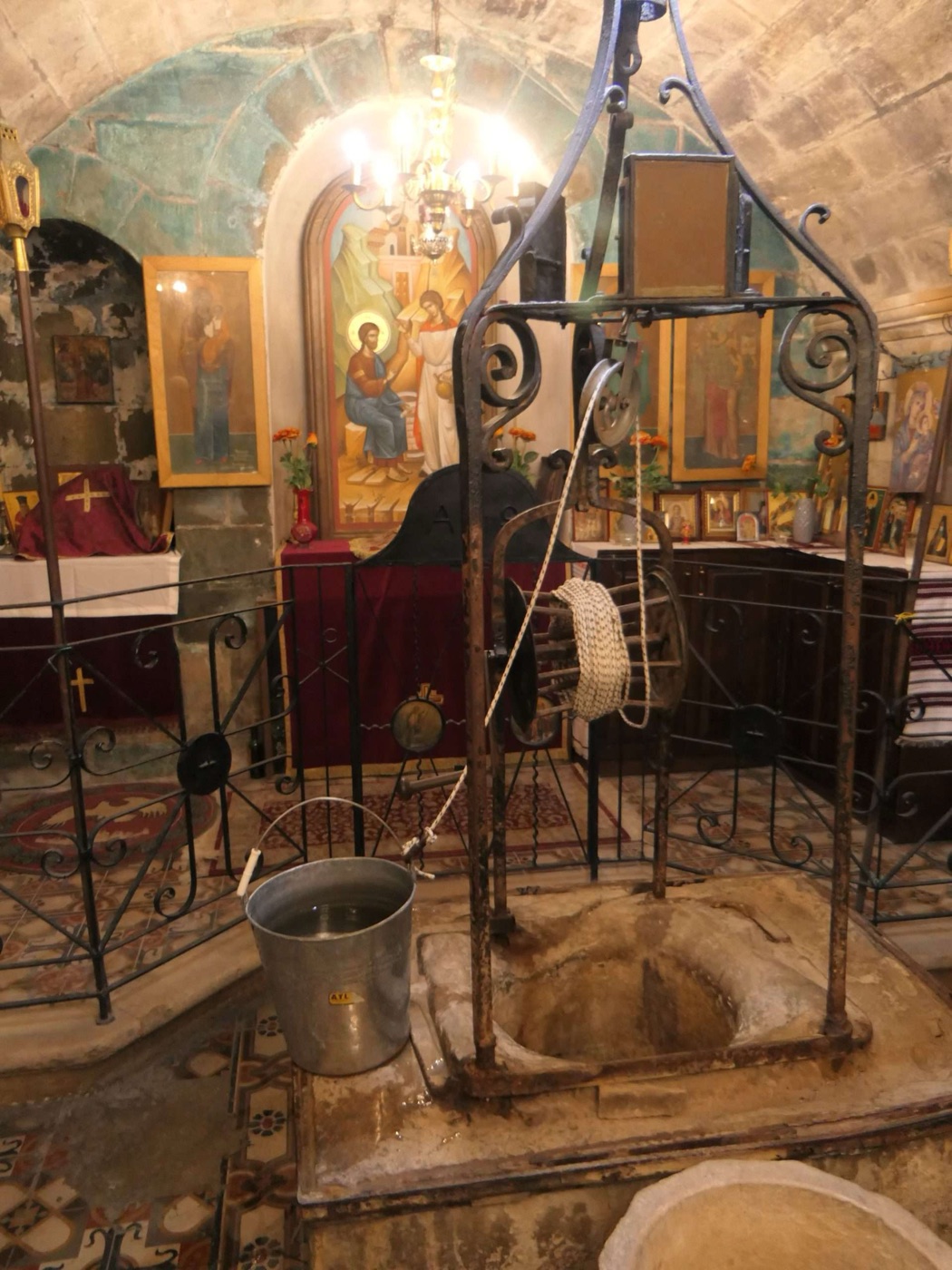
A well too deep to reach into
The well at Balata, near Nablus, known for many centuries as Jacob's Well. The ironwork, the drum and the bucket are modern. The shaft is the old part, and it is deep enough that nobody draws from it by hand — which is exactly why a well in Genesis is dug, owned and quarrelled over. This is not one of Isaac's wells. Genesis 26 names his, and none of them has been identified on the ground.
Photograph of the well at Balata, near Nablus. Source: Wikimedia Commons, File:Jacob's well.jpg. CC0 public domain dedication.
Read Genesis 20 first, then Genesis 24 to 26 in your Bible. Read 20 and 26 close together and make two lists: what is the same in both, and what is different. In Genesis 24, find the servant's prayer and write down the exact sign he asks for, then read on and check it off part by part as Rebekah does it. In Genesis 25, notice how short the trade between the brothers is, and what the chapter says about it afterwards. Keep what the chapters state apart from what you might expect them to say: Genesis never tells you why Esau agreed.
Original passage written for this workbook — not a quotation from Scripture.
1Stated in Genesis 20 and 26, or Not stated there? Tap each detail to send it left or right.💎 Uses the box aboveSort into two
◄ Stated in Genesis 20 and 26Not stated there ►
2Match each first detail with the detail paired with it.Match the Pairs
Genesis 20→
Genesis 26→
The servant's sign→
Esau→
The wells→
3Fill both blanks to complete the reasoning.Build the Argument
Genesis 20 and Genesis 26 run the same five steps with two different men, so a reader can , which shows .
That is the whole workbook. The standardized test is optional and is scored separately.
Optional · Isaac & Jacob · Genesis 20; 24–26
Standardized Test
Reading passage · Whose Well Is It? · Ancient Custom and Careful Evidence · ten questions in the shapes a standardized reading test uses: main idea, detail, vocabulary in context, inference, evidence, synthesis, insert text, prose summary and fill in a table.
Optional. This section is not counted in your workbook score. It gets a report card of its own, and skipping it still leaves your workbook complete.
Original passage written for this workbook — not a quotation from Scripture.
Whose Well Is It?
In dry country, a well is not a convenience. It is the thing a herd lives on, and it takes weeks of hard digging, often through rock, before any water is reached. That cost is why wells were owned. Excavated wells across the ancient Near East are lined with stone to stop the sides falling in, and some were kept covered, so that nobody could water a flock without the owner knowing. Legal documents from the region record who had the right to draw and who did not, and they record the quarrels when that was disputed. A covenant between two herding families often settled exactly this. Stopping a well up with earth, rather than taking it, was a way of pushing a neighbor off land without a fight: the water was still there, and it was useless. None of this dates any particular quarrel or names anybody. It shows what was at stake whenever an ancient text mentions a well.
1What is the passage mostly about?Main Idea
2Why are excavated wells lined with stone?Detail
3In this passage, a “covenant” is ___.Vocabulary in Context
4What did some owners do so nobody could water a flock unnoticed?Detail
5You can infer that stopping a well with earth was meant to ___.Inference
6What evidence does the passage use for who could draw water?Evidence
7What does the passage say its evidence cannot do?Synthesis
8Insert Text. Look at the four squares [1]–[4] in the passage below. They mark the places this sentence could be added: “Not every quarrel ended in an agreement.”
Excavated wells across the ancient Near East are lined with stone to stop the sides falling in, and some were kept covered, so that nobody could water a flock without the owner knowing. [1] Legal documents from the region record who had the right to draw and who did not, and they record the quarrels when that was disputed. [2] A covenant between two herding families often settled exactly this. [3] Stopping a well up with earth, rather than taking it, was a way of pushing a neighbor off land without a fight: the water was still there, and it was useless. [4]
Where does the sentence fit best?Insert Text
9Prose Summary.The passage explains why a well mattered so much in dry country. Six statements are listed below. Choose the THREE that best capture what the passage is saying. The other three do not belong — they are small details, or ideas the passage never puts forward. Each correct choice earns a mark of its own.Prose Summary
10Fill in a Table. Sort what this evidence settles from what it leaves open. Tap each statement to send it to the left column or the right one. Three belong in each.Fill in a Table
◄ The evidence shows thisThe evidence cannot show this ►
Independent study guide by Lokosmos Academy. Not affiliated with or endorsed by Crossway or any Bible publisher. Contains original retelling and analysis only; no Scripture text is reproduced in full. Reference edition: keyed to the ESV® Bible — read Genesis 20; 24–26 in your own Bible alongside this workbook; any Bible works for reading, and the vocabulary and questions follow the ESV’s wording. No ESV® text is quoted in this workbook. ESV® and the English Standard Version® are registered trademarks of Crossway.
Lokosmos Academy is an independent study resource, not affiliated with or endorsed by Crossway or any Bible publisher. This workbook is keyed to the wording of the ESV® Bible; any Bible works for reading — the vocabulary and quiz answers simply follow the ESV’s wording. These workbooks reprint no text of the ESV® Bible; every passage summary, question and example sentence is original wording. ESV® and the English Standard Version® are registered trademarks of Crossway.