Where we left offIsaac and Abimelech have made their covenant of peace, and Isaac's own household is about to divide.
Two brothers fight before they are even born. One sells his future for a hot meal. Years later the other one puts on his brother's clothes and walks in to a blind old man.
Why these chapters go togetherGenesis 25 to 27 is one quarrel in three moves: born struggling, a birthright traded, a blessing taken. Each move costs Esau more than the one before it.
What We Will Learn
Section
What you will practice
Word Study
Words for family rights and deceiving: birthright, blessing, deceived, trembled, hunter, quiet, inherit
Bible Study
How to read a scene where you know more than a character does
Lokosmos Treasure Wisdom
Why a spoken blessing could not be taken back, and what a father's word did in law
Chapter Summary
Ch.
What happens
25
Two Brothers, Struggling — Rebekah's twins struggle inside her, and the LORD tells her that two nations are there and the older will serve the younger. Esau is born first and grows into a hunter; Jacob is quiet and stays among the tents. Esau comes in starving from the field, and Jacob will only feed him for his birthright. Esau swears it away, eats, and goes.
26
Isaac's Own Years — Between the two brother scenes, Genesis stops on Isaac. He settles at Gerar in a famine, prospers, digs out his father's wells, and finally makes peace with Abimelech. The chapter closes on Esau marrying two Hittite women, which Genesis says made life bitter for Isaac and Rebekah.
27
The Stolen Blessing — Isaac is old and cannot see. He sends Esau to hunt and prepare a meal so he can bless him. Rebekah hears, and dresses Jacob in Esau's clothes with goatskins on his hands and neck. Isaac doubts, tests him by touch, smell and voice, and blesses him anyway. Esau comes back and cries out; Isaac trembles, but says the blessing stands.
Part 1 · Isaac & Jacob · Genesis 25–27
Word Study
Study 7 key words from Genesis 25–27, then answer each question.
📜
💎 Lokosmos Treasure Wisdom · a true fact behind the storyA Blessing You Could Not Take Back
Open your Bible atGenesis 27:33, then Genesis 27:37
Word Study · A Word That Held in LawRead what Isaac says when Esau comes in. He trembles. Then he says the thing that decides the chapter: the blessing has been given, and it stands. To us that sounds unfair. In that world a formal spoken word was more like a signed paper than a wish. Clay records from the region show a father settling his property out loud. Witnesses were named, so nobody could later say it never happened. Once said in front of people, it was binding. That is why Esau asks for another blessing instead of asking for the first one back.
Why this helps you read the BibleEsau is not being childish. He knows the word cannot be undone. That shows you why the chapter treats one sentence as seriously as a theft.
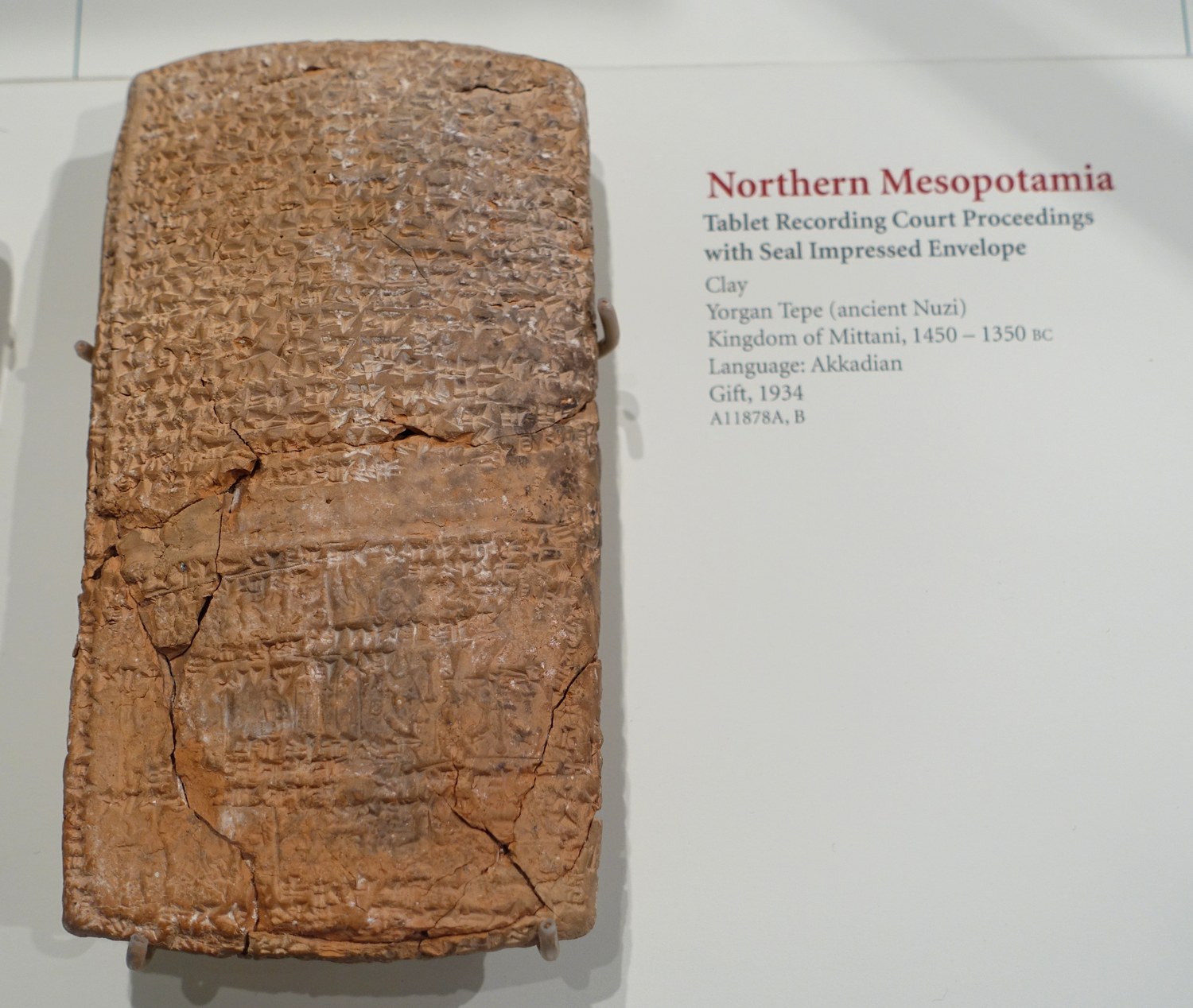
A family decision, written down and sealed
A clay tablet from Nuzi recording court proceedings, shown with the sealed clay envelope it traveled in. This is the kind of document the box describes — a decision made in front of witnesses and then put beyond argument. It is a land case, not an inheritance, and it has nothing to do with Isaac. It shows what such a record looked like, not what happened in Genesis 27.
Tablet in Akkadian recording court proceedings, with seal-impressed envelope. Yorgan Tepe (ancient Nuzi), 1450–1350 BC. Oriental Institute Museum, University of Chicago. Source: Wikimedia Commons. CC0 public domain dedication.
⚖ Still argued aboutWhether Isaac knew. Genesis 27:23 says he did not recognize Jacob. But he had already said out loud that the voice was Jacob's, and he asks again in verse 24. The chapter never settles what he understood by the time he blessed.
🗣 Say itEsauEE-saw(ē-sȯ)JacobJAY-kub(jā-kəb)Rebekahrih-BEK-uh(ri-be-kə)EdomEE-dum(ē-dəm)Padan-aramPAY-dan-AIR-am(pā-dan-er-am)HittiteHIT-ite(hi-tīt)
birthrightn.Gen 25:31
The rights and inheritance belonging to the firstborn son
“Genesis 25 has Jacob ask his brother to hand this over.”
blessingn.Gen 27:35
Words spoken over someone to give them good things
“Genesis 27 has Isaac say this has gone to Jacob and cannot be recalled.”
deceivedv.Gen 27:35
Made someone believe something that is not true
“Genesis 27 uses this word for what Esau says his brother did.”
trembledv.Gen 27:33
Shook, from shock or fear
“Genesis 27 says Isaac did this when he realised who had come.”
huntern.Gen 25:27
Someone who catches wild animals for food
“Genesis 25 gives Esau this job, and puts him out in open country.”
quietadj.Gen 25:27
Calm and settled; not restless
“Genesis 25 uses this word for Jacob, and keeps him near the tents.”
inheritv.Gen 28:4
To receive what is passed down in a family
“Genesis 28 has Isaac speak of land passing to Jacob.”
ⓘ The vocabulary words in this list are selected to help you understand and complete this workbook. Some may not appear word-for-word in your Bible. The example sentences are our own wording, written to make the verse clearer — they are not quotations from it. Read each verse in your own Bible.
1Isaac says the blessing cannot be undone. Why did a spoken blessing hold in that world?💎 Uses the box aboveGen 27:33
2A ‘birthright’ is what belongs to the firstborn son.Gen 25:31
3Fill in each blank with the correct word.Gen 27:33, 35
Word choices:trembleddeceivedquietinherit- some words will not be used
Esau says his brother has their father. Gen 27:35
When Isaac understood, he violently. Gen 27:33
4Someone who catches wild animals for food is a ___.Gen 25:27
5To be ‘deceived’ is to be told the truth plainly.Gen 27:35
6To ‘inherit’ is to receive what is passed down in a family.Gen 28:4
7Fill in each blank with the correct word.Gen 25:27, 31; 27:35
Word choices:quietbirthrightblessinghunter- some words will not be used
Jacob was a man who stayed among the tents. Gen 25:27
Words spoken over someone to give them good things are a . Gen 27:35
Part 2 · Isaac & Jacob · Genesis 25–27
Understanding
Show you understood what happens in Genesis 25–27.
🧠
💎 Lokosmos Treasure Wisdom · a true fact behind the storyWhat Touch and Smell Cannot Tell Him
Open your Bible atGenesis 27:21–27
Close Reading · A Blind Father's Three TestsIsaac cannot see, so he checks three other ways. Read the verses with three columns in your head. He feels the hands, and the goatskins say Esau. He smells the clothes, and they are Esau's own, so they say Esau too. But he hears the voice, and he says out loud that the voice is Jacob's. Two tests agree and one does not, and he blesses him anyway. When a scene checks the same question more than once, line the answers up. The one that does not match is where the chapter puts its weight. Genesis 27:23 says he did not recognize him, and then it stops there.
Why this helps you read the BibleThe chapter gives you all three results and no verdict. Line them up yourself. That is how you find the question it is asking.
Three tests, and the one that fails
Diagram of three stated tests · the touch, the smell, the voice and Isaac's own words about the voice are all in Genesis 27. Setting what he checks beside what it tells him is a way of reading the scene. Genesis 27:23 says Isaac did not recognize him; it never says what he had concluded by the time he blessed, and the drawing does not guess.
Verses: Genesis 27:21–27. Drawn for Lokosmos Academy.
1What does the LORD tell Rebekah about her twins?Gen 25:23
2What does Esau get for his birthright?Gen 25:34
3How does Rebekah disguise Jacob?💎 Uses the box aboveGen 27:15–16
4What does Isaac do when Esau comes in?Gen 27:33
5Write the numbers 1–5 in the boxes to show the correct order across Genesis 25–27. Number 1 = what happens first.Gen 25–27
Esau comes in, and Isaac says the blessing stands.
The twins struggle, and the LORD speaks to Rebekah.
Esau comes in hungry and sells his birthright.
Isaac grows old and can no longer see.
Rebekah dresses Jacob in his brother's clothes.
6Isaac notices that the voice does not match.Gen 27:22
7Isaac says out loud that the voice is Jacob's, and blesses him anyway.Gen 27:22–23
Part 3 · Isaac & Jacob · Genesis 25–27
Literary Craft
Understanding HOW and WHY the story is told across Genesis 25–27.
📖
💎 Lokosmos Treasure Wisdom · a true fact behind the storyYou Know More Than Isaac Does
Open your Bible atGenesis 27:5–10, then 27:18–24
Literary Craft · Dramatic IronyGenesis tells you the plan before it happens. You watch Rebekah listen at the tent, and you watch her dress Jacob up. So when Isaac asks who is there, you already know the answer and he does not. That gap has a name: dramatic irony. It is a choice by the writer, and it changes everything about how the scene feels. You are not solving a mystery. You are watching a man walk into one, and you cannot say anything. Watch how the writer keeps you a step ahead, and ask what that is doing to you as you read.
Why this helps you read the BibleGenesis often lets you know what a character does not. Spot that, and you know the writer wants you watching the person. You are not meant to be guessing the plot.
Dramatic irony
When the reader knows something a character does not. Genesis shows you Rebekah's plan before Isaac asks who is standing in front of him.
Contrast
Two things set side by side so the difference shows. One brother hunts in the field; the other stays among the tents.
Repetition
Something done more than once on purpose. Isaac tests the same question three separate ways before he blesses.
1You watch Rebekah's plan, then watch Isaac ask who is there. What is that called?💎 Uses the box aboveGen 27:5–18
2Fill in each blank with the correct word.Gen 25–27
Word choices:contrastironyrepetitionblessing- some words will not be used
Two things set side by side to show a difference is a .
Doing the same thing more than once on purpose is .
3Why does Genesis show you the plan before the scene?Gen 27:5–10
4One brother hunts in the field and the other stays among the tents.Gen 25:27
5Isaac checks who is in front of him only once.Gen 27:21–27
6Fill in each blank with the correct word.Gen 27
Word choices:ironycontrastrepetitiontrembled- some words will not be used
Knowing what a character does not know is dramatic .
Testing the same question three ways is .
7Two of Isaac's tests agree and one does not. What does the chapter never tell you?Gen 27:22–27
Part 4 · Isaac & Jacob · Genesis 25–27
Wisdom
Three deeper challenges — no single-word recall. Read, weigh the evidence, and reason it out.
🌿
💎 Lokosmos Treasure Wisdom · a true fact behind the storyTwo Brothers, Two Ways of Living
Open your Bible atGenesis 25:27–28
Daily Life · Herders and HuntersOne verse sets the brothers apart, and it does it by their work. Esau is a man of the field who hunts. Jacob is quiet and stays among the tents. In that world those are two whole ways of living, not two hobbies. A herding household kept flocks, moved with water and grazing, and lived off milk and wool and meat it raised itself. Hunting brought food in but built nothing that lasted. The next verse adds that each parent loved a different son. Genesis puts all of that in two verses and then lets the story run.
Why this helps you read the BibleGenesis tells you who people are by what they do. Read those two verses slowly. They say more about this family than any verse later on.
Read Genesis 25 to 27 in your Bible. Start with the twins, and notice how few words the birthright trade takes. Then read Genesis 27 slowly, with a pencil. Every time Isaac checks who is in front of him, mark it, and write down what that check tells him. You should end with three marks and one that does not match the other two. Then find the verse where Isaac says the blessing stands, and keep what the chapter states apart from what you would like it to say: Genesis never tells you what Isaac was thinking.
Original passage written for this workbook — not a quotation from Scripture.
1Stated in Genesis 25–27, or Not stated there? Tap each detail to send it left or right.Sort into two
◄ Stated in Genesis 25–27Not stated there ►
2Match each first detail with the detail paired with it.💎 Uses the box aboveMatch the Pairs
Touch→
Smell→
Voice→
The birthright→
The blessing→
3Fill both blanks to complete the reasoning.Build the Argument
Clay records show a father's spoken settlement being upheld and witnessed, so Isaac saying the blessing stands , which shows .
That is the whole workbook. The standardized test is optional and is scored separately.
Optional · Isaac & Jacob · Genesis 25–27
Standardized Test
Reading passage · A Word That Counted as a Deed · Ancient Legal Custom and Careful Evidence · ten questions in the shapes a standardized reading test uses: main idea, detail, vocabulary in context, inference, evidence, synthesis, insert text, prose summary and fill in a table.
Optional. This section is not counted in your workbook score. It gets a report card of its own, and skipping it still leaves your workbook complete.
Original passage written for this workbook — not a quotation from Scripture.
A Word That Counted as a Deed
We settle property with paper. Much of the ancient Near East settled it with speech, in front of people who could later say what was said. Clay tablets from the region record fathers dividing property among sons by declaring it aloud, with the names of those present written down afterwards. The witnesses are the point. A statement nobody heard could be denied; a statement ten people heard could not. Some tablets go further and record a son challenging such a settlement, which tells us these things were contested and therefore mattered. A blessing spoken over a son was not a wish for good luck. It was an act, and the ancient reader would have understood at once why undoing one was not simply a matter of changing your mind. What these tablets cannot do is tell us about any one family. They describe a custom, not a case.
1What is the passage mostly about?Main Idea
2What was written down after such a declaration?Detail
3In this passage, a “blessing” is ___.Vocabulary in Context
4Why could a statement ten people heard not be denied?Detail
5You can infer that undoing a spoken blessing was hard because ___.Inference
6Which detail best shows these settlements mattered?Evidence
7What does the passage say the tablets cannot do?Synthesis
8Insert Text. Look at the four squares [1]–[4] in the passage below. They mark the places this sentence could be added: “A challenge only makes sense if the settlement was binding.”
The witnesses are the point. [1] A statement nobody heard could be denied; a statement ten people heard could not. [2] Some tablets go further and record a son challenging such a settlement, which tells us these things were contested and therefore mattered. [3] A blessing spoken over a son was not a wish for good luck. [4]
Where does the sentence fit best?Insert Text
9Prose Summary.The passage explains why spoken words settled property. Six statements are listed below. Choose the THREE that best capture what the passage is saying. The other three do not belong — they are small details, or ideas the passage never puts forward. Each correct choice earns a mark of its own.Prose Summary
10Fill in a Table. Sort what these tablets settle from what they leave open. Tap each statement to send it to the left column or the right one. Three belong in each.Fill in a Table
◄ The tablets show thisThe tablets cannot show this ►
Independent study guide by Lokosmos Academy. Not affiliated with or endorsed by Crossway or any Bible publisher. Contains original retelling and analysis only; no Scripture text is reproduced in full. Reference edition: keyed to the ESV® Bible — read Genesis 25–27 in your own Bible alongside this workbook; any Bible works for reading, and the vocabulary and questions follow the ESV’s wording. No ESV® text is quoted in this workbook. ESV® and the English Standard Version® are registered trademarks of Crossway.
Lokosmos Academy is an independent study resource, not affiliated with or endorsed by Crossway or any Bible publisher. This workbook is keyed to the wording of the ESV® Bible; any Bible works for reading — the vocabulary and quiz answers simply follow the ESV’s wording. These workbooks reprint no text of the ESV® Bible; every passage summary, question and example sentence is original wording. ESV® and the English Standard Version® are registered trademarks of Crossway.