Where we left offJacob has the blessing, and a brother angry enough that his mother sends him away.
A man running away from his brother sleeps on the ground with a stone under his head, and wakes up saying God was here and he did not know it. Then he works seven years for the wrong wife.
Why these chapters go togetherGenesis 28 to 30 is what happens to the man who took the blessing. He leaves with nothing, meets God on the way, and then spends twenty years being paid back in his own coin.
What We Will Learn
Section
What you will practice
Word Study
Words for promises, work and family: vow, pillar, served, wages, wept, conceived, increased
Bible Study
How to follow a pattern of names, and how a trick comes back on the man who used one
Lokosmos Treasure Wisdom
What a standing stone was for, how long a wedding lasted, and what shepherds were paid
Chapter Summary
Ch.
What happens
28
A Stone and a Stairway — Isaac sends Jacob away to find a wife among Rebekah's family, and repeats Abraham's blessing over him. On the road Jacob stops for the night, puts a stone under his head and dreams of a stairway set on the earth with its top in the heavens, and the LORD standing above it. He wakes, says God was in that place and he did not know it, sets the stone up as a pillar, names the place Bethel and makes a vow.
29
Seven Years, and Seven More — Jacob meets Rachel at a well and works seven years for her. On the wedding night Laban gives him Leah instead. Jacob works another seven years. Leah bears four sons while Rachel has none, and each son is named for something the mother says as he is born.
30
A Family and a Flock — The two sisters keep count against each other, and more sons are born; at last Rachel bears Joseph. Jacob then asks to leave, and he and Laban argue over wages. Jacob takes the speckled and spotted animals as his pay, sets peeled rods at the watering troughs, and his flocks increase greatly.
Part 1 · Isaac & Jacob · Genesis 28–30
Word Study
Study 7 key words from Genesis 28–30, then answer each question.
🗻
💎 Lokosmos Treasure Wisdom · a true fact behind the storyWhy He Stood the Stone Up
Open your Bible atGenesis 28:18, then Genesis 28:22
Word Study · Standing StonesJacob takes the stone he slept on and sets it upright. That is not just tidying. A stone stood on end was a real marker in that world, and archaeologists have dug up rows of them at sites across the region. A standing stone could mark a grave, a border, an agreement or a place where something happened. It is a way of saying here, to people who will come later and never meet you. So when Jacob stands his stone up and gives the place a name, he is doing something anyone then would have understood. He is leaving the spot marked.
Why this helps you read the BibleThe stone is not decoration. It is Jacob's answer to what happened there. Knowing that shows you the vow and the stone are one act, not two.
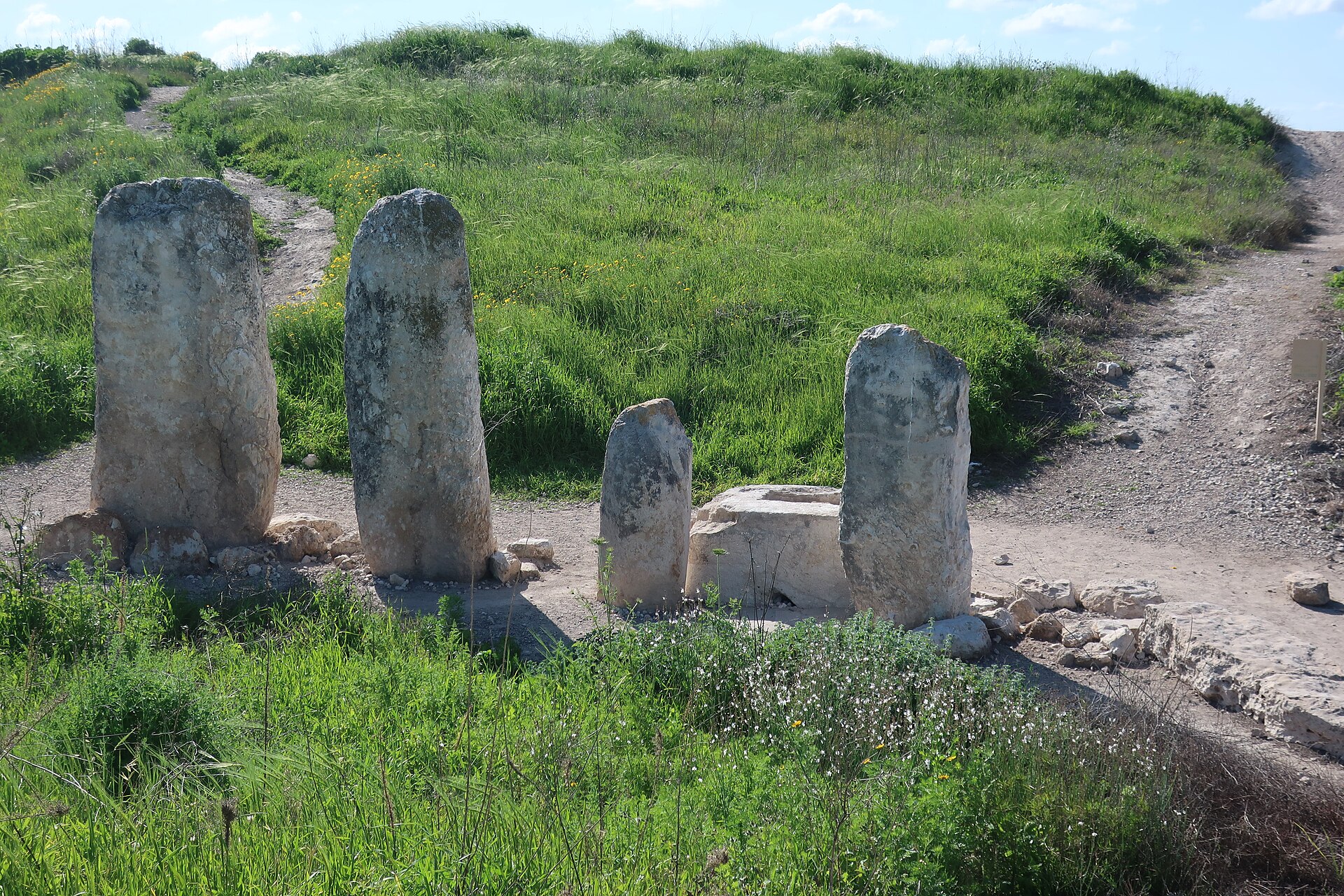
Stones somebody stood up and left
Standing stones in a row at Tel Gezer, set up in the Canaanite period. They shelter nothing and store nothing; standing up is the whole point of them. This is the practice Genesis 28:18 describes, not Jacob's own stone at Bethel. What these particular stones were set up to mark is not known.
Photograph of the standing stones at Tel Gezer, Israel, by Davidbena. Source: Wikimedia Commons, File:Stone pillars at Gezer.jpg. CC0 public domain dedication.
⚖ Still argued aboutWhether Jacob's ladder is a ladder. The Hebrew word occurs only here, and a ramp or stairway of the kind a ziggurat had is argued for as often as steps.
🗣 Say itBethelBETH-el(be-thel)LuzLUZ(ləz)LabanLAY-ban(lā-bən)LeahLEE-uh(lē-ə)RachelRAY-chul(rā-chəl)Padan-aramPAY-dan-AIR-am(pā-dan-er-am)
vown.Gen 28:20
A serious promise made to God
“Genesis 28 has Jacob make one of these when he wakes.”
pillarn.Gen 28:18
A stone set upright as a marker
“Genesis 28 has Jacob stand his stone upright as one of these.”
servedv.Gen 29:20
Worked for someone
“Genesis 29 has Jacob do this for seven years, to marry Rachel.”
wagesn.Gen 30:28
Payment for work done
“Genesis 29 has Laban ask Jacob what he wants to be paid.”
weptv.Gen 29:11
Cried
“Genesis 29 says Jacob did this out loud at the well.”
conceivedv.Gen 29:32
Became pregnant
“Genesis 29 uses this word each time a son is on the way.”
increasedv.Gen 30:43
Grew larger in number
“Genesis 30 says Jacob's flocks grew a great deal.”
ⓘ The vocabulary words in this list are selected to help you understand and complete this workbook. Some may not appear word-for-word in your Bible. The example sentences are our own wording, written to make the verse clearer — they are not quotations from it. Read each verse in your own Bible.
1Jacob stands his stone on end. What did a standing stone do in that world?💎 Uses the box aboveGen 28:18
2A ‘vow’ is a serious promise made to God.Gen 28:20
3Fill in each blank with the correct word.Gen 28:18; 29:20
Word choices:pillarservedwageswept- some words will not be used
He set the stone up as a . Gen 28:18
Jacob seven years for Rachel. Gen 29:20
4Payment for work done is called ___.Gen 30:28
5To have ‘increased’ is to have grown smaller in number.Gen 30:43
6To have ‘wept’ is to have cried.Gen 29:11
7Fill in each blank with the correct word.Gen 28:20; 29:32
Word choices:vowconceivedincreasedpillar- some words will not be used
Jacob makes a at Bethel. Gen 28:20
Leah and bore a son. Gen 29:32
Part 2 · Isaac & Jacob · Genesis 28–30
Understanding
Show you understood what happens in Genesis 28–30.
🧠
💎 Lokosmos Treasure Wisdom · a true fact behind the storyEvery Son Is Named for a Sentence
Open your Bible atGenesis 29:32–35, then Genesis 30:6–24
Close Reading · A Pattern of NamesRead the births with a pencil. Each one runs the same way. A son is born, the mother says something, and the boy is named out of what she said. Do that for all of them and you end up with a list of sentences, not a list of names. Together they are a record of twenty years inside one household: who felt unloved, who felt forgotten, who was counting. Genesis never stops to describe how these women felt. It gives you the names, and the names carry it. That is a whole family told in a column of words.
Why this helps you read the BibleThe names are the feelings. Reading them as a list is how you hear what the chapter never says out loud about this household.
1What does Jacob say when he wakes from the dream?Gen 28:16
2How long does Jacob work before the wedding?💎 Uses the box aboveGen 29:20
3What does Laban give Jacob on the wedding night?Gen 29:23
4What reason does Laban give?Gen 29:26
5Write the numbers 1–5 in the boxes to show the correct order across Genesis 28–30. Number 1 = what happens first.Gen 28–30
Jacob sleeps with a stone under his head and dreams.
Laban gives him Leah, and he works seven more years.
Jacob and Laban argue about wages.
He sets the stone up and names the place Bethel.
Jacob works seven years for Rachel.
6Each of Leah's sons is named out of something she says.Gen 29:32–35
7Genesis explains why the peeled rods worked.Gen 30:37–43
Part 3 · Isaac & Jacob · Genesis 28–30
Literary Craft
Understanding HOW and WHY the story is told across Genesis 28–30.
📖
💎 Lokosmos Treasure Wisdom · a true fact behind the storyThe Man Who Tricked Is Tricked
Open your Bible atGenesis 29:23–26
Literary Craft · ReversalJacob used a father who could not see. He used a disguise. The younger son took the older one's place. Now read Genesis 29. Laban uses a night Jacob cannot see in. He uses a swap. The older sister takes the younger one's place. And Laban gives a reason: here the younger does not go before the older. When a story turns a trick back on the one who used it, writers call that a reversal. Genesis does not tell you it is a punishment. It just lets you see the shape.
Why this helps you read the BibleGenesis reports the two scenes and never joins them for you. Seeing the shape is the reading. Calling it a punishment would be adding.
The trick comes back
Diagram of two scenes · every detail in both rows is stated in Genesis 27 or Genesis 29, including Laban's reason in 29:26. Setting them out in the same shape is a way of reading them together. Genesis never calls the second a punishment for the first, and the drawing does not either.
Verses: Genesis 27:15–27 and 29:21–26. Drawn for Lokosmos Academy.
Reversal
When a character's own trick is turned back on him. Jacob used a disguise and the dark on his father; Laban uses the dark on Jacob.
Significant naming
A name given out of what happened or what somebody said. Every son born in these chapters is named from a sentence his mother speaks.
Symbol
A visible thing standing for something bigger. Jacob's stone marks the place, and the place keeps the name he gave it.
1Jacob used the dark and a disguise; then the dark and a substitution are used on him. What is that?💎 Uses the box aboveGen 27; 29
2Fill in each blank with the correct word.Gen 28–30
Word choices:reversalnamingsymbolwages- some words will not be used
A trick turned back on the one who used it is a .
A name given out of what somebody said is significant .
3What makes the sons' names in these chapters significant naming?Gen 29:32–35
4Genesis says plainly that Laban's trick was Jacob's punishment.Gen 29:25–26
5Jacob's stone stands for the place and what happened there.Gen 28:18–19
6Fill in each blank with the correct word.Gen 28
Word choices:symbolreversalnamingvow- some words will not be used
A visible thing standing for something bigger is a .
A serious promise made to God is a . Gen 28:20
7Laban's reason mentions the younger and the older. Why does that land so hard?Gen 29:26
Part 4 · Isaac & Jacob · Genesis 28–30
Wisdom
Three deeper challenges — no single-word recall. Read, weigh the evidence, and reason it out.
💎
💎 Lokosmos Treasure Wisdom · a true fact behind the storyA Wedding Lasted a Week
Open your Bible atGenesis 29:27–28
Daily Life · Wedding CustomLaban tells Jacob to finish the week. Then he will have Rachel too. That is a real custom, not an excuse he made up. A wedding in that world was a week of feasting, not an afternoon. The bride was veiled, and she was brought to the tent at night. Both of those facts sit behind this scene, and the chapter explains neither one. Genesis says Jacob did not know until morning. It never tells you how that could happen, because the first readers did not need telling. What is strange to us was completely ordinary to them.
Why this helps you read the BibleA gap in a Bible story is often a thing the first readers already knew. Ask what a passage assumes before you decide it does not make sense.
Read Genesis 28 to 30 in your Bible. At Bethel, notice what Jacob does with the stone and what he says as he wakes, and keep those two together. Then make a list as you read the births: for each son, write the sentence first and the name second. In Genesis 29, read the wedding night and then read Laban's reason in verse 26 out loud. Hold it against Genesis 27. Keep the shape you notice apart from a verdict Genesis never gives: it never says this was a punishment.
Original passage written for this workbook — not a quotation from Scripture.
1Stated in Genesis 28–30, or Not stated there? Tap each detail to send it left or right.Sort into two
◄ Stated in Genesis 28–30Not stated there ►
2Match each first detail with the detail paired with it.Match the Pairs
The stone→
Seven years→
The wedding night→
Laban's reason→
The sons' names→
3Fill both blanks to complete the reasoning.💎 Uses the box aboveBuild the Argument
Rows of standing stones have been dug up across the region and marked graves, borders and agreements, so Jacob standing his stone up , which shows .
That is the whole workbook. The standardized test is optional and is scored separately.
Optional · Isaac & Jacob · Genesis 28–30
Standardized Test
Reading passage · Stones Left Standing · Ancient Custom and Careful Evidence · ten questions in the shapes a standardized reading test uses: main idea, detail, vocabulary in context, inference, evidence, synthesis, insert text, prose summary and fill in a table.
Optional. This section is not counted in your workbook score. It gets a report card of its own, and skipping it still leaves your workbook complete.
Original passage written for this workbook — not a quotation from Scripture.
Stones Left Standing
Across the ancient Near East, people set stones upright and left them there. Archaeologists have uncovered them singly and in rows. Such a stone is often called a pillar, and a pillar is not a building: it shelters nothing and stores nothing. Its whole purpose is to be noticed, and to say that this spot is not like the ground around it. What a particular pillar marked is the hard part. The same shape was used for a grave, for a border between two families, for an agreement, and for a place where something was believed to have happened. Where an inscription survives we can sometimes tell, and most do not survive. So a pillar tells you somebody wanted a place remembered. It does not tell you what they remembered.
1What is the passage mostly about?Main Idea
2What does the passage say a standing stone does not do?Detail
3In this passage, a “pillar” is ___.Vocabulary in Context
4What has the same shape of stone been used for?Detail
5You can infer that most standing stones ___.Inference
6What evidence lets us sometimes say what a stone marked?Evidence
7What does the last sentence say a stone cannot tell you?Synthesis
8Insert Text. Look at the four squares [1]–[4] in the passage below. They mark the places this sentence could be added: “The stone itself gives no clue which.”
What a particular pillar marked is the hard part. [1] The same shape was used for a grave, for a border between two families, for an agreement, and for a place where something was believed to have happened. [2] Where an inscription survives we can sometimes tell, and most do not survive. [3] So a pillar tells you somebody wanted a place remembered. [4]
Where does the sentence fit best?Insert Text
9Prose Summary.The passage explains what a standing stone can and cannot tell us. Six statements are listed below. Choose the THREE that best capture what the passage is saying. The other three do not belong — they are small details, or ideas the passage never puts forward. Each correct choice earns a mark of its own.Prose Summary
10Fill in a Table. Sort what a standing stone settles from what it leaves open. Tap each statement to send it to the left column or the right one. Three belong in each.Fill in a Table
◄ A standing stone shows thisA standing stone cannot show this ►
Independent study guide by Lokosmos Academy. Not affiliated with or endorsed by Crossway or any Bible publisher. Contains original retelling and analysis only; no Scripture text is reproduced in full. Reference edition: keyed to the ESV® Bible — read Genesis 28–30 in your own Bible alongside this workbook; any Bible works for reading, and the vocabulary and questions follow the ESV’s wording. No ESV® text is quoted in this workbook. ESV® and the English Standard Version® are registered trademarks of Crossway.
Lokosmos Academy is an independent study resource, not affiliated with or endorsed by Crossway or any Bible publisher. This workbook is keyed to the wording of the ESV® Bible; any Bible works for reading — the vocabulary and quiz answers simply follow the ESV’s wording. These workbooks reprint no text of the ESV® Bible; every passage summary, question and example sentence is original wording. ESV® and the English Standard Version® are registered trademarks of Crossway.